
If your little one has recently started reading, you have probably heard the term 'high frequency words'. And if you are wondering what it means, you are in the right place!
High frequency words in English are some of the most commonly used words in written and spoken language. Helping your child recognise them early can make a huge difference in how quickly and confidently they learn to read. Let's break it all down for you, simply and clearly.
High Frequency Words: The Building Blocks of English Reading
So, what exactly are high frequency words? Simply put, these are words that appear most often in everyday text. For example, 'the,' 'is,' 'and,' 'you,' 'said.' That's because they are everywhere.
In fact, as early as 1936, educator Edward Dolch identified 220 of the most common words in children's books, proving just how central these words are to early reading.
Since many of these words do not follow normal phonics rules, children are simply taught to spot and remember them by sight.
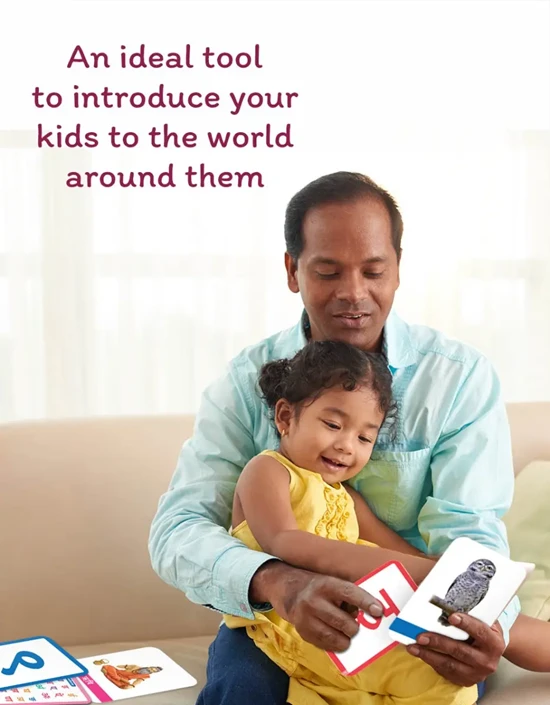
Child Learning High Frequency Words with Flashcards
High Frequency Words in English: A Grade-Wise Breakdown
Now that you know what these words are, you are probably curious: which words should my child know at their age? Here is a simple, grade-wise breakdown to help you out.
| Pre-Primary (Age 3-4) | Primary (Age 5-6) | Grade 1-2 (Age 6-8) |
| I, a, the, is, it | said, was, you, they | because, there, people |
| go, we, see, me | do, are, he, she, we | little, could, would |
| and, in, on, up, at | what, have, from, or | every, found, school |
These are not hard rules, and every child learns at their own pace. But having a general sense of what words to focus on can really help you guide your child at home. You can also find age-appropriate word lists built into phonics learning kits, which are designed to make early reading feel natural and fun.
Learning Tips: How to Help Your Child Master High Frequency Words Faster
1. Make It a Daily Habit, not a Chore
Five to ten minutes every day works better than one long session a week. Keep it light and playful. Even pointing out words on cereal boxes or street signs during a walk counts!
2. Use Flashcards the Fun Way
Flashcards are a classic for a reason. But instead of just drilling them, try turning it into a game. Show your child a card and race to say the word first. Celebrate when they get it right!
3. Games, Songs, and Repetition
Children learn best when they are having fun. You can sing word songs, play word bingo, or try matching games at home. Repetition helps these words stick in your child’s memory without it feeling like studying.
4. Read Together Every Day
Reading aloud is one of the most powerful things you can do. When your child sees high frequency words repeated in real and in story books, recognition becomes natural over time.
5. Reward Progress, Not Perfection
Celebrate every word they learn. A sticker chart, a small praise session, or even a high-five can go a long way. Positive reinforcement builds reading confidence.
Conclusion
High frequency words are not just a school topic. They are the real foundation of your child's reading journey. When your little one can recognise these common words quickly, reading starts to feel less like a task and more like an adventure.
Start small, stay consistent, and most importantly, make it fun. You do not need to do it all at once. With a little daily practice and a lot of encouragement, your child will be reading confidently before you know it!
Frequently Asked Questions (FAQs)
1. At what age should children start learning high frequency words?
Ans: Most children begin learning high frequency words around age 4 to 5, when they start phonics and early reading programmes in pre-primary or kindergarten.
2. How many high frequency words should a child know?
Ans: By end of Grade 2, children ideally know 200 to 300 words. Starting with the top 100 is a great, manageable goal for early learners.
3. Are sight words and high frequency words the same thing?
Ans: They overlap but are not identical. Sight words are memorised visually; high frequency words are simply the most common words in English.
4. What if my child struggles to remember high frequency words?
Ans: Try different methods like songs, games, or tracing. Every child learns differently. Consistent, short daily practice works better than long, infrequent sessions.
5. Can I teach high frequency words at home without special tools?
Ans: Absolutely! Simple flashcards, sticky notes around the house, and reading together daily are very effective. Structured activity books can also add variety and structure.