
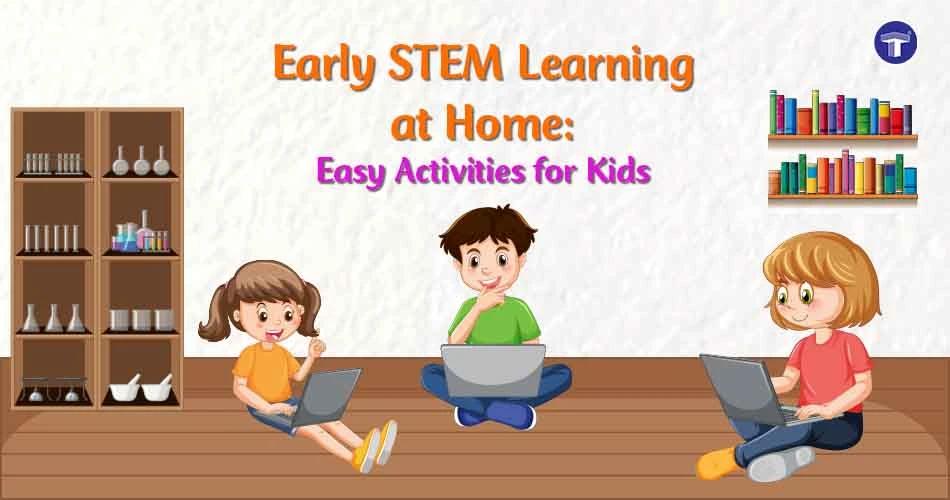
Young children are naturally curious. They ask questions, experiment with objects, and love discovering how things work. Early STEM learning at home simply builds on this curiosity in a meaningful way.
STEM stands for Science, Technology, Engineering, and Mathematics. But for toddlers and preschoolers, it does not mean complex lessons. It means simple, hands-on activities that encourage thinking, observing, and problem-solving in daily life.
What Exactly is Early STEM Learning at Home?
Understanding early STEM learning at home helps parents introduce it naturally.
- Learning through exploration: Children learn STEM concepts when they experiment, mix, build, count, and observe results.
- Real-world problem-solving: STEM activities teach children to ask questions like ‘What will happen if?’ and ‘Why did this change?’, enhancing their inquisitiveness.
- Hands-on experience over memorisation: Instead of worksheets alone, kids learn better by doing. Practical exploration builds deeper understanding.
It’s important that Early STEM learning at home feels playful, not pressured.
Easy STEM Activities for Kids at Home
When small activities become part of your child’s daily schedule, learning feels effortless. Early STEM learning at home grows stronger through consistent, simple practice.
Easy STEM Activities for Kids at Home
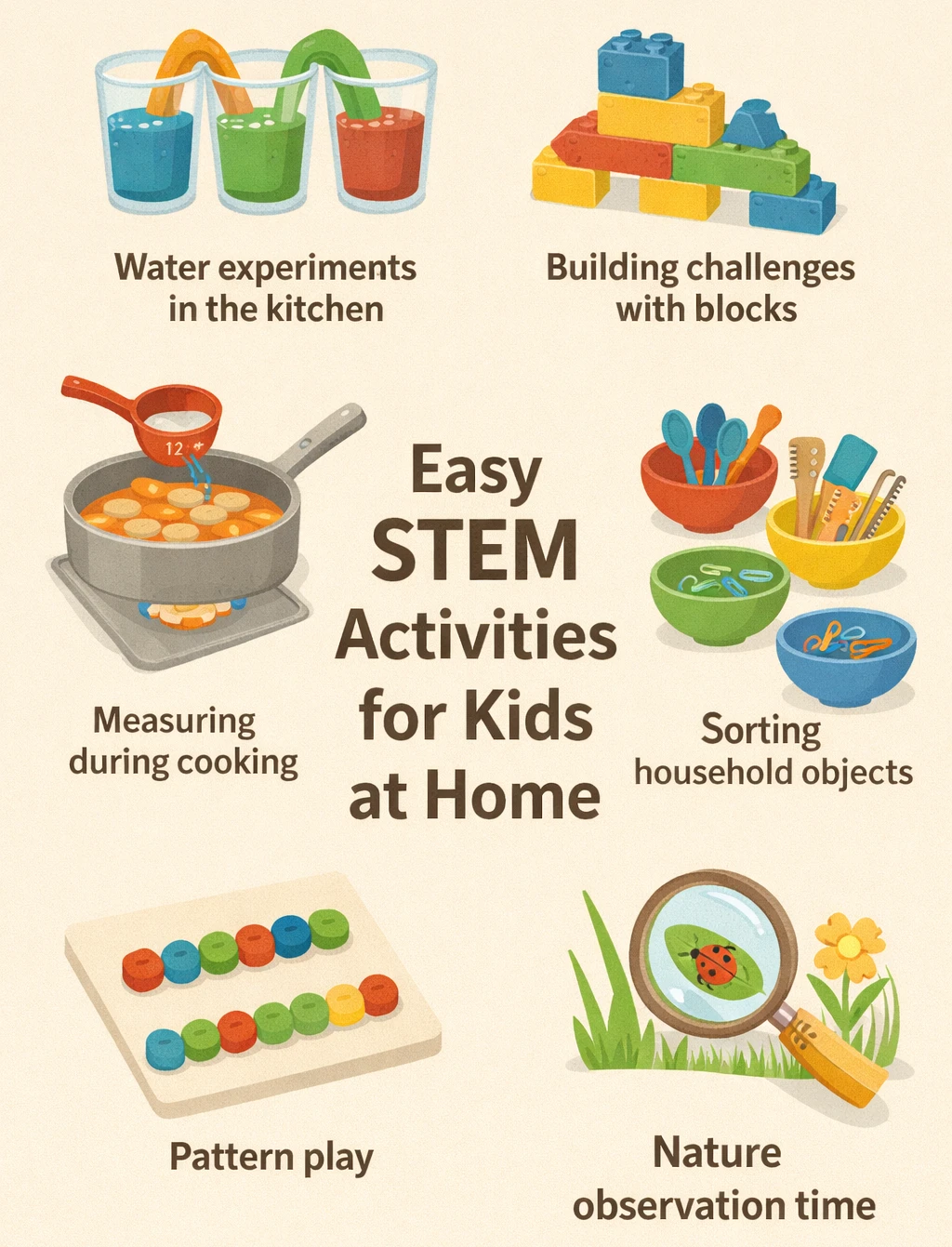
1. Water experiments in the kitchen
Let your child explore the concepts of floating and sinking using bowls, spoons, and small toys. Ask them to predict what will happen.
2. Measuring during cooking
Invite your child to count spoons of flour to be used while making dough or measure the quantity of water while pouring in a glass. This builds early math skills and number sense in young children.
3. Building challenges with blocks
- Ask your child to build a tower with blocks and prevent it from falling. This introduces basic engineering and problem-solving skills in a child’s early years.
- Keep blocks in an open basket so your child can start building on their own, without waiting for instructions.
4. Sorting household objects
- Sort buttons, pulses, or toy cars by colour or size. This strengthens observation and classification skills, which are foundational math concepts in early STEM learning at home.
- Offering one sorting activity at a time also builds logical thinking and focused problem-solving.
5. Pattern play
- Create simple colour or shape patterns using beads or crayons, and invite your child to observe the sequence and continue it independently.
- Recognising and extending patterns supports early mathematical reasoning, an important part of STEM for preschoolers.
6. Nature observation time
- Collect leaves or stones during a walk and compare sizes or textures at home.
- This builds scientific observation skills and encourages children to ask questions about the natural world.
Simple daily repetition of these easy STEM activities for kids helps build thinking habits and discipline over time. Structured Activity Books designed around early math and logic can gently support these hands-on experiences during quiet learning sessions.
Common Mistakes Parents Make While Teaching STEM
When introducing early STEM learning at home, you need to consider some points:
- Giving too many instructions: Allow children to explore freely instead of correcting every step.
- Expecting perfect outcomes: STEM learning is about experimenting, not getting everything right.
- Turning it into a formal lesson: Keep STEM activities at home entertaining. The main goal is to foster curiosity in children.
- Overloading with materials: Use simple household items. Too many tools can overwhelm young children.
Conclusion
Early STEM learning at home does not require expensive kits or complex plans. It grows naturally through simple daily activities that encourage curiosity and independent thinking.
When children explore, measure, build, and sort regularly, they develop strong problem-solving skills. Over time, these easy activities for kids create a foundation for confidence and lifelong learning.
Frequently Asked Questions (FAQs)
1. At what age should I start STEM learning at home?
Ans: You can begin early STEM learning at home from age three. Simple activities like sorting, measuring, and observing nature are perfect for building early thinking skills.
2. Do I need special STEM toys?
Ans: No. Everyday household items like cups, spoons, blocks, and natural objects are enough to introduce STEM concepts to kids effectively.
3. How much time should kids spend on STEM daily?
Ans: Fifteen to twenty minutes of focused, hands-on STEM activity each day is sufficient. Consistency matters more than long sessions.
4. Can STEM activities improve school readiness?
Ans: Yes. Early STEM learning strengthens logic, number sense, observation skills, and problem-solving abilities, which support smoother academic transitions.
5. How do I keep my child interested in STEM?
Ans: Rotate STEM activities weekly and encourage open-ended questions. Let your child experiment and discover answers independently.