
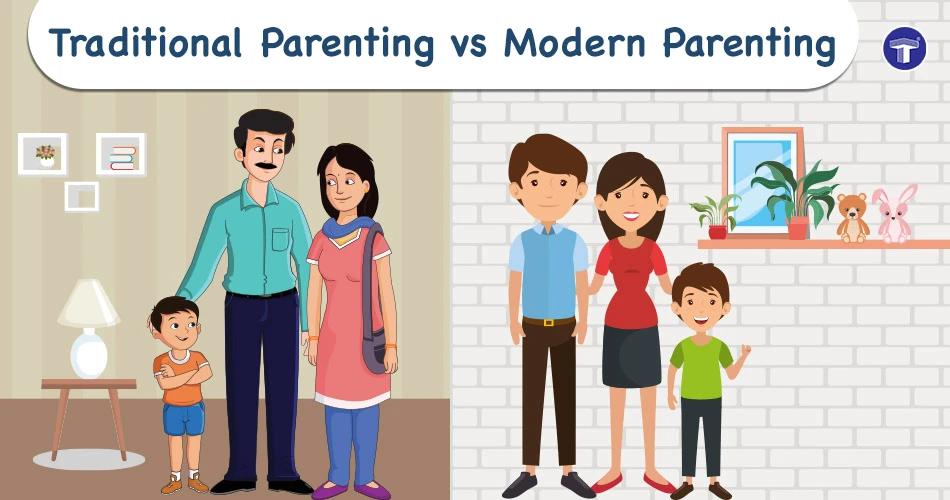
Parenting today is no longer about following just one rulebook. It is about understanding where you come from, where the world is going, and how your child fits in between. The discussion around traditional parenting vs modern parenting has become more relevant than ever before.
With changing lifestyles, digital influence, and evolving mindsets, parents often feel confused, should I be strict or gentle? Should I follow what my parents did or what the new age parenting norms preach?
Let’s break it down in a simple, practical, and non-judgmental way.
‘Traditional Parenting vs Modern Parenting’, Why This Debate Is Everywhere
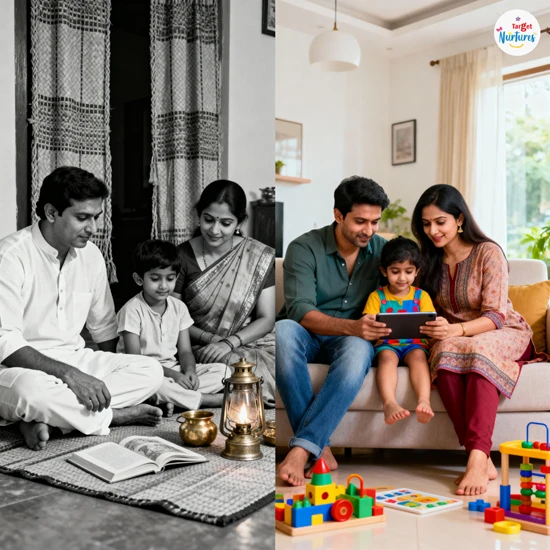
Traditional Parenting vs Modern Parenting in Two Eras
These days, conversations around traditional parenting and modern parenting exist because the experience of childhood itself has changed.
Earlier, parenting was focused on obedience, discipline, and structured upbringing. Now, it revolves around emotional intelligence, individuality, and mental health.
Between all this lies the concept of parenting styles, which psychologists often group into 4 parenting types.
To grasp these types clearly, we must first explore where traditional parenting comes from.
Roots of Traditional Parenting in Indian Family Systems
In many Indian households, traditional parenting was built around joint families, community values, and respect for hierarchy.
Children grew up under the guidance of elders, learning values through stories, rituals, and observation. Discipline was considered a sign of love, structure meant safety, and emotional strength was built through real-life responsibilities.
This form of Indian parenting created emotionally resilient children, but often left little room for emotional expression.
As lifestyles shifted towards nuclear families, this structure slowly transformed into what we now call modern parenting.
The Rise of Modern Parenting in a Digital Generation
Modern parenting focuses on communication, emotional awareness, and individuality.
Parents today are more involved in understanding their child’s feelings, encouraging expression, and supporting choices. Concepts like gentle parenting, conscious parenting, and positive discipline have become part of everyday vocabulary.
But modern parenting also faces challenges like excessive screen time, digital addiction, social media pressure, and unrealistic comparisons.
And this is where we circle back to the 4 parenting types. Because today, the debate of modern vs traditional parenting types doesn’t hold as much weight. Both approaches face their own problems, and understanding parenting styles gives a clearer, more meaningful picture.
Understanding the 4 Parenting Types and Their Impact
Explaining the 4 Parenting Types Visually
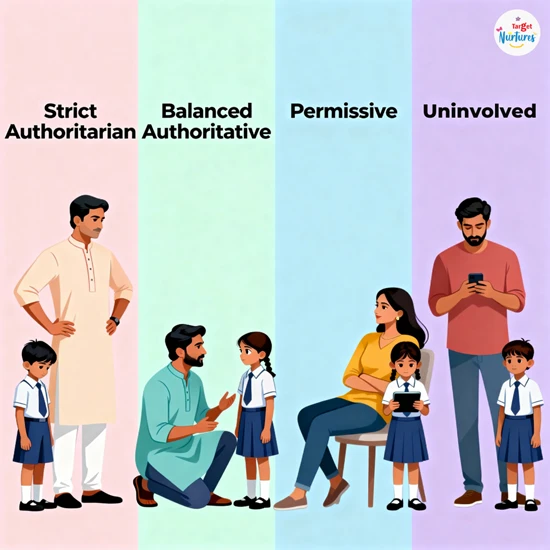
Psychologists broadly classify parenting styles into the 4 parenting types:
- Authoritarian Parenting: Strict rules, high discipline, low emotional flexibility.
- Authoritative Parenting: Balanced approach combining structure with warmth.
- Permissive Parenting: High emotional support but low boundaries.
- Uninvolved Parenting: Low involvement and minimal guidance.
Among these, authoritative parenting is considered most effective because it balances discipline with emotional support.
Interestingly, traditional parenting leans towards authoritarian parenting, while modern parenting often aligns with permissive parenting and gentle parenting.
This is why today’s parents do not just follow culture, they explore scientific and psychological approaches too.
But what truly changes everything is whether these worlds can be merged.
Can Traditional Parenting and Modern Parenting Work Together?
The answer is yes, and they should.
Children need the structure of traditional parenting and the emotional safety of modern parenting.
They need discipline and also understanding.
They need boundaries and also freedom to express.
A child raised with values like respect, gratitude, and responsibility, while also being taught emotional regulation, self-expression, and confidence, becomes balanced and resilient.
This blend creates what many now call balanced parenting or conscious modern Indian parenting.
However, parenting is not shaped only at home, it is deeply influenced by society, culture, and digital exposure.
How Culture, Social Media, and Surroundings Shape Modern Parenting
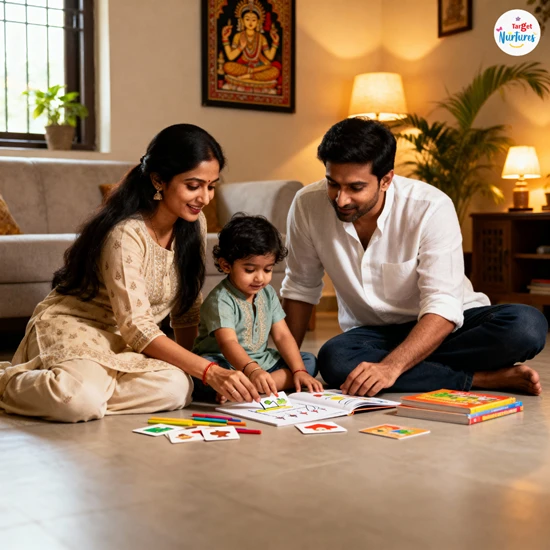
Real Life Modern Parenting With Indian Family
Culture decides our first lessons in parenting styles. In India, Indian parenting has always been value-driven. But urbanisation has introduced Western ideas of modern parenting into everyday life.
Social media often sets unrealistic standards, making parents compare their journey with curated online versions of others.
Urban families lean towards modern parenting techniques, while many rural families still follow traditional parenting values rooted in community.
Both are valid. Both work differently.
What matters is how parents adapt their parenting style to their environment and child.
A Practical Conclusion for Today’s Parents
You do not need to choose between traditional parenting and modern parenting.
You need awareness. You need flexibility. And most importantly, you need to trust your instinct.
Understand the 4 parenting types. Choose what fits your child’s personality, your environment, and your family values.
Because at the end of the day, parenting is not about being perfect; it is about being present, consistent, and emotionally available. And that is the true power of conscious modern parenting.
Frequently Asked Questions on Modern Parenting and the 4 Parenting Types
1. Why are parenting styles shifting so quickly in the 21st century?
Ans: Because technology, psychology, and awareness around child development are rapidly evolving.
2. How does social media influence modern parenting decisions?
Ans: It exposes parents to global trends, and/or unrealistic standards, which affect decision making.
3. Can traditional parenting and modern parenting be combined effectively?
Ans: Yes, blending structure with emotional intelligence leads to healthier parenting outcomes.
4. Do traditional parenting methods still work in today’s digital world?
Ans: They do, when adapted with awareness and flexibility rather than fear.
5. How does culture influence the perception of parenting styles?
Ans: Culture shapes what is considered respect, discipline, and acceptable child behaviour.
6. What role does extended family play in traditional parenting and modern parenting?
Ans: In traditional parenting, the extended family plays a central role. In modern parenting, it is more supportive and advisory.
7. How do parenting expectations differ between urban and rural families?
Ans: Urban families focus on emotional development and exposure. Rural families prioritise discipline, resilience, and community belonging.