
In today’s digital world, many parents wonder whether e-books or paper books are better for their child’s learning. Screens are everywhere, yet traditional books still hold a special place in childhood.
When it comes to e-books vs. paper books for kids, the answer is not always simple. Each format offers unique benefits, especially during the early years when reading habits and attention skills are still developing.
Benefits of E-Books for Kids
A Meta-Analysis of Educational Materials in Language Learning found that e-books can positively support the learning process, in some cases even more effectively than printed books.
- Convenience and portability: E-books allow children to access multiple titles on one device. This is helpful while travelling or during waiting times.
- Interactive features: Many e-books include audio narration, animations, and clickable elements. These features can support early readers and make stories more engaging.
- Adjustable reading settings: Font size, brightness, and background settings can be customised. This makes reading more accessible for children with visual preferences.
- Support for reluctant readers: Some children feel more motivated using digital devices. Interactive elements can encourage them to spend more time reading.
While e-books provide flexibility, the learning experience depends heavily on how and when they are used.
Benefits of Paper Books for Children
A 2023 Study in the Review of Educational Research found that children who read physical books showed stronger comprehension than those reading digitally, suggesting that reading paper books may help improve retention and deeper understanding.
- Better focus and fewer distractions: Paper books do not include notifications or pop-ups. This helps children stay immersed in the story.
- Stronger comprehension and retention: Research suggests that children often remember content better when reading from paper compared to screens.
- Sensory engagement: Turning pages, feeling textures, and seeing progress physically can strengthen kids’ memory connections.
- Building early reading habits: A home filled with Story Books and Activity-based Learning Books naturally encourages a reading routine. Structured Early Learning Kits can support focus while keeping learning playful.
Paper books often help toddlers associate reading with calm, comforting bonding moments shared with a parent.
E-Books vs Paper Books for Kids: A Parental Guide
This comparison matters most when looking at learning outcomes.
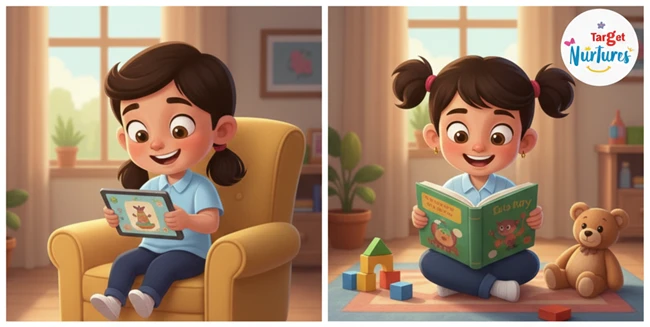
A child reading an e-book vs. a printed book
1. Reading comprehension
Studies show that children often demonstrate deeper comprehension when reading from paper. Screen reading may encourage skimming rather than slow processing.
2. Attention span
Paper books support sustained attention. Digital reading, especially with animations, can distract children by shifting their attention away from the story and toward the screen effects.
3. Eye health and screen exposure
Extended screen reading increases digital eye strain. Paper books reduce blue light exposure, which is important for young children.
4. Engagement style
E-books engage through interaction. Paper books engage through imagination. When a story is read aloud from a physical book, children visualise scenes more actively.
5. Habit formation
If the goal is building a lifelong reading habit, paper books often create stronger routines. A bedtime story with a physical book becomes a comforting ritual.
That said, E-Books vs Paper Books for Kids does not have to be a competition. For learning, balance often works best. For example, paper books can be used for daily reading time, while e-books may be helpful for travel or short sessions.
If storybooks don’t always hold your child’s attention, try introducing high-quality General Knowledge books during travel to keep them engaged and curious.
Conclusion
When comparing E-Books vs. Paper Books for Kids, both formats offer benefits. Digital books bring convenience and accessibility, while paper books encourage deeper focus and emotional bonding.
For toddler parents, the goal is not to eliminate one format completely. It is to create a healthy reading environment where screen time is balanced and traditional reading builds strong foundations. A thoughtful mix can support both learning and long-term reading habits.
Frequently Asked Questions (FAQs)
1. Are e-books bad for young children?
Ans: E-books are not harmful when used in moderation. The key is limiting screen time and choosing age-appropriate, distraction-free content.
2. Do children understand stories better from paper books?
Ans: Many studies suggest children retain information better from printed books due to fewer distractions and deeper focus.
3. How much digital reading time is safe for kids?
Ans: Short, supervised sessions are recommended. Balance digital reading with offline activities to reduce screen strain.
4. Can e-books replace bedtime storybooks?
Ans: Digital books can be used occasionally, but paper books often create stronger bonding and calming bedtime routines.
5. What type of books are best for toddlers?
Ans: Simple Story Books and Activity-based Learning Books support language development and early comprehension skills.