

Children under five are exposed to more screen time each day than advised.
In India, preschool-aged children spend an average of 2.2 hours per day on screens, which is twice the recommended limit.
This excessive screen time is a growing concern; the harmful consequences are still unknown to most parents.
So, what to do? Read along and you’ll find some practical and doable strategies to reduce your child’s screen time without constant fights!
Why Excess Screen Time Hurts
The World Health Organization recommends limiting the screen time for pre-schoolers to one hour per day and avoiding screens for at least one hour before bedtime.
Here’s why:
- Strain on Eyes
- Posture Problems
- Encourages Passive Thinking
- Sleep Issues
- Brain and Focus Trouble
- Emotional and Social Impact
Screen use in young children adversely affects their behaviour and language development. Limiting screen time and improving the quality of the screen content for a child’s overall development is the need of the hour.
Signs Your Child Is Getting Too Much Screen Time
Spotting early warning signals makes all the difference. While a little screen time can be harmless, too much of it starts showing up in subtle changes in your child’s behaviour, health, and daily routine. Parents should step in before habits turn into struggles.
Here’s what to watch out for.
- Irritability when devices are taken away.
- Skipping outdoor play for gadgets.
- Complaining of eye strain or headaches.
- Trouble sleeping at night.
- Falling grades or lower concentration.
8 Practical Tips to Reduce Your Child’s Screen Time
We know cutting down screen time can feel like asking a kid to give up their favourite chocolate — not easy! But with the right mix of structure, fun, and a little creativity, you can make it happen without tears or tantrums.
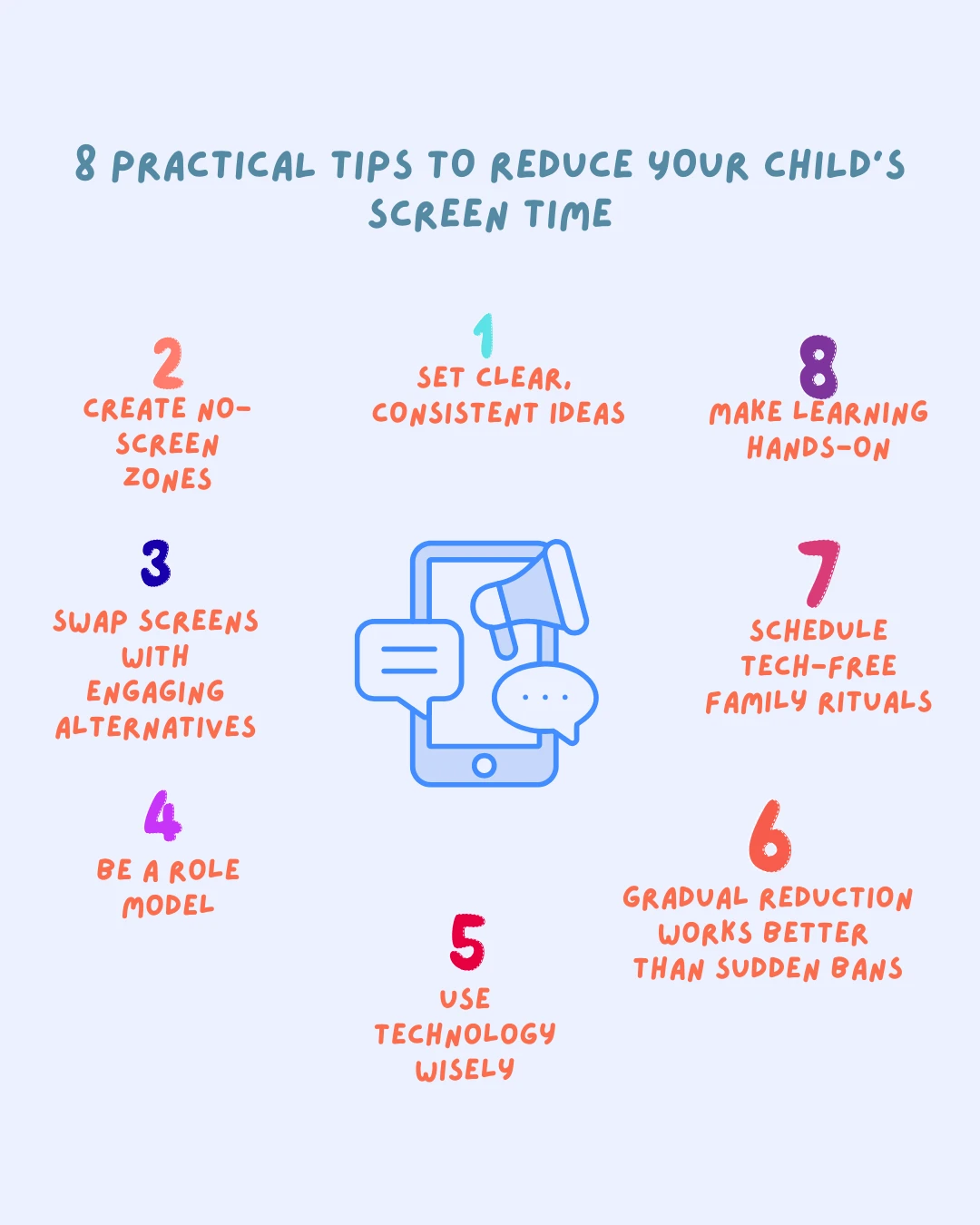
Fun and Practical Tips to Reduce Screen Time for Kids
1. Set Clear, Consistent Ideas
Kids thrive on routine. Let them know the time limits – when and how long they can use screens.
Make a ‘Screen-Time Chart’ and tick off each day’s limit.
Think of it as a friendly contract between you and your child, not a punishment.
2. Create No-Screen Zones
Designate areas where gadgets simply aren’t allowed like the bedroom, the dining table, or the study corner.
Replace the tablet in the bedroom with a colourful bookshelf full of engaging reads, making saying ‘no’ to screens much easier, thereby reducing your child’s screen time.
3. Swap Screens with Engaging Alternatives
Boredom is the real villain here. To limit access to devices, replace them with hands-on fun:
- Outdoor play: cycling, cricket, gardening, anything that gets them moving.
- Indoor fun: colouring books, art and craft, challenging activities, pretend play, or reading together.
4. Be a Role Model
If you scroll through your phone just to while away time or during meals, your child will copy you.
Show them you can have fun without a screen, join them in reading, sketching, or even making a messy DIY craft.
5. Use Technology Wisely
Pick quality educational content on apps or videos, co-watch them with your child, and let them ask you questions to make it interactive.
And yes, parental controls are your secret weapon!
6. Gradual Reduction Works Better than Sudden Bans
Pulling the plug all at once often backfires. Cut down 15–20 minutes daily and fill the space with something exciting - like a bedtime storytelling session.
Soon, screens will feel less essential, and stories will become the highlight of the day.
7. Schedule Tech-Free Family Rituals
Plan regular activities like Sunday picnics, Saturday night board games, or evening walks where no devices are allowed.
Consistency makes these rituals something your child looks forward to.
8. Make Learning Hands-On
Swap online videos with real life experiments and activitiy books to reduce dependence on electronic devices for your child’s development.
Use Target Publications’ Activity Books or Craft Kits to turn curiosity into creative action.
Conclusion
Reducing screen time for kids may seem challenging at first, but with consistent routines, creative alternatives, and mindful use of technology, it becomes achievable and rewarding. By following these 8 fun and practical tips to reduce screen time, parents can create a healthier balance between digital exposure and real world experiences. Limiting screens not only prevents the harmful effects of screen time but also nurtures better focus, sleep, and emotional wellbeing. Remember, building healthy screen time for kids is about balance, not outright bans, ensuring your child grows with curiosity, stronger bonds, and joyful play beyond the screen.
Frequently Asked Questions (FAQs)
1. What is the 3 6 9 12 rule for screen time?
Ans: Under 3 years of age: no screen media. Under 6 years of age: no own gaming console. Under 9 years of age: no own mobile phone or smartphone. Under 12 years of age: no unsupervised computer use/social media use.
2. How much screen time is healthy for a 5-year-old?
Ans: The American Academy of Pediatrics recommends up to 1 hour a day of high-quality, age-appropriate content, preferably with an adult, engaging and discussing the material. Try to reduce the screen time even more, than that specified in this limit.
3. Does educational content count as screen time?
Ans: Yes. Even if it’s educational, it still involves prolonged screen exposure. The impact is healthier when you co-view, ask questions, and connect the learning to real world experiences.
4. Should I completely ban screens for my child?
Ans: A total ban isn’t necessary and may cause frustration. Instead, focus on balance, supervision, and choosing enriching content that complements, rather than replaces the real world learning and play.
5. What’s the best way to reduce screen time without fights?
Ans: Gradually cut back usage while introducing fun brain-boosting activities. When kids have exciting alternatives like crafts, reading, or outdoor games, they’re less likely to resist reduced screen time.
6. What are the consequences of increased screen time?
Ans: Too much screen time can lead to obesity, sleep problems, chronic neck and back problems, depression, anxiety, and lower test scores in children.