
In a world where screens often replace scissors and playtime happens on tablets, something timeless still sparks a child’s imagination.
What is it?
It is the joy of creating with their own hands. Imagine this: your little one cutting, pasting, sorting, painting, and proudly saying, ‘I made this!.’
Yet, something magical happens when children learn through their hands — when they cut, glue, paint, sort, and create. That’s the magic of hands-on learning using 10 DIY learning tools (which you can make at home for kids!), where creativity meets curiosity and play turns into discovery.
These 10 DIY learning tools for kids aren’t about fancy materials or Pinterest perfection. They’re simple, homemade learning ideas that transform everyday household items into powerful tools for growth.
Just a few basic supplies and maybe a little inspiration using our activity kits and books, a spark of imagination, and your time can turn your home into a joyful, educational playground that inspires lifelong learning.
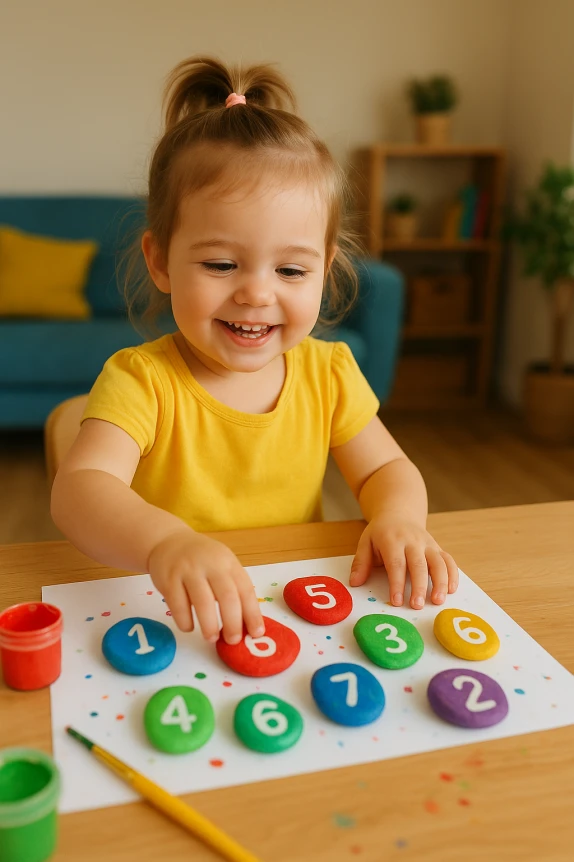
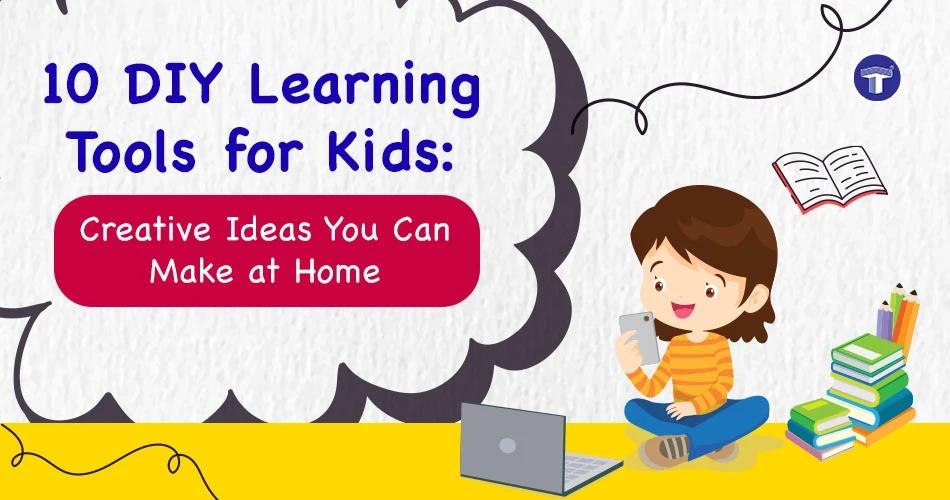
Kid enjoying DIY learning tool made at home
The Hidden Impact of Screen Time and How DIY Learning Tools for Kids Can Help
In the rush of modern life, children often interact more with screens than with real-world objects.
A study on ‘Prevalence of Preschoolers Meeting vs Exceeding Screen Time Guidelines’ shows that 79.4% of 2-year-olds and 94.7% of 3-year-olds exceeded the recommended 1 hour of screen time per day. This limits their ability to explore, question, and create.
DIY learning tools for kids bring back that spark of discovery.
Here’s why they are powerful:
- Encourage active learning: Children engage their senses: touching, moving, and building to understand concepts.
- Boost focus and imagination: Crafting teaches patience, observation, and problem-solving.
- Develop fine motor skills: Using scissors, crayons, or glue strengthens hand-eye coordination.
- Foster sustainable habits: Making toys from recycled materials teaches creativity and environmental awareness.
- Strengthen parent-child bonds: These activities are filled with laughter, teamwork, and shared pride.
The combination of structured books and creative projects nurtures well-rounded learners.
10 Creative DIY Learning Tools for Kids
Each creative DIY learning tool is affordable and made from materials you probably have at home.
To make them even more effective, pair each DIY tool with Target’s pre-primary books for guided skill-building.
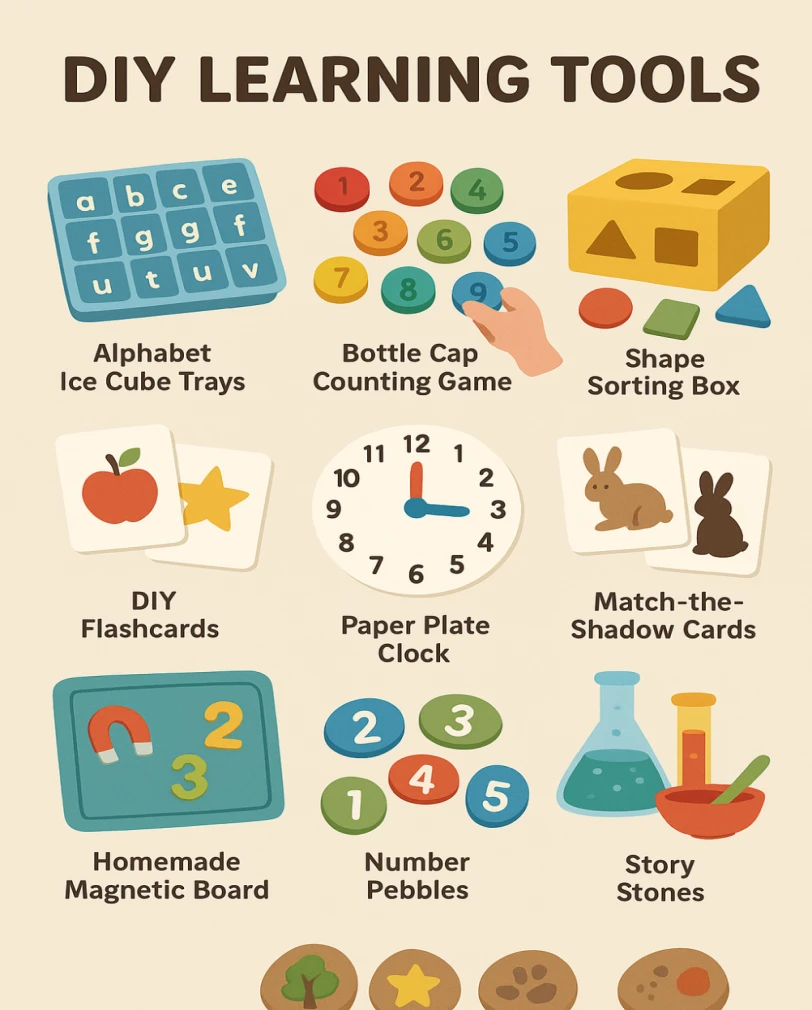
Creative DIY learning tools for kids you can make at home
1. Alphabet Ice Cube Trays
- What You’ll Need: Alphabet moulds or ice trays, food colouring, and water.
- How to Make It: Fill each slot with coloured water and freeze. Pop out the cubes and encourage your child to ‘build’ short words before they melt.
- Learning Outcome: Letter recognition, phonics, and sensory play.
- Pair With:
- Alphabet Writing Book: children can trace the letters after identifying them.
2. Bottle Cap Counting Game
- What You’ll Need: Used bottle caps, markers, and beads.
- How to Make It: Write numbers on the bottle caps. Collect some colourful beads. Ask your child to place the right number of beads on each cap, as per the number written on the cap.
- Learning Outcome: Counting, number sequencing, and fine motor coordination.
- Pair With:
- Numbers Writing Book: practise writing the same numbers for reinforcement.
3. Shape Sorting Box
- What You’ll Need: A shoebox, scissors, and coloured paper.
- How to Make It: Make a simple shape sorter using a cardboard box, cut out basic shapes on the lid and create matching pieces from coloured paper. Children can drop each piece through the right slot.
- Learning Outcome: Shape identification, size comparison, and colour recognition.
- Pair With:
- Flashcards for Kids 1 to 6 Years – Alphabets, Numbers, Shapes and Colours for structured concept learning.
4. DIY Flashcards
- What You’ll Need: Cardboard, markers, glue, and magazine pictures.
- How to Make It: Cut pieces of cardboard and draw simple pictures, letters, or numbers on them. Laminate or tape them for durability, perfect for quick recognition games.
- Learning Outcome: Improves vocabulary, memory, and recognition.
- Pair With:
- My First Flash Cards for Kids to build connections between words and visuals.
5. Paper Plate Clock
- What You’ll Need: A paper plate, pens, and two paper strips for hands.
- How to Make It: Turn a paper plate into a fun learning clock by drawing numbers around the edge and attaching clock hands with a split pin. Kids can move the hands to learn time.
- Learning Outcome: Telling time and understanding daily routines.
- Pair With:
- General Knowledge Book (sections on time and routine activities).
6. Match-the-Shadow Cards
- What You’ll Need: Pictures of objects and their shadows.
- How to Make It: Create pairs of cards, one with object images and the other with their shadows. Kids match each object to its shadow.
- Learning Outcome: Visual discrimination and logical thinking.
- Pair With:
- Activity Books that encourage pattern recognition and reasoning.
7. Homemade Magnetic Board
- What You’ll Need: A baking tray, printed alphabets and magnetic tape.
- How to Make It: Cover a metal tray or sheet with colourful paper and use magnetic letters, numbers, or shapes for play.
- Learning Outcome: Improves spelling, reading, and motor skills.
- Pair With:
- English Alphabet Writing Book or Cursive Writing Books to extend learning.
8. Number Pebbles
- What You’ll Need: Smooth pebbles, paint, and markers.
- How to Make It: Collect smooth pebbles and write numbers on them with a marker. Let children arrange, count, or match them to simple number cards.
- Learning Outcome: Basic arithmetic and number recognition.
- Pair With:
- Number Writing Book to reinforce numerical learning.
9. Story Stones
- What You’ll Need: Stones, paints, and markers.
- How to Make It: Paint simple pictures or symbols on small stones, like a sun, tree, or house, and let children use them to create and narrate their own stories.
- Learning Outcome: Storytelling, creativity, and sequencing.
- Pair With:
- Story Books to expand imagination and vocabulary.
10. DIY Science Kit – Volcano or Rainbow Jar
- What You’ll Need: Vinegar, baking soda, food colouring, and jars.
- How to Make It: Fill a small box with safe household items like a magnifying glass, droppers, spoons, and small containers. Let kids explore mixing colours, observing textures, or simple sink-and-float experiments.
- Learning Outcome: Introduces early science and cause-and-effect understanding.
- Pair With:
- EVS and General Knowledge Books for concept connection.
How Parents Can Encourage DIY Learning at Home
The most powerful learning happens when parents and children learn together. You don’t need to be an expert, just curious and encouraging.
Here’s how you can make DIY learning memorable:
- Let your child lead: Give them choices on what to build or decorate.
- Ask questions: ‘What will happen if we add another colour?’ sparks curiosity.
- Connect books with DIYs: After an activity, read or trace related topics in Target’s pre-primary books.
- Appreciate effort over perfection: Every crooked cut and messy line is a step in creative confidence.
- Create a display corner: Remember the drawing your parents proudly pinned to the fridge? Your child feels the same joy when you celebrate their creations with a special display corner at home.
Common Challenges (and How to Overcome Them)
1. ‘My child loses interest quickly.’
Keep each DIY learning tool made at home short, easy, and colourful.
2. ‘We don’t have many supplies.’
Recycle what you have — cardboard, bottles, caps, and old paperwork perfectly.
3. ‘I’m not creative.’
Creativity grows with participation. Follow the steps, and your child’s ideas will inspire you.
4. ‘My child prefers screens.’
Turn it into a challenge: ‘Let’s create our own toy instead of watching one!’
5. ‘We can’t do this daily.’
You don’t have to. A weekly DIY learning hour paired with Target’s Kinder Trails Kit works wonders.
Conclusion
Learning doesn’t always need textbooks or screens. Sometimes, it starts with a few paper plates, bottle caps, and pebbles. These DIY learning tools for kids made at home remind us that creativity and curiosity are the most powerful teachers. These simple DIY home projects can transform learning into joyful exploration. So, gather your supplies, set a small table, and let your home become your child’s favourite classroom—where imagination builds knowledge, one craft at a time.
Frequently Asked Questions (FAQs)
1. What age group is suitable for these DIY tools?
Ans: These DIY learning tools are perfect for children aged 3 to 7 years, covering the pre-primary to early primary stage. They’re designed to make learning fun and hands-on, matching the way young minds explore and absorb new ideas.
2. Are these activities safe for toddlers?
Ans: Yes, these activities are completely safe under adult supervision. Just make sure to avoid tiny materials like beads or buttons for very young children and always guide them through cutting or sticking parts.
3. How do Target Learning Ventures’ books enhance DIY learning?
Ans: Target’s pre-primary books perfectly complement these DIY ideas by providing structure and reinforcement. When kids explore concepts through crafts and then revisit them in books, they understand, apply and remember better.
4. How often should I try these activities?
Ans: You can start small—even one or two DIY sessions per week can make a huge impact. Regular short sessions keep children curious and motivated, without overwhelming their daily routine.
5. Can DIY learning replace classroom teaching?
Ans: DIY learning doesn’t replace formal lessons; instead, it enriches and strengthens what children learn in school. It bridges theory and practice, making education more exciting, memorable and creative for kids.