
‘My child knows A to Z… but what now?’
If you’ve asked yourself that recently—you’re not alone.
A lot of parents tell us the same thing. Their child can sing the alphabet, recognise letters, and even point out the difference between ‘b’ and ‘d’. But when it comes to reading or writing simple words like cat, pin, or sun, they struggle.
They guess. They mix up spellings. And sometimes, they just don’t want to try.
We get it, but here’s the good news: this is completely normal.
Because the real magic happens after the alphabet.
And that magic often begins with simple three-letter words.
Why 3 Letter Words Are Important?
Well, 3 letter words are your child’s first step to reading fluently.
They’re short, easy to pronounce, and give your child a sense of achievement when they spell them correctly. And once they get the hang of one word (like cat), it opens the door to a whole family of words (hat, bat, mat, etc.).
Here’s what makes them powerful:
- They teach how sounds (phonics) form words
- They improve pronunciation and vocabulary
- They make spelling practice easier and more fun
- They build early reading confidence
- They set up the base for learning longer words later
Think of 3 letter words as the training wheels of language. Once your child learns to ride, there’s no looking back!

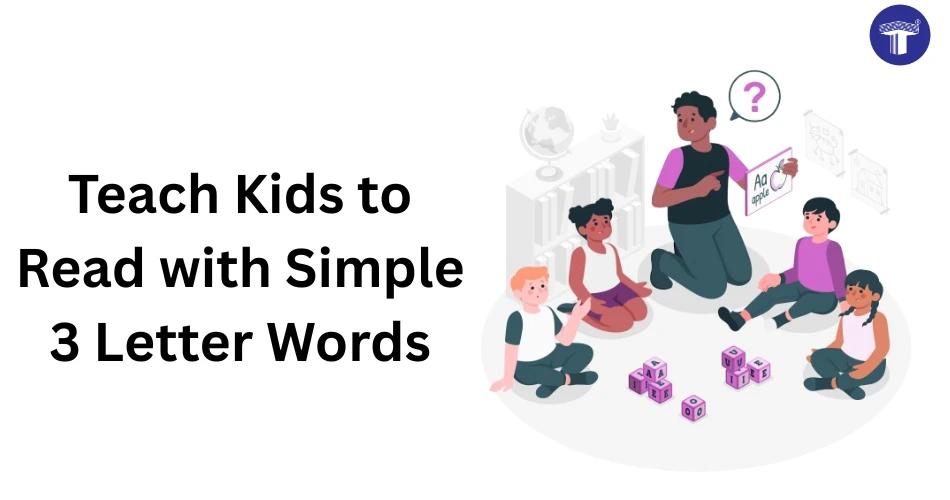
Learning can feel like playtime!
How to Start Teaching 3 Letter Words at Home
You don’t need to be a teacher to help your child with their first words.
You just need a little patience, some creativity, and the right tools. Here are a few simple, parent-approved ways to make it fun and effective:
-
Start with CVC Words
That’s Consonant–Vowel–Consonant words like cat, dog, pen, mug. These follow a clear sound pattern and are easiest to grasp.
-
Sound It Out Together
Break it down: C-A-T. Say each letter and then blend it slowly. Let your child repeat after you.
-
Use Real Objects
Have a toy cup? Label it. Write cup next to it. Connect the word to something they can see and touch.
-
Create Rhyming Games
Say a word, and when your child finds a rhyming word, clap together!
Example: “Let’s find words that rhyme with ‘bat’ (hat, cat, mat)—clap for each one!”
-
Introduce Tracing Early
Tracing letters helps improve hand-eye coordination and locks the word in their memory. Make it feel like drawing, not homework.
Tip from our team:
Use a book that includes colourful illustrations, vowels and consonants, tracing lines, and playful exercises to make learning joyful. Books designed for ages 3+ with just the right balance of guidance and fun can make a huge difference.
Want to try it right away?
We’ve created a free worksheet to help your child start their 3 letter word journey today!
Just 10 minutes a day can go a long way.
Every time your child spells a word on their own, their face lights up. And yours probably does too.
That little 3-letter word?
It’s more than just a spelling win—it’s the beginning of self-confidence, communication, and a lifelong love for learning.
At Target Publications, we know how special this phase is, which is why we created My First 3-Letter Words book that gently supports your child through their very first words. It’s filled with playful tracing, colourful visuals, and age-appropriate activities designed to make learning fun and stress-free for both, you and your little one.

A perfect start to your kids learning journey.
So whether you’re just starting or looking for the right way to support your child, remember:
It’s not about how many words they know. It’s about how they feel while learning them.
You’ve got this, and we’re here cheering you on.
What’s your child’s favourite 3-letter word so far?
Drop it in the comments below, we would love to hear!
Frequently Asked Questions about 3 Letter Words
Q: What age is ideal to start 3 letter words?
A: Once your child is familiar with the alphabet (typically around 3 years), they’re ready to start!
Q: What if my child keeps making mistakes?
A: That’s okay! Repetition builds memory. Let them make errors, gently correct them, and keep it playful.
Q: Can I mix reading and writing while teaching 3 letter words?
A: Absolutely! In fact, it’s encouraged. Let them trace the word, say it aloud, and spot it in their surroundings. In fact, our My First 3-Letter Words book book is designed with tracing activities on every page to support this very method.
Q: My child gets bored easily. Will this work?
A: Kids love colours and interaction. That’s why combining visuals, tracing, and matching games keeps them engaged.
Q: Should I teach uppercase or lowercase 3-letter words first?
A: Start with lowercase, that’s what they’ll see most while reading. But don’t worry if they mix cases early on. With time and practice, they’ll get it!