

If you have ever watched your toddler flip through a picture book with wide, curious eyes, you already know something magical is happening. Picture books are not just bedtime staples; they quietly shape how your child sees, thinks, and creates.
Here is something even more exciting: the right picture books can actually improve your child's drawing skills. Yes, really! Let's explore how.
Why Picture Books are More Than Just Stories for Kids
Picture books are a child's first window to the visual world. Long before kids can read words, they read images. Here is what they quietly absorb:
-
Visual Storytelling Skills
Children learn that images carry meaning. They understand sequencing, cause and effect, and narrative simply by following illustrations.
-
Emotional Intelligence Through Art
Facial expressions and body language in pictures help toddlers name feelings. This awareness later reflects in their own drawings.
-
Spatial Awareness and Design Thinking
Pictorial illustrations teach children about layout, proportion, and how objects relate in space, all foundational drawing concepts.
-
Observation Skills That Last a Lifetime
Noticing pictures in detail trains children to notice shapes, patterns, colours, and lines. Observation is the heart of drawing.
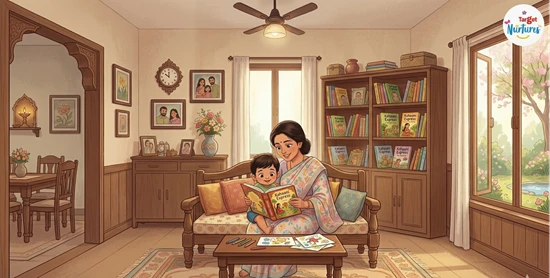
A Parent and a Child Reading a Colourful Picture Book
Picture Books and Phonics: How Letters, Words, and Images Work Together
The way picture books and phonics books blend text and images does more than support reading. It builds your child's drawing skills as well.
-
Letters as Shapes
When children first encounter letters, they see them as shapes. Tracing letters is often a child's very first drawing experience.
-
Word-Image Connections
When 'apple' sits beside an apple illustration, children associate visuals with meaning. This trains the brain to think in pictures.
-
Typography and Artistic Awareness
Bold, playful fonts in picture books show children that text itself can be art, opening minds to creative expression.
7 Simple Ways to Use Picture Books to Improve Your Child's Drawing Skills
Research conducted in the past decade have linked arts participation to cognitive growth, strengthening of long-term memory, and reading ability. Here is how you can use picture books to nurture your child's drawing skills every day.
1. 'Copy the Character' Drawing Time
After going through a picture book, invite your child to draw their favourite character. This encourages observation, hand-eye coordination, and creativity all at once.
2. Talk About Colours and Shapes Out Loud
While reading, point out shapes in illustrations. Ask, 'What shape is the sun?' This trains children to see art analytically.
3. Create a 'Before and After' Scene
Ask your child to draw what happened before the first page or after the last. This builds visual storytelling as well as drawing skills.
4. Use Books as Texture and Pattern Inspiration
Many picture books designed for toddlers, feature rich textures and patterns. Encourage your child to recreate such effects in drawings.
5. Build a 'Story in Drawings' Together
After finishing a picture book, encourage your child to make a simple four-panel drawing retelling the story concisely.
6. Focus on One Illustration Per Session
Do not rush through a book. Spend time on one illustration, discuss it, and ask your child to draw something inspired by that page.
7. Let Them Illustrate Their Own Mini Book
After several picture book reading sessions, give your child blank pages to create their own picture book. This is where their drawing skills come together beautifully.
Conclusion
Picture books and drawing skills go together more naturally than most parents realise. Every time you sit with your child and a good book, you are quietly building an artist.
So grab an engaging picture book, keep drawing supplies nearby, and let your child's creativity flow.
Frequently Asked Questions
1. At what age can kids start drawing inspired by picture books?
Ans: Most children begin scribbling around 12 to 18 months. By age 2 to 3, picture book illustrations can actively inspire simple shapes, figures, and recognisable characters in their drawings.
2. Do picture books really help with fine motor skills?
Ans: Absolutely! Detailed illustrations naturally motivate children to recreate what they see. This encourages pencil grip, steady line control, and hand-eye coordination, all essential early drawing skills.
3. How long should a drawing session after storytime be?
Ans: Around 10 to 15 minutes works well for toddlers. Always follow your child's lead. Even a five-minute spontaneous drawing moment after reading counts and builds real creative habit.
4. Which types of picture books are best for improving drawing skills?
Ans: Books with bold, clear illustrations, rich colours, and expressive characters work wonderfully. Titles featuring strong shapes, visible patterns, and imaginative scenes give children the most inspiring visual reference.
5. Can picture books replace formal art classes for young children?
Ans: Not entirely, but they are an accessible and joyful starting point. Picture books build visual literacy, observation, and creative confidence that any structured art learning can later strengthen further.