
As parents, one of the biggest decisions we face is choosing the right Indian education board for our child. With multiple boards in Indian education like CBSE, ICSE, IB, and SSC, the choice can feel overwhelming. Each Board comes with its own teaching style, exam pattern, and advantages.
In this guide, we’ll explore each option in detail so you can decide which education board is best in India for your child’s future.
Overview of Indian Education Boards
When it comes to schooling in India, parents usually have to choose from four major boards. Each one has a different teaching style, syllabus depth, and future opportunities.
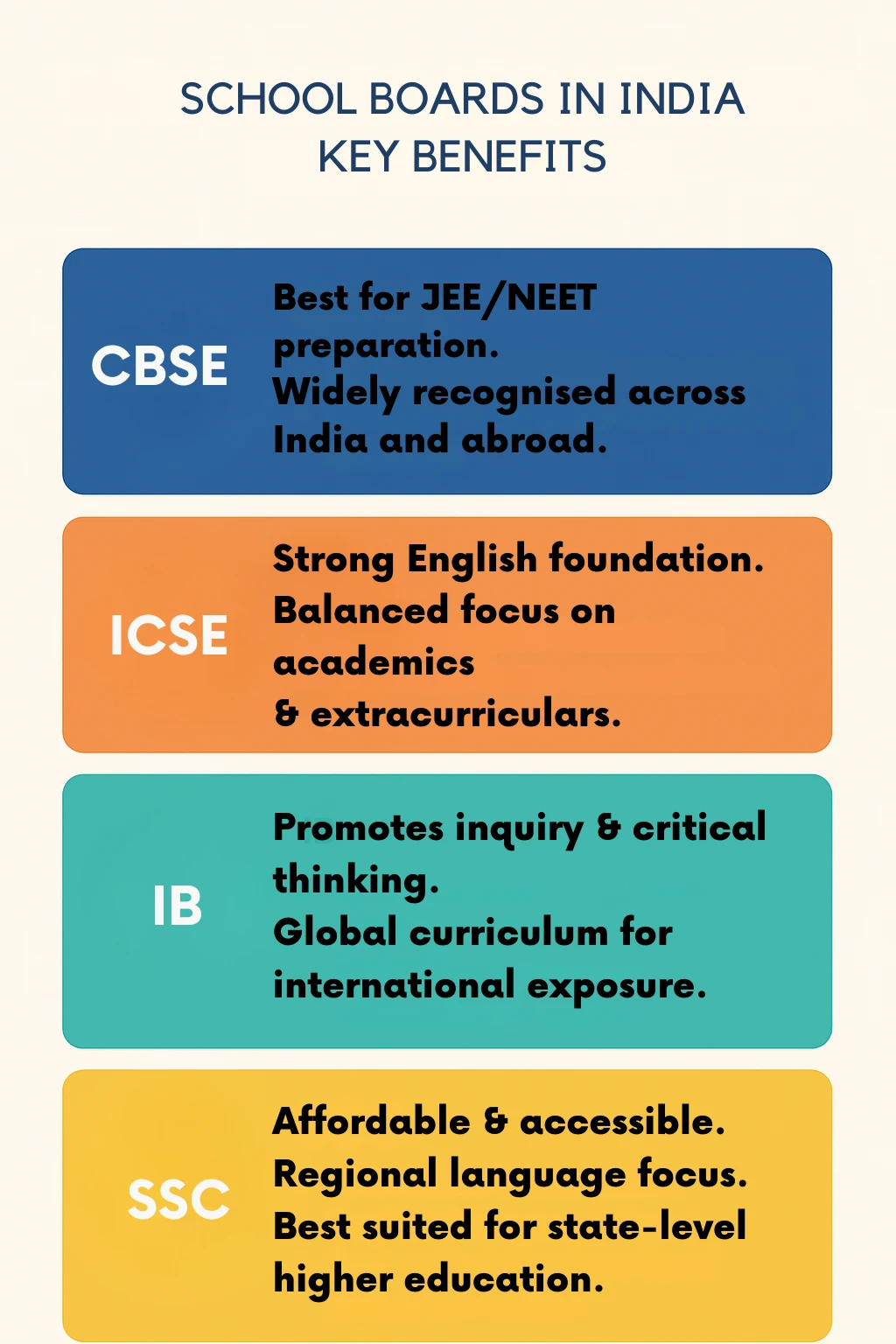
- CBSE (Central Board of Secondary Education): The most popular and widely recognised Indian education board across India. It emphasises Science and Mathematics, follows the NCERT curriculum, and is closely aligned with competitive exams like JEE and NEET.
- ICSE (Indian Certificate of Secondary Education): Known for its detailed and comprehensive syllabus, ICSE places equal importance on languages, arts, and sciences. It builds strong English skills and is valued for its balanced academic approach.
- IB (International Baccalaureate): An internationally recognised curriculum that focuses on inquiry-based learning, creativity, and critical thinking. IB schools prepare students for global opportunities and higher education abroad with their holistic, project-driven programs.
- SSC (State Secondary Board): Designed and managed by individual states, SSC boards focus on accessibility, ensuring educational opportunities reach families across the State. By emphasising regional languages and local contexts, SSC makes learning culturally relevant and widely available in cities, towns, and villages
Key Benefits of Indian Education Board for Students
CBSE: Central Board of Secondary Education
The Central Board of Secondary Education (CBSE) is the most widely recognised Indian education board, trusted by millions of parents.
Curriculum Focus:
CBSE builds a strong foundation in Mathematics and Science, while also giving due importance to other subjects. Its syllabus is closely aligned with national-level entrance exams like JEE, NEET, and UPSC, making it the preferred choice for families with academic and competitive exam aspirations.
Reach:
With more than 27,000 schools in India and abroad, CBSE ensures consistency in curriculum and evaluation standards. This wide presence makes it one of the most accessible Boards for families across regions.
Flexibility:
Since CBSE schools are available in almost every city, student transfers are smooth and hassle-free, a big relief for parents with transferable jobs or families that relocate frequently.
Nursery and Primary Education:
At the early years stage, many parents look for CBSE nursery and primary programs. These schools typically use play-based, activity-driven methods that encourage curiosity, hands-on learning, and social development in children. The approach ensures that children are not overwhelmed, but instead build a love for learning from the start.
If you’re exploring nursery school options, you may also find our guide on fun nursery activity books for kids helpful, a great way to support early learning at home.
Advantages of CBSE Board
- National-level recognition
- Easier for competitive exams
- Practical approach with NCERT books
- Strong network of schools
ICSE: Indian Certificate of Secondary Education
The Indian Certificate of Secondary Education (ICSE) is known for its comprehensive and well-rounded curriculum, which gives equal weight to Science, Mathematics, Arts, and Languages.
Curriculum Focus:
Unlike Boards that lean heavily towards Science and competitive exams, ICSE ensures a balanced academic exposure. Students develop strong foundations not only in core subjects but also in literature, humanities, and creative arts.
Teaching Style:
ICSE schools encourage analytical thinking, detailed writing, and conceptual understanding. Instead of rote memorisation, students are taught to explain concepts in depth—building skills that help in higher education and career development.
Language Strength:
One of ICSE’s biggest advantages is its strong emphasis on English language skills. Students become proficient in written and spoken English, which is a valuable asset for global opportunities.
Flexibility for the Future:
ICSE is well-recognised by universities in India and abroad, making it easier for students to pursue higher studies internationally. Its holistic approach prepares children not only for exams but also for overall personality development and global exposure.
Benefits of ICSE Board
- Rich language and literature base
- Equal focus on academics and extracurricular
- Globally accepted curriculum
- Builds strong foundation in English
IB: International Baccalaureate
The International Baccalaureate (IB) is a globally recognised curriculum designed to nurture curiosity, creativity, and independent thinking. It is especially popular among parents who want their children to have international exposure and flexibility in higher education choices.
Curriculum Focus:
IB emphasises inquiry-based learning, project work, and critical thinking over rote memorisation. Students are encouraged to ask questions, explore real-world problems, and come up with innovative solutions.
Teaching Style:
With its global outlook, IB equips students with skills needed to succeed in international universities. The program develops confidence, research ability, communication, and a multicultural mindset—qualities highly valued in today’s interconnected world.
Flexibility Across Ages:
IB offers programs for all age groups—the Primary Years Programme (PYP), Middle Years Programme (MYP), and Diploma Programme (DP). This means a child can begin with IB in the early years and continue seamlessly through school, experiencing a consistent and progressive learning journey.
Benefits of IB
- Global Recognition
- Holistic Development
- Critical Thinking Skills
- Flexible Programs
- Multicultural Exposure
SSC: State Secondary Board
The State Secondary Certificate (SSC) refers to the school boards managed individually by different states in India. Each state designs its own syllabus, often with a strong emphasis on the regional language, culture, and context, making learning more relatable for children.
Curriculum Focus:
Based on SCERT (State Council of Educational Research and Training) guidelines, SSC follows a state-level curriculum tailored to regional needs and contexts.
Teaching Style:
The approach often emphasises accessibility, ensuring education reaches students from all backgrounds.
Local Relevance:
With the option to learn in regional languages, students develop a deep connection with their cultural and linguistic heritage.
Benefits of SSC Board
- Regional language learning
- Easier for students preferring local/state universities
- Simplified Syllabus
- Government Recognition
- Wide Network
How Many Education Boards in India?
Currently, parents can choose from four major Indian education boards: CBSE, ICSE, IB and SSC, along with international curriculum options like Cambridge IGCSE. The right choice often depends on a child’s aptitude, future career plans, and the family’s educational goals.
For a deeper dive into how CBSE, ICSE, IB, and IGCSE compare, you can also check out this detailed guide by C.P. Goenka International School.
Final Thoughts
There is no single ‘best Board of education in India’. The right choice depends on your child’s learning style, career goals, and your family’s priorities.
At the end of the day, what matters most is not just the Board, but the school’s teaching environment, teachers, and how much your child enjoys learning.
FAQs
1. Which Indian education board is better: CBSE, ICSE, IB, or SSC?
Ans: Each Board has unique benefits. CBSE is great for competitive exams, ICSE for strong language and holistic growth, IB for global exposure, and SSC for accessibility.
2. Is IB better than CBSE or ICSE?
Ans: IB is not 'better’ but different. It suits children aiming for international universities and project-based learning, while CBSE/ICSE are more exam-focused.
3. Which education Board is best in India for competitive exams?
Ans: CBSE is considered the best Indian education board for JEE, NEET, and other national entrance exams due to its NCERT-based syllabus.
4. Which Board is better for overall development?
Ans: ICSE and IB are often preferred for overall personality development, language skills, and extracurricular balance.
5. What are the advantages of CBSE Board?
Ans: The CBSE Board is one of the most widely available Indian education boards, making school transfers easier for families. Its curriculum is highly aligned with central competitive exams like JEE and NEET, while also focusing on practical, application-oriented learning that helps children understand concepts beyond rote memorisation.
6. What are the benefits of ICSE and SSC Board?
Ans: The ICSE Board is well-known for its strong foundation in English, global recognition, and balanced approach that gives equal importance to academics, languages, and extracurricular activities. On the other hand, the SSC Board is valued for being affordable and widely accessible, with a practical syllabus that makes it suitable for students aiming for state-level higher education and government exams.