
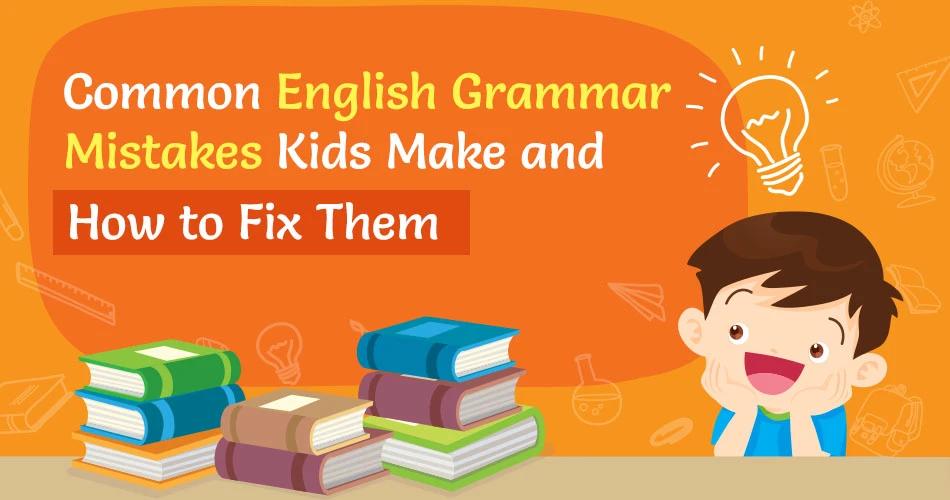
As young children begin to speak, read, and write, they naturally stumble upon a few language bumps along the way. Whether your child is learning grammar at school or through home activities, it's normal to spot some common errors in English.
Here’s a helpful guide to the common grammar mistakes kids between ages 5 and 10 often make and how you can gently correct them during daily conversations, homework time, or story sessions.
1. Present and Past Tense Confusion
"Yesterday I go to school."
Young kids often mix up tenses, especially when speaking quickly or recalling events.
Fix it gently: Repeat their sentence back using the correct tense.
Try saying: “Oh, you went to school yesterday? That sounds fun!”
2. Your vs. You’re
"Your my best friend."
This is a classic common mistake in English writing.
Tip: Explain that “you’re” means you are, while “your” shows ownership.
Fun trick: Ask them to replace “you’re” with “you are” and see if it still makes sense!
3. Misplacing Apostrophes
"The dog’s are playing."
Apostrophes confuse even grown-ups! Kids might add them where they don’t belong or forget them entirely.
Teach this: Apostrophes show ownership (the dog’s bone) or shorten words (it’s = it is).
Plural words like “dogs” don’t need an apostrophe.
4. There / Their / They’re
"Their going to the park with there dog."
These sound alike but have different meanings. This is a common error in English writing.
Break it down:
There = place
Their = belonging to them
They’re = they are
Parent tip: Use flashcards or draw silly pictures to help your child remember.
5. Confusing Similar Spellings and Words
"I no the answer!" or "I want to eat to."
These common mistakes in English happen because many English words sound alike.
Practice with examples:
Know vs. No
To / Two / Too
By / Buy / Bye
Play a game: Spot the wrong word in a sentence and correct it together!
6. Falling into Pronoun Disagreement
"Everyone brought their toys. He forgot their lunch."
Young learners may mix singular and plural pronouns.
What to listen for: Using "they" for one person or "he/she" when talking about multiple.
Gently reframe: “Oh, did he forget his lunch?”
7. Articles (a, an, the)
"I saw elephant at zoo."
Little learners often skip articles altogether.
Teach through books: Point out how every noun is often paired with a, an, or the.
Use examples:
a dog, an apple, the moon
8. Me vs. I
"Me and Riya went to the park."
This is one of the most common grammar mistakes in spoken English. Kids often use "me" instead of "I" when they're the subject of a sentence.
Quick rule: If your child is doing the action, use “Riya and I.”
Make it fun: Act it out together! Ask, “Who went to the park?” and let them say, “I did!”
Final Thoughts for Parents
Grammar learning is a journey and it doesn’t have to be boring or stressful. These common errors are all part of growing up and learning to express oneself. Encourage your child to read aloud, write stories, and even play grammar games with you.
Looking for the right tools to support their learning? Check out our English Grammar and Vocabulary Books Pack — thoughtfully designed for kids aged 5 to 10 to build strong language foundations in a fun, engaging way.
Remember: gentle correction + consistent use = confident communication!
Frequently Asked Questions (FAQs)
1. Why does my child keep making the same grammar mistakes even after correction?
Ans: Repetition is normal at this age! Children are still developing their language habits. Gentle correction, consistency, and positive reinforcement go a long way. Turn corrections into games or stories to make them stick.
2. At what age should my child have basic grammar concepts in place?
Ans: By age 5–7, children typically start using basic grammar like plurals, simple tenses, and articles. Between 8–10, they begin refining sentence structure, pronouns, and more advanced usage. Every child learns at their own pace, so focus on progress, not perfection.
3. Should I correct my child every time they make a grammar mistake?
Ans: No need to correct every single time—it can feel discouraging. Instead, model the correct sentence back to them or correct gently during reading or writing time. The goal is to build confidence, not fear.
4. My child speaks well but makes mistakes when writing. Is that normal?
Ans: Yes, very normal! Speaking and writing use different parts of the brain. Writing develops later and needs more practice. Encourage journaling, story writing, or even comic strips to help.
5. How can I make grammar fun for my child?
Ans: Use games, songs, storytelling, or engaging English grammar books to make learning enjoyable. Grammar doesn’t have to be boring—act out verbs, play “spot the mistake,” or try out fun worksheets.
We recommend using free grammar worksheets from K5 Learning to give your child extra practice in a playful way. And don’t forget—everyday conversations are full of teachable grammar moments too!
6. What are the most common errors in English made by kids in India?
Ans: Kids commonly mix up tenses, misuse articles, confuse homophones (like their/there), and say me instead of I. Exposure to multiple languages at home can also influence their sentence structure, something that can be gently balanced over time.
7. What are some basic grammar rules my child should know by age 7?
Ans: By age 7, your child should be familiar with basic grammar rules like using capital letters at the beginning of sentences, ending sentences with punctuation, understanding subject-verb agreement, and correctly using articles like a, an, and the. These basics create a strong foundation for clearer writing and speaking as they grow.
8. How to learn English grammar step by step for kids?
Ans: Start with the basics—nouns, verbs, and simple sentence structure. Then gradually introduce pronouns, tenses, punctuation, and articles. Use fun tools like picture books, worksheets, and games to keep it engaging. Encourage your child to read aloud, speak in full sentences, and correct mistakes gently. Learning English grammar step by step builds confidence and strong communication skills over time.