
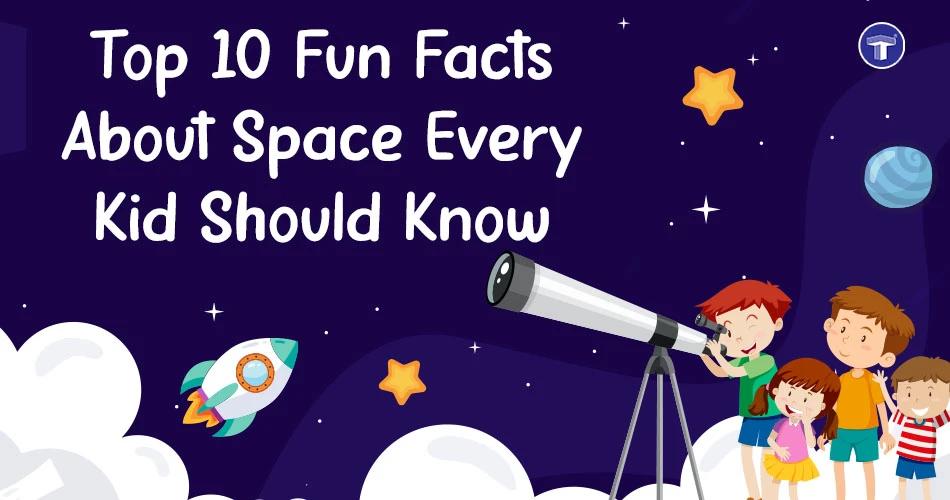
Discovering the wonders of space is one of the most exciting adventures for children. It sparks curiosity, builds scientific thinking, and opens up a universe of imagination. Here are the top 10 fun facts about space that every Indian child and their parents will love to explore together.
This list is written in simple, friendly language; perfect for kids up to 10 years old. Each fact is short, easy to understand, and filled with interesting facts about space that make learning fun for curious young minds.
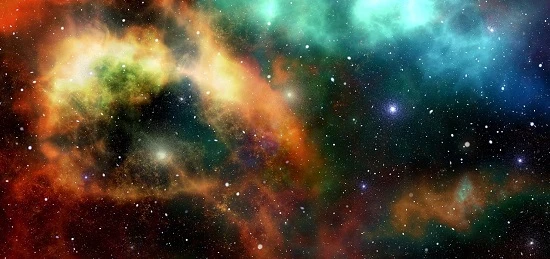
The endless beauty of our vast universe
According to experts, teaching ‘space science for kids’ helps build critical thinking, curiosity, and a lifelong love of learning. You can read more about why space science matters here.
1. The Sun is a Massive Ball of Hot Gas
Did you know the Sun is mostly made of hydrogen and helium? It’s so huge that over one million Earths could fit inside it. Without the Sun’s warmth and light, there would be no life on Earth; it truly is our cosmic superstar and the centre of our solar system. This is one of those fun facts about space that reminds us how vital the Sun really is!
2. There are Eight Planets in Our Solar System
Our solar system has eight fascinating planets, each with its own unique features. From Mercury, the closest to the Sun, to Neptune, the farthest away, every planet tells a special story. Pluto is now called a dwarf planet. Exploring our solar system facts helps children see how every world has its own character and mystery.
3. Space is Completely Silent
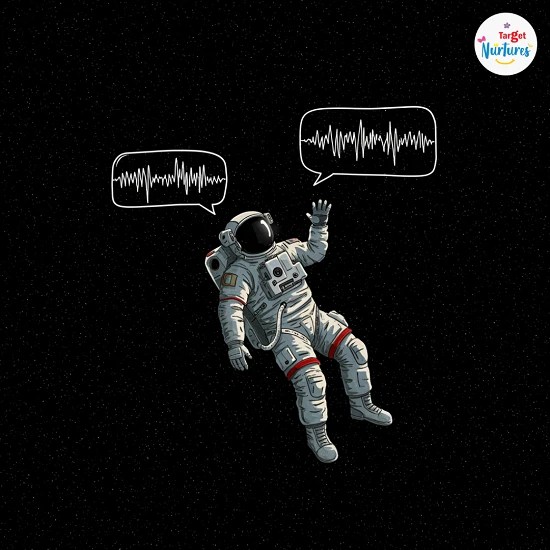
Silent space exploration – astronaut in deep space
Unlike Earth, there’s no air in space to carry sound waves. That means you cannot shout or sing in space, no matter how loud you try! Astronauts communicate using radios; otherwise, there’s perfect space silence all around. This is one of the random facts about space that may sound made-up but is completely true!
4. A Day on Venus is Longer Than its Year
Here’s another fascinating fact: Venus spins so slowly that one day lasts about 243 Earth days, but it takes only 225 Earth days to go around the Sun. So, a day on Venus is actually longer than a year! It’s one of those fun space facts for 10 year olds that will definitely surprise your child.
5. Jupiter Has the Biggest Storm in the Solar System
The Great Red Spot on Jupiter is a gigantic storm that has been swirling for more than 300 years. It’s much larger than Earth itself; imagine a storm that never ends! Jupiter’s mighty winds and colours make it one of the most fascinating parts of our solar system.
6. Saturn’s Rings are Made of Ice and Rocks
The graceful rings of Saturn aren’t solid; they’re made of billions of tiny pieces of ice, dust, and rock orbiting the planet. Some are as small as sand grains; others are as big as mountains. Learning such fun facts about space helps children understand how different and beautiful each planet can be.
7. There Might Be Water on Mars
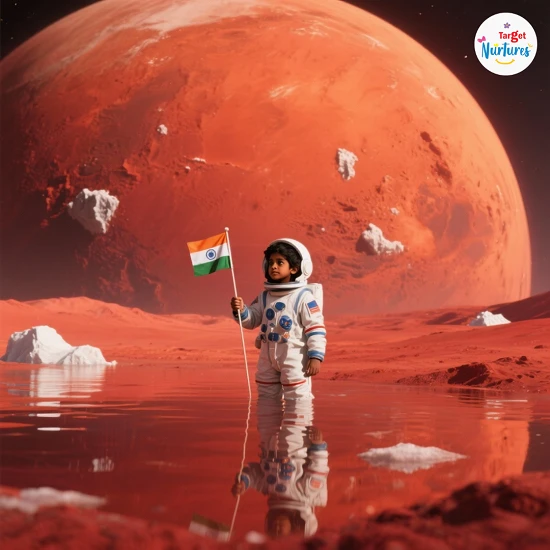
Indian child astronaut exploring Mars discovery
The Red Planet, Mars, has polar ice caps, and scientists believe there could be underground lakes of salty water. Isn’t that amazing? Perhaps future Indian astronauts will be the ones to confirm it. These interesting facts about space show how much there’s still to discover in space exploration.
8. Space is Full of ‘Shooting Stars’, But they are Not Stars
When you see a shooting star, you are actually watching a meteor, a small piece of space rock, burning up as it enters Earth’s atmosphere. It looks like a glowing line across the night sky; a perfect example of how random facts about space can be both surprising and beautiful.
9. Our Moon Was Once Part of Earth
Scientists believe that billions of years ago, a giant asteroid hit Earth; a large chunk broke off and eventually became our Moon. Isn’t it amazing to know that Earth and the Moon share the same beginnings? These kinds of fun space facts for 10 year olds show how our planet and its neighbours are like family.
10. Space Has its Own Indian Heroes
India has some truly inspiring space heroes. Rakesh Sharma, the first Indian astronaut to travel into space, proved that even Indian children can dream of reaching the stars. Today, ISRO scientists and Indian space missions continue to make history; maybe your child will be the next space hero of India!
How Fun Space Facts Inspire Curiosity in Indian Kids
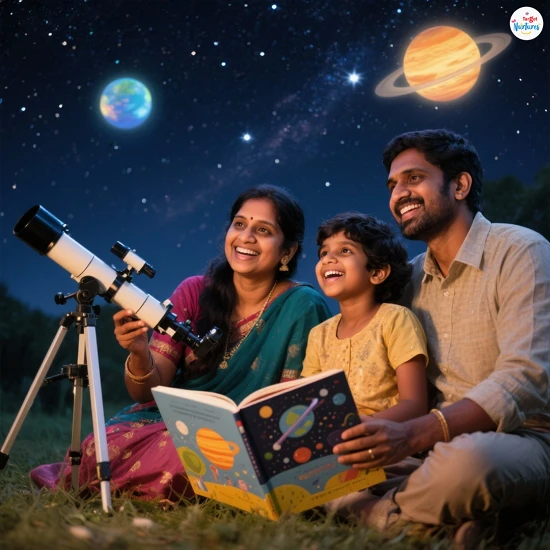
Family stargazing and learning space facts
Learning about space is a brilliant way to spark curiosity, imagination, and a love for science. These fun space facts and our solar system facts make the universe feel exciting and close enough to touch.
Whether your child loves rockets, stargazing, or learning fun facts about space, sharing these interesting facts about space helps them dream big. Encourage your little explorer to ask questions, observe the night sky, and imagine their place among the stars, because every great discovery begins with curiosity.
FAQs
1. Why is space so dark?
Ans: Space looks very dark because it has no atmosphere like Earth to scatter sunlight. On Earth, the sky appears blue during the day because sunlight bounces off air molecules; in space, there's nothing to scatter the light, so space looks black even though there are many stars. Also, the universe is expanding, which stretches the light from faraway galaxies into forms we can't see, making space appear dark to our eyes.
2. What makes planets stay in orbit around the Sun?
Ans: Planets stay in orbit because of gravity. The Sun’s gravity pulls the planets toward it, while the planets keep moving forward. The balance between this pull and their forward motion makes them circle the Sun in a steady path instead of flying away or falling in.
3. What is the difference between stars and planets?
Ans: Stars are giant balls of hot glowing gases that produce their own light and heat, like the Sun. Planets are smaller objects that do not create their own light; they shine by reflecting the light from a star.
4. How do astronauts live in space?
Ans: Astronauts live in space by staying inside spacecraft or space stations designed to provide air to breathe, food to eat, and protection from space dangers. They float in microgravity and use special gear and routines to keep healthy while exploring.
5. Can kids see planets from Earth without a telescope?
Ans: Yes! Some planets, like Venus, Mars, Jupiter, and Saturn, can often be seen from Earth with the naked eye. They look like bright stars, but don’t twinkle like stars do.
6. How many planets are there in our solar system?
Ans: There are eight planets in our solar system. They are Mercury, Venus, Earth, Mars, Jupiter, Saturn, Uranus, and Neptune. Pluto is considered a dwarf planet now.