
As a parent, you play a huge role in your child’s early learning journey. Understanding basic grammar, especially nouns, will give them a strong foundation in reading and writing. So let’s walk through this together, step by step.

Understanding Nouns
What Is a Noun? (Made Easy)
A noun is a word that names a person, place, animal, or thing.
It’s that simple. Here are a few examples to help your child understand:
- Person – mother, teacher, Rahul
- Place – school, park, Delhi
- Animal – dog, cat, tiger
- Thing – toy, bag, book
Example in a Sentence:
Rahul saw a tiger in the zoo.
Here, “Rahul,” “tiger,” and “zoo” are all nouns.
Types of Nouns to Teach Your Child
When your child becomes comfortable with basic nouns, you can slowly introduce these simple types of nouns:
1. Common Nouns
These are general names of things.
Example: boy, city, pencil, animal
2. Proper Nouns
These are special names and always start with a capital letter.
Example: Riya, Kolkata, Monday
3. Singular Nouns
These name one person or thing.
Example: apple, bag
4. Plural Nouns
These name more than one.
Example: apples, bags
5. Collective Nouns
These are names for a group.
Example: a flock of birds, a bunch of flowers
Why Should Your Child Learn Nouns?
Understanding nouns is essential because:
- Nouns are the starting point for sentence building.
- They help children talk, write, and describe things clearly.
- A strong base in nouns improves grammar, vocabulary, and communication skills.
Easy Activities to Teach Nouns
Here are a few fun, simple activities you can do with your child at home to reinforce their learning:
1. Noun Hunt
Ask your child to look around the house and find things that are nouns.
They can name them, draw them, or write them down.
Have them look for:
- 3 people (like mom, dad, sister)
- 3 animals (like dog, bird, fish)
- 3 places (like kitchen, school, park)
- 3 things (like toy, book, cup)
Make it fun by saying:
“Let’s go on a Noun Hunt! Can you spot 12 nouns around you?”
Pro Tip: Let your child draw what they find if writing is tricky, they’ll still be learning!
2. Story Time with Nouns
Read a short storybook and pause to ask your child, ‘Can you spot the nouns in this sentence?’
3. Noun Sorting Game
Create flashcards with words. Let your child sort them into: Person, Place, Animal, or Thing.
4. Draw and Label
Ask your child to draw 2 nouns from each category and label them.

Examples of Nouns: Dog, Apple, Schoolbag, Toy
Noun Worksheet for Kids
Topic: Person, Place, Animal, or Thing
Instructions for Parents: Ask your child to read each sentence and fill in the blank with a suitable noun.
Activity 1: Fill in the Blanks with a Noun
- The __________ is eating a banana. (Hint: animal)
- I go to the __________ to study. (Hint: place)
- My __________ gave me a gift. (Hint: person)
- That is my favorite __________ to play with. (Hint: thing)
- A __________ is barking loudly outside. (Hint: animal)
- We sat on the __________ under the tree. (Hint: thing)
- The __________ is wearing a blue dress. (Hint: person)
- I saw a __________ flying in the sky. (Hint: animal)
- Dad took me to the __________ on Sunday. (Hint: place)
- I keep my books in the __________. (Hint: thing)
Activity 2: Circle the Noun in Each Sentence
- The bird is sitting on a branch.
- Riya has a red pencil.
- The school is closed today.
- A tiger lives in the jungle.
- Mom baked a cake.
Done with the activities? Let’s keep the fun going! Explore more exciting grammar activities and build your child’s confidence with our easy-to-use Nurture English Grammar Books (Classes 1 to 4).
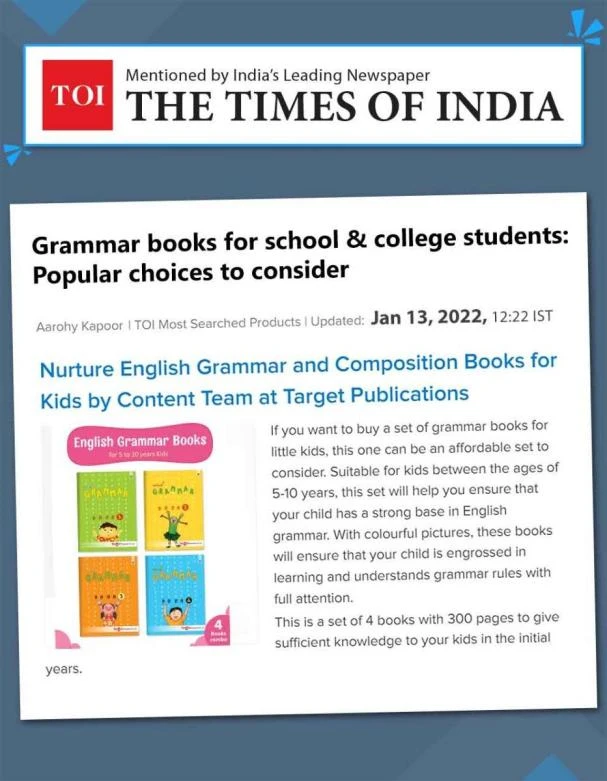
Featured in The Times of India
More Ways to Support Your Child’s Learning
Looking for more ways to help your child master nouns? These trusted educational blogs offer fun ideas, printable games, and expert tips. Explore interactive noun games, sorting activities, and hands-on worksheets that complement your child’s learning style:
Creative Noun Games and Activities – TurtleDiary
How to Teach Nouns – Lucky Little Learners
These resources pair perfectly with our blog activities and grammar book suggestions.
In Summary
Helping your child learn nouns doesn’t have to feel like a grammar lesson.
With just a few minutes a day, playful learning and relatable examples, your child will start recognising and using nouns easily. This small step makes a big difference in their reading and writing confidence.
Looking for ideas to make grammar fun at home? Explore our blog:
How to Make English Grammar Fun for Kids at Home
Together, with the right tools and encouragement, your child will grow confident in using English grammar every day, starting with nouns!
Share Your Experience Below!
We’d love to hear from you! Have you tried any of these noun activities with your child? What worked well or what would you like help with? Share your experiences, questions, or even your child’s favorite noun in the comments below. Let’s learn and grow together as a community of parents supporting early learning!
Frequently Asked Questions
Q1: What is a noun in simple words?
Ans: A noun is a word used to name a person, place, animal, or thing.
Q2: How do I know if a word is a noun?
Ans: If it names something your child can see, touch, visit, or talk about—it’s likely a noun.
Q3: What’s the best age to teach nouns?
Ans: You can start teaching nouns as early as 1 years old using simple words and pictures.
Q4: How can I make grammar fun for my child?
Ans: Use games, books, drawing, and storytelling to introduce grammar concepts naturally.
Q5: Do proper nouns need capital letters?
Ans: Yes! Proper nouns always begin with a capital letter, like India or Diya.
Q6: What’s the best way to teach grammar to my child at home?
One of the best ways to teach grammar at home is by combining fun, everyday activities with structured practice. Our English Grammar Books for Classes 1 to 4 make this easy with simple explanations and engaging exercises tailored for young learners.