
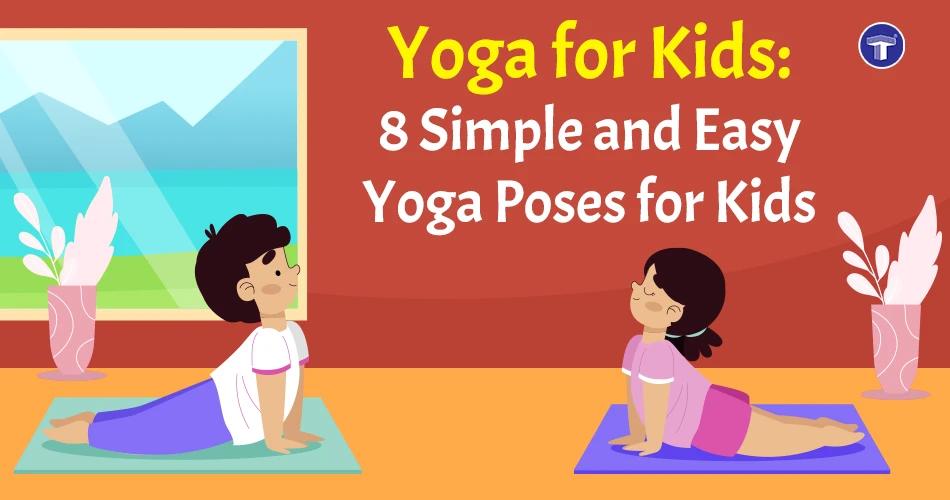
Children are wonderfully full of movement; they fidget, wiggle, jump, explore, and ask a hundred questions in a minute. Their energy is beautiful, but for many parents, it can also feel overwhelming when that energy turns into restlessness, short attention spans, or difficulty settling into a task.
A report by the WHO claims that children are more prone to mental health conditions as they age. These challenges often stem from physical, emotional, and social pressures like poverty, abuse, or violence, leading to disorders such as anxiety and depression.
That’s where yoga for kids steps in like a quiet, gentle friend.
It gives children a simple way to pause, breathe, and feel their own bodies. At home, in their comfort space, a few playful and easy yoga poses can help them slow down, helping them find a sense of calm they don’t even realise they need.
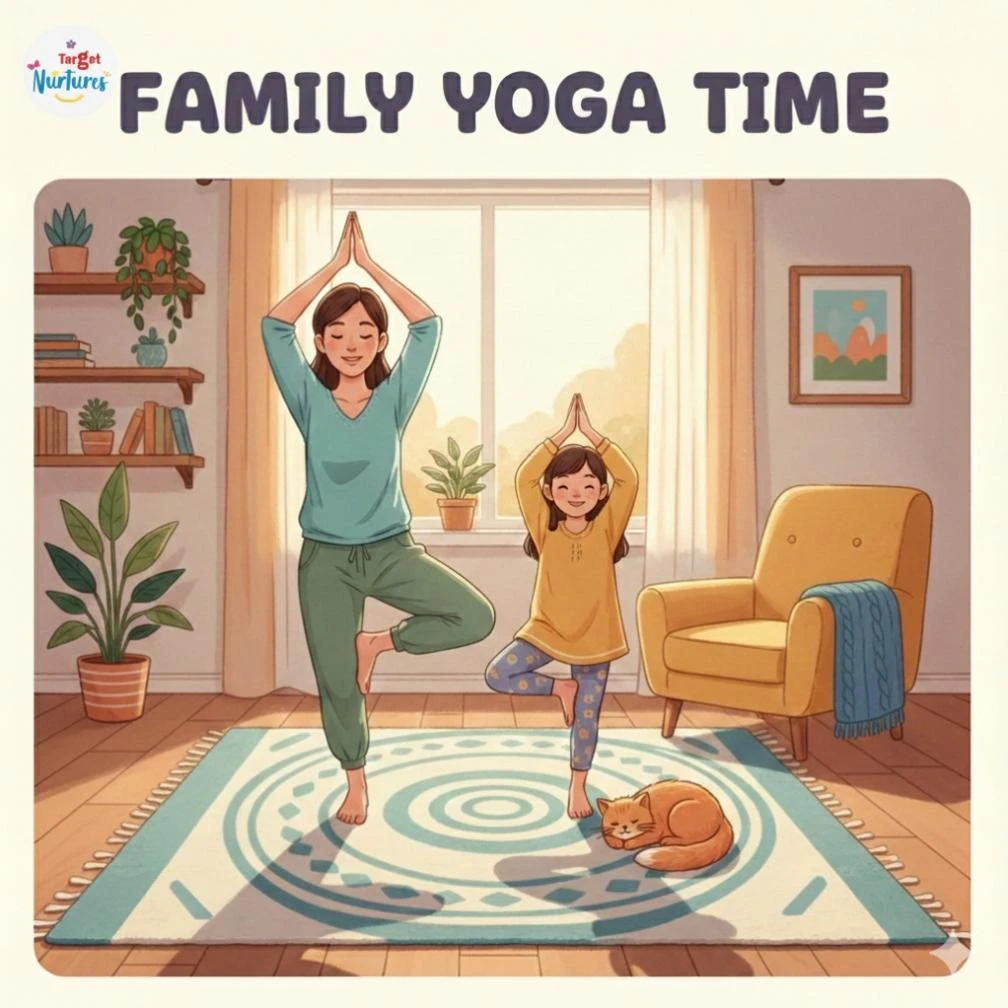
Parent and kid practising easy yoga poses at home
For parents, practising yoga with their child becomes a tiny moment of togetherness, the kind that stays in your heart long after the day is over.
8 Kids’ Yoga Poses that Reduce Restlessness and Improve Focus
Here are some easy and fun yoga poses for kids to try at home, along with their key benefits and a short practice guide.
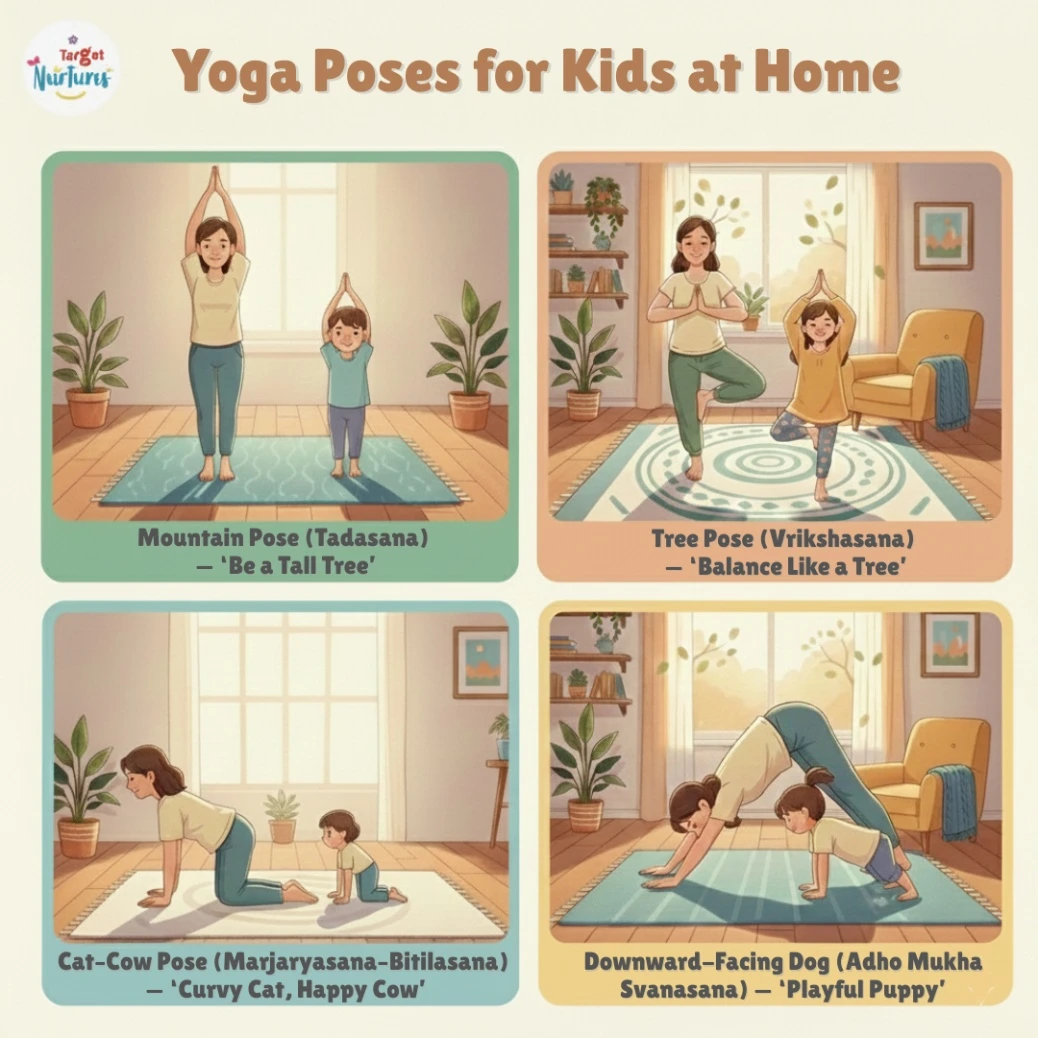
Easy yoga poses for kids to try at home
1. Mountain Pose (Tadasana): ‘Be a Tall Tree’
How does Mountain Pose help:
Improves posture, balance, and mobility in the ankles, hips, shoulders, and upper back.
How to do Mountain Pose:
- Ask your child to stand straight with feet slightly apart and arms relaxed by their sides.
- Slowly lift both arms towards the sky like tree branches growing tall.
- Encourage them to take slow breaths while standing still for a few seconds.
2. Tree Pose (Vrikshasana): ‘Balance Like a Tree’
How does Tree Pose help:
Builds balance, focus, and concentration through controlled standing.
How to do Tree Pose:
- Help your child stand on one leg and place the other foot on their ankle or calf.
- Let them keep their hands together at the chest or raise them gently above the head.
- Hold the pose briefly, then switch legs.
3. Cat–Cow Pose (Marjaryasana–Bitilasana): ‘Curvy Cat, Happy Cow’
How does Cat-Cow Pose help:
Improves flexibility, releases restlessness, and increases body awareness.
How to do Cat-Cow Pose:
- Ask your child to move into a position where their hands and knees are touching the ground, just like a table.
- While breathing in, lift the head and gently drop the tummy (cow).
- While breathing out, round the back and tuck the chin (cat).
4. Downward-Facing Dog (Adho Mukha Svanasana): ‘Playful Puppy’
How does Downward-Facing Dog help:
Stretches the whole body, improves strength, and helps release excess energy.
How to do Downward-Facing Dog:
- Ask your child to balance on hands and knees with palms flat on the mat.
- Help them lift their hips up and back, making their body look like an upside-down “V”.
- Encourage pressing hands into the mat and holding for a few calm breaths before gently coming down.
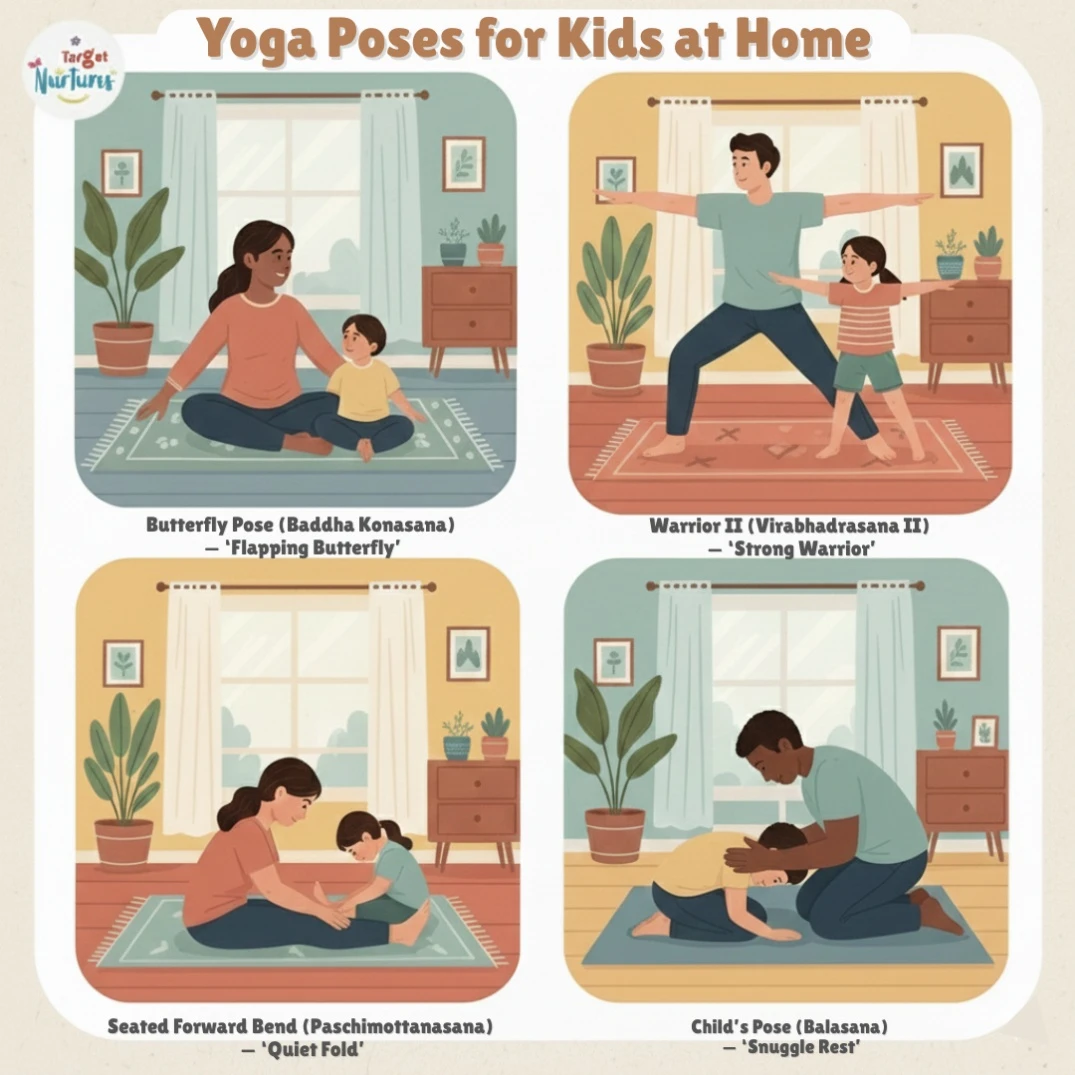
Parents helping kids practise easy yoga poses
5. Butterfly Pose (Baddha Konasana): ‘Flapping Butterfly’
How does Butterfly Pose help:
Calms the body, opens the hips, and encourages sitting still with ease.
How to do Butterfly Pose:
- Ask your child to sit on the floor and bring the soles of their feet together.
- Hold the feet and gently move the knees up and down like butterfly wings.
6. Warrior II (Virabhadrasana II): ‘Strong Warrior’
How does Warrior II help:
Builds strength, focus, and a sense of stability.
How to do Warrior II Pose:
- Help your child stand with legs wide apart and turn one foot outward.
- Bend the front knee slightly and stretch both arms out to the sides.
- Ask them to look over the front hand and hold the pose briefly.
7. Seated Forward Bend (Paschimottanasana): ‘Quiet Fold’
How does Seated Forward Bend help:
Slows down the body and mind while encouraging calmness.
How to do Seated Forward Bend:
- Ask your child to sit with legs stretched out in front.
- Encourage them to bend forward slowly and reach towards their toes.
- Let them relax in the position for a few calm breaths.
8. Child’s Pose (Balasana): ‘Snuggle Rest’
How does Child’s Pose help:
Deeply relaxes the body and helps children calm down when feeling overwhelmed.
How to do Child’s Pose:
- Ask your child to kneel and gently sit back on their heels.
- Help them bend forward and rest their head on the mat or a cushion.
- Encourage slow breathing and quiet rest for a short while.
Safety while Practising Yoga for Kids:
- Always supervise, avoid forcing full poses and let your child work within their comfort zone.
- Keep sessions short for pre-primary kids.
- Modify poses, use chair support, wall support, or hold hands for balance.
- If a child has physical challenges or medical conditions, check with a paediatrician or a qualified instructor first.
How Parents Can Help Their Kids Practise Yoga at Home
1. Practise Together for a Few Minutes Daily
- Children learn best by imitation, so practising yoga for kids together makes the poses easier and more enjoyable for them.
- Even 5–7 minutes of easy yoga poses builds routine, comfort, and a sense of togetherness.
2. Turn Yoga for Kids into a Story or Game
- Use playful cues like ‘Be a tall tree!’ or ‘Flap your butterfly wings!’ while guiding yoga poses for kids.
- Story-based yoga asanas for kids feel like play, helping children stay focused without feeling pressured.
3. Create a Simple, Cosy Yoga Corner at Home
- Dedicate a small space with a mat, cushion, or soft toy nearby.
- A familiar space helps children associate kids’ yoga at home with slowing down and relaxing.
- Soft lighting or quiet background music can make the space more inviting.
4. Keep Yoga Instructions Gentle and Encouraging
- While teaching easy yoga poses to the kids, use soft cues instead of strict corrections.
- Celebrate effort with phrases like ‘You balanced so well today!’ or ‘Great slow breathing!’
- Positive reinforcement helps children enjoy yoga without fear of doing it wrong.
5. Use Yoga for Kids During Transition Times
- Introduce short sessions before homework, bedtime, or after play.
- Simple yoga asanas during these moments help reduce restlessness and emotional overwhelm naturally.
Conclusion
Yoga for kids isn’t just another activity to fill your child’s day; it’s a soft pause in a busy little world. It’s the moment your child learns how steady their breath can be and how peaceful the inside of their mind feels when they slow down.
As a parent, you get to stand beside them in this journey, guiding them, laughing with them when they wobble, cheering for them when they balance, and watching as they slowly discover calmness in their own little way.
With just a few minutes of simple poses at home, you are giving your child something far beyond flexibility or balance:
You’re giving them tools for focus.
You’re giving them skills to manage big emotions.
You’re giving them moments of connection they will remember.
And in these tiny moments, both you and your child grow, not just in strength, but in understanding, warmth, and togetherness.
Frequently Asked Questions (FAQs)
1. What is the right age to start yoga for kids at home?
Ans: Kids can start yoga at home as early as 2.5–3 years with playful, simple yoga poses. At this age, yoga for kids should focus on movement, balance, and fun rather than perfection.
2. How often should kids practise yoga for the best results?
Ans: Practising yoga for kids 3–4 times a week is ideal. Consistency helps children develop focus, calmness, and body awareness gradually.
3. Can yoga really improve focus in pre-primary children?
Ans: Yes, simple yoga poses for kids teach them to stay still, follow cues, and concentrate for short periods. Yoga for focus works best when practised regularly in a relaxed setting.
4. How long should a yoga session be for young kids?
Ans: For pre-primary children, 7–12 minutes of kids’ yoga at home is enough. Short, consistent sessions are more effective than long or forced practice.
5. Is yoga safe for children to practise at home?
Ans: Yoga for kids is safe when poses are gentle and guided by parents. Avoid forcing positions and let children practise within their comfort level.
6. Do kids need special equipment to practise yoga at home?
Ans: No special equipment is needed for kids' yoga at home. A mat, soft surface, or even a carpet is enough for simple yoga poses for kids.
7. How can parents encourage kids to enjoy yoga at home?
Ans: Parents can practise together, use playful names, and turn kids' yoga into a story or game. A positive and pressure-free approach keeps children interested.
8. Can yoga help with bedtime routines for children?
Ans: Yes, calming yoga for kids before bedtime helps slow the body and mind. Gentle poses and breathing make it easier for children to relax and sleep better.