


Picture yourself standing at the edge of a great swimming pool. You know all the strokes. The theory of swimming is perfect in your head. But until you actually dive in and feel the cold water, until you learn to pace yourself and battle the exhaustion, you haven't truly prepared.
It’s the same with NEET. You may have mastered concepts, formulas, and cycles, you may even recite P = V × I in your sleep or know the Krebs cycle better than your own family tree. But the real challenge isn’t the syllabus of NEET.
It’s what happens to your mind inside the exam hall. When adrenaline spikes. When your brain misreads a simple question. When one tough Physics problem shakes your rhythm. You can’t afford for the first time you feel the panic of a difficult Physics problem to be on the day that matters most.
So, we are going to intentionally recreate that exam-day intensity right here with NEET exam practice, in your quiet room, so that when the real challenge arrives, your mind is not surprised. Rather it is ready, resilient, and utterly focused.
1. Mimic the Official Exam Pattern
The first step in realistic question practice is ensuring your mock test accurately reflects the real NEET exam.
When you know the structure, timing, and marking scheme, you’re better equipped to choose the right NEET mock test book and practise the right way:
- Understand the Format: The NEET (UG) exam is a pen-paper based test. Since the NEET paper pattern change in 2025, the NEET exam now has 180 compulsory multiple-choice questions (45 Physics, 45 Chemistry, 90 Biology). With Section B removed in NEET 2026, the exam will no longer offer any optional questions.
- Time Limit: Since the paper pattern change in 2025, the total duration is 3 hours (180 minutes). Set a strict timer for this exact duration. Do not pause it, even for a short break.
- Marking Scheme: Use the official NEET marking scheme for evaluation: +4 for every correct answer and -1 for every incorrect answer. Zero marks for unattempted questions. This is crucial for practising your strategy of when to skip a question.
2. Simulate ‘Pre-Exam Routine’
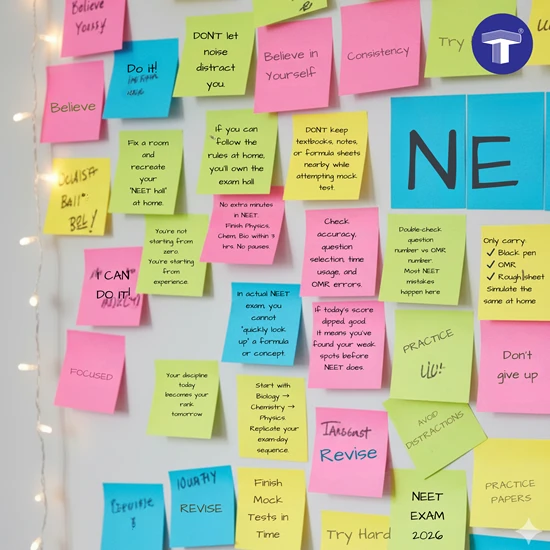
NEET exam practice at home
Think of the actual NEET exam day. You won’t wake up at noon, scroll through social media, grab a random snack, and stroll into the exam hall. Your entire morning will follow a rhythm: steady, controlled, and predictable. That rhythm is what keeps your mind calm when the timer starts.
To train that rhythm before every mock, follow these steps:
- Wake up at the same time as the actual exam.
- Avoid heavy meals before the mock.
- Avoid screens 1 hour before mock.
3. Set the Examination Environment
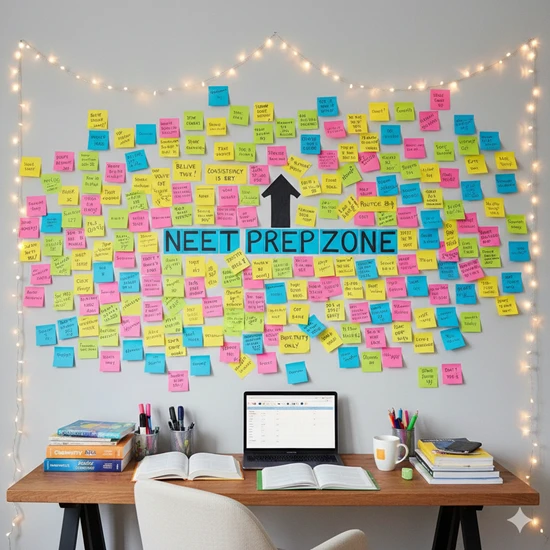
Creating NEET exam practice environment
The moment you enter the exam hall, the air shifts. A heavy silence settles in as everyone waits for the question paper. The hall is quiet and distraction-free and so should your home be during a mock test! Which is why, you should follow these suggestions:
- Choose a room or desk that you can designate solely for the mock test. It should be quiet, well-lit, and away from high-traffic noise producing areas like the living room or kitchen.
- Sit in a hard-backed chair.
- Use a basic desk. Avoid bed/sofa.
- Wear comfortable but simple clothes.
- Sit upright. No slouching.
Your physiology influences your performance.
Also, the ‘No Distractions Policy’ should entail the following:
- Switch Off your mobile phone or place it in a different room.
- Inform your family that you are taking a 3-hour exam and must not be disturbed.
- Clear your desk of all study materials, notes, and textbooks. You should only have your question paper, OMR sheet, pen, and water bottle, just like in the real exam.
- Exam Timing: Ideally, take your mock test at the same time slot as the actual NEET exam (usually from 2:00 p.m. to 5:00 p.m.). This helps train your biological clock to be at its sharpest during the crucial hours on exam day.
3. Keep Everything Strictly Timed
In the real exam, every second feels sharper. You flip a page and suddenly realise you’ve lost ten precious seconds. You stare at a tricky Physics question for a moment too long, and your heartbeat reminds you that time isn’t waiting. In NEET, micro-mistakes in timing lead to macro-losses in marks.
That’s why your mock test should run like clockwork. Follow these micro-timings to build the reflexes you’ll rely on in the exam hall:
- 3 minutes for OMR details
- 10 seconds to turn pages
- 2–3 seconds to re-read tough questions
- 40–45 minutes per subject
3. Master the OMR Sheet
Imagine finishing a perfect paper only to lose months of work because of one mis-ticked bubble. You hand over your answer sheet and, later, discover you bubbled the wrong row or missed a digit in your roll number, that tiny slip erased a year of effort. Practise filling it under time pressure until the movements become automatic: write fast, check quick, fill dark.
Here’s how to do it right:
OMR Sheets: Use a book that contains NEET OMR sheets which closely resemble the official one. Never simply mark answers on the question paper itself.
Filling Details: Start the timer and first practise filling in all the required details (Roll Number, Test Booklet Code, etc.) accurately and quickly.
Decide on your OMR filling strategy:
- Block-by-Block: Fill the OMR for one subject (e.g., Biology) after completing it.
- After Every Few Questions: Fill the OMR after every 10–15 questions.
- All at the End: This is HIGHLY RISKY and generally not recommended, as you might run out of time or panic.
Use the Right Pen: Use the same type of Blue or Black Ballpoint Pen that is permitted in the exam to practice darkening the bubbles completely and quickly.
6. Close the Loop: Your Post-Mock Ritual
Imagine walking out of the real exam hall with sweaty palms, racing thoughts, replaying every question in your head. That 30-minute window after the exam is where clarity hits.
Try and recreate that moment too.
Walk away from your desk.
Drink water.
Let your brain cool down.
Then come back and check your paper with the same marking scheme NTA uses. Identify where you lost marks, not just what you got wrong, but why. Was it panic? Was it misreading? Was it a silly OMR error?
This analysis will help you not just simulate exam-like environment for NEET exam practice but also provide you with a way to improve your scores when you attempt the actual exam.
Conclusion
You wouldn't step onto a battlefield without training your stamina and reflexes, would you? It's time to bring the pressure home, so you can leave your fear outside the exam hall. This is your chance to stop hoping you'll perform and start guaranteeing it.
Frequently Asked Questions (FAQs)
1. Why is it important to simulate real NEET exam conditions during practice?
Ans: Simulating real exam conditions helps you build accuracy, stamina, and time management so the actual NEET exam feels familiar, not overwhelming.
2. How do I create an exam-like setup for NEET mock tests?
Ans: Sit in a quiet room, keep only your stationery and admit-card essentials, use a strict timer, and complete the paper without breaks or distractions.
3. How do toppers simulate NEET exam conditions at home?
Ans: Toppers follow the exact NEET timing, sit at a desk, use OMR sheets, avoid phones, and evaluate themselves immediately after the test.
4. Can I improve my NEET score just by simulating exam conditions at home?
Ans: Yes—replicating real test conditions consistently trains your mind and reduces exam-day stress, which directly improves performance.