

Preparing for NEET 2026 can definitely feel overwhelming. With lakh of students competing hard every year for limited medical seats, it’s not just about how much you study, but the NEET study strategy you follow. Every student have unique NEET study tricks and styles. Hence, identifying your learning style can give you the edge you need to succeed in the examination.
If you are looking forward to NEET 2026 as the start of your medical career and want to know how to study smart for NEET, then this article is definitely going to help you kickstart your preparation.
Choosing the right learning style for NEET
How Does Choosing a Learning Style Matter For Your NEET Study Strategy?
Every student follows different learning styles and yours could be your own unique style. If you study against your natural learning style, you may feel frustrated, demotivated, and less focused. Hence, identifying the effective study technique for your NEET preparation becomes equally important as to choosing what to learn. For an exam like NEET where everyday of study counts, finding out the right NEET study strategy is very crucial.
Before diving into the different learning styles, analyse the chapterwise weightage for NEET to know what you’re up against.
Given below is an explanation of the four distinct learning styles for you to have a clear understanding of them:
Different Learning Styles Explained for Forming NEET Study Strategy
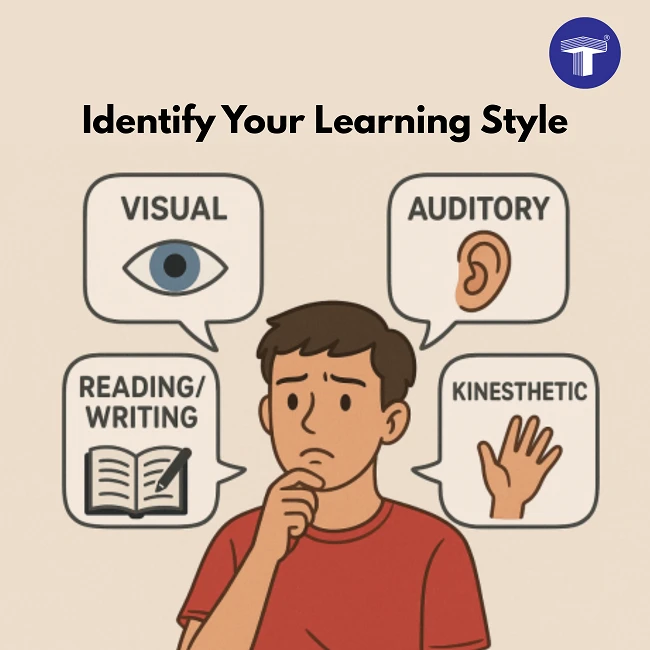
Everyone has their own way of forming a strategy for their NEET preparation, based on their habits and preferences. Broadly, these learning styles can be grouped into four different types:
1. Visual Learning Style
If you prefer learning through diagrams, flowcharts, mind–maps, illustrations, and videos and also find it easy to understand and retain concepts with the help of images and colour-coded notes, then yes, you are a visual learner. If you want to to excel in your NEET 2026 preparation with the help of visual learning style, add our Absolute Series to your study desk.
2. Auditory Learning Style
Do you experience better retention through conceptual videos, video lectures, and when you receive an aloud explanation of the concept or read it loudly for yourself? Well, hello then you are an auditory learner. Need access to unique conceptual explanations through videos, subscribe to our YouTube channel.
3. Reading/Writing Learning Style
Prefer notes and books that provide a thorough explanation? Are you the one who learns by writing/reading summaries and solving questions based on the concept learned? Then yes, you fall in the category of reading/writing learners. If reading aloud, writing, and solving questions give you an edge in your overall preparation, then you should definitely add our 38 Years Previous Solved Papers books to your study list.
If self assessment is your go to method to test yourself, and you’re wondering, ‘What are the books to study for NEET?’ Worry not. We have a wide range of test series for you i.e. the Academic Ace series.
4. Kinesthetic Learning Style
Most students understand concepts better when they see them applied in a practical way. For example, performing experiments like mixing different types of acids and bases makes the idea come alive. Even solving problems using physics formulae, though not hands-on, still helps strengthen conceptual understanding by showing how the theory works in real situations. If this sounds like you, then you definitely belong to the family of kinesthetic learners.
Feel the need to have more such helpful resources to strengthen your preparation, visit our website and find all the necessary NEET books to master the NEET (UG) exam 2026.
To Sum it Up
At the end of the day, there’s no ‘right’ or ‘wrong’ NEET study strategy, it’s about finding which of the different learning styles clicks for you. Whether you’re a visual learner who thrives on diagrams, an auditory learner who remembers best through discussions, the key is to study smart with the right study material, not just hard.
Frequently Asked Questions (FAQS)
1.Is it possible to take the NEET exam after a gap of one year between Std. 11 and 12?
Ans: Yes, you can take the NEET exam even after you take a one year between Std. 11 and 12.
2. How many questions are there in each section for Physics, Chemistry, and Biology in the NEET exam?
Ans: Physics and Chemistry have 45 questions each, while Biology has a total of 90 questions. The total number of questions in NEET is 180.
3. Which learning style is best for cracking NEET exam?
Ans: There is no learning style that is considered the best for the NEET exam. The learning style that suits you the most and helps you in your preparation could be considered the best suited learning style for you.
4. Can I use multiple learning styles while preparing for NEET exam?
Ans: Almost every student has a mix of two learning styles that is best suited for their NEET preparation.
5. How can I know if I am a visual, auditory, or kinesthetic learner for NEET 2026 preparation?
Ans: The method of learning you prefer and the one that fits naturally to your learning experience will help you identify which type of learner are you. The visual learner would be more inclined towards diagrams, flowcharts, and mind-maps while an auditory learner would like to learn through video and audio lectures or classroom explanations. The kinesthetic leaner would always want to have a practical experience of the concepts learned.