

When it comes to Physical Chemistry, understanding only the concepts won’t cut it. This tricky section, full of calculations, formulas, and problem-solving skills, often intimidates aspirants. But here’s the silver lining, a well-organised NEET Physical Chemistry formula sheet can turn this challenge into an opportunity.
Imagine having a NEET Physical Chemistry formula list at your fingertips.
Mastering these formulas can make NEET preparation a little easier, smarter, and more efficient.
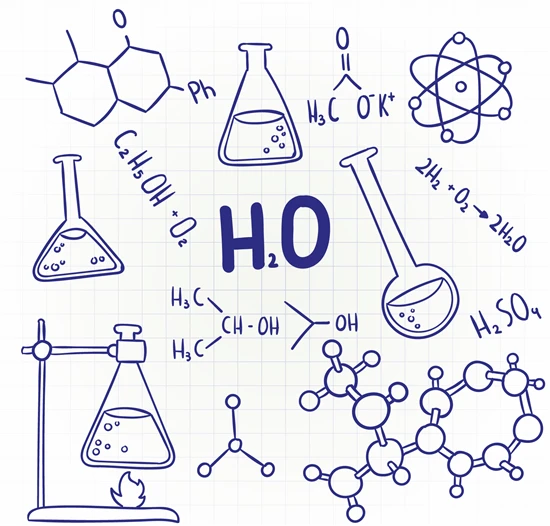
Physical Chemistry Concepts and Laboratory Illustrations
Importance of Physical Chemistry in NEET (UG) 2026
Physical Chemistry is the backbone of Chemistry in NEET. It bridges the gap between conceptual understanding and problem-solving skills. You’ll majorly come across numerical and formual-based questions from this section, where scoring marks become a breeze if formulas are on your fingertips. Not only this, but Physical Chemistry carries a significant weightage, that is, 35–40% of the total Chemistry section.
Key Topic in Physical Chemistry in NEET (UG) 2026
The following are some of the important topics from Physical Chemistry that appear frequently in the NEET examination:
- Equilibrium (Chemical and Ionic)
- Chemical Thermodynamics and Thermochemistry
- Electrochemistry
- Chemical Kinetics
- Solutions and Colligative Properties
- Atomic Structure
- Some Basic Concepts of Chemistry (Mole Concept)
- Surface Chemistry
Using the right physical chemistry formulas for NEET at the right time can save precious minutes and help you secure marks that are crucial to your final score.
Complete Physical Chemistry Formula Sheet for NEET (UG) 2026
Here’s a comprehensive list of all Physical Chemistry formulas aligned with the NEET (UG) 2026 updated syllabus. Keep this as a reference during your preparation:
- Ideal Gas Equation: P V = n RT
Where, P is pressure, V is volume, n is the number of moles, R is the gas constant, and T is the temperature.
- Boyle's Law: P1V1 = P2 V2 for a given amount of gas at a constant temperature.
- Charles' Law: V 1/ T 1 = V 2 / T 2 for a given amount of gas at constant pressure.
- Avogadro's Law: V 1/ n 1 = V 2/ n 2 for a given temperature and pressure.
- Van der Waals Equation (for real gases): ( P + V 2 a n 2 ) ( V − nb ) = n RT
Where a and b are Van der Waals constants.
- Gibbs Free Energy (for a spontaneous process): Δ G = Δ H − T Δ S
Where Δ G is the change in free energy, Δ H is the change in enthalpy, Δ S is the change in entropy and T is the temperature.
- First Law of Thermodynamics: Δ U = q + w
Where Δ U is the change in internal energy, q is the heat absorbed or released, and w is the work done.
- Rate of Reaction (for zero-order reaction): Rate = k
- Rate of Reaction (for first-order reaction): Rate = k [ A ]
Where [ A ] is the concentration of the reactant.
Download the Physical Chemistry Formula Sheet for NEET in PDF format here.
How To Use This Physical Chemistry Formula Sheet For Maximum NEET (UG) 2026 Advantage
- Integrate with Practice: Don’t just memorise. Apply these formulas while solving previous year questions and mock tests.
- Daily Quick Revision: Spend 15 to 20 minutes daily reviewing this formula sheet. Regular exposure builds confidence.
- Topic-wise Mastery: Focus on high-weightage topics like Thermodynamics, Chemical Kinetics, and Electrochemistry first. This ensures maximum marks in minimum time.
- Create Shortcuts: Develop mnemonics or shorthand symbols for complex formulas. This makes recollection faster during exams.
- Link with Conceptual Clarity: Remember, formulas won’t work until backed by understanding. Combine this sheet with NEET (UG) notes and solved examples.
By following this method, you can save valuable time and reduce errors in numerical problems. Perseverance is the key to success, and a structured approach like this gives you edge in NEET UG 2026 examination.
Conclusion
Physical Chemistry may seem daunting, but with the right formula sheet and systematic preparation, it becomes a scoring section rather than a challenge. NEET aspirants who master these formulas not only save time but also secure marks that cam make them the top ranker.
Keep this NEET physical chemistry formula sheet handy, revise regularly, and approach NEET (UG) 2026 with confidence.
Frequently Asked Questions
1. Is it necessary to memorize all physical chemistry formulas for NEET?
Ans: Formulas play a key role in Physical Chemistry. But simply mugging them up won’t always work. You need to connect each formula with clear concepts and actively use them in your daily practice to see real results.
2. Can I rely only on formula sheets without solving numericals?
Ans: You can’t rely on formulas just by memorising them. To truly understand their application them and solve numericals accurately, you need to practise problems regularly.
3.What percentage of NEET chemistry questions are formula-based?
Ans: Around 30 to 40% of NEET Chemistry questions are formula-based, and most of these come from Physical Chemistry.