

You’ve been studying to appear for the NEET exam for months. The syllabus for NEET is halfway done. However, something feels not quite right. Test scores have plateaued, revisions don’t feel sharp, and confidence swings between ‘I’ve got this’ and ‘Do I really?’ The notes are piling up, mock tests keep coming, and yet clarity feels distant. You know you’ve been studying hard, but can’t quite tell if it’s working.
Maybe you’ve already tried optimising your NEET self study plan or figured out your learning style—because yes, how you study matters just as much as what you study.
And perhaps you’ve even started revising core topics like Units and Measurements from NEET Physics, hoping to build a stronger base. But somewhere between theory and practice, the big question remains: how do you really know if your NEET preparation is on track?
This mid-preparation phase is the trickiest part of the NEET journey. It’s when hard work meets uncertainty. That’s why a Mid-Preparation Self-Evaluation Method is essential. It helps you pause, reflect, and see your NEET preparation for what it really is: not just effort, but measurable progress.
Why the Need to Evaluate Mid-Preparation while NEET preparation?
By mid-preparation, NEET stops being about memorising chapters, it becomes a game of insight. How much have you actually improved since your last test? Which concepts are slowing you down? And how close are you to your target score?
A Mid-Preparation Self-Evaluation Toolkit is designed to answer those exact questions. It gives structure to your self-analysis, turning unstructured practice into targeted NEET preparation strategy. Because NEET toppers don’t just prepare, they measure their preparation.
Building Your Mid-Preparation Self-Evaluation Toolkit for NEET 2026
A self-evaluation NEET toolkit is about choosing tools that help you measure how far you’ve come and what’s holding you back. The right mix of books and insights can transform your mid-preparation phase from guesswork into a data-backed strategy.
Here’s how to build yours:
1. Identify Knowledge Gaps
a) Evaluate Concept Retention and Question Evolution
If you want to test not just what you know but how you’ve adapted to changing patterns, the 38 Years NEET Previous Solved Papers PSP (1988–2025) is essential.
The chronological arrangement of over 2,700 questions helps you trace how NEET’s focus areas and difficulty levels have evolved.
Its graphical insights and topic-wise weightage analysis provide a macro view of your preparedness—especially useful if you’ve completed multiple mock cycles.
The strategic hints and answer keys make self-assessment faster and more accurate, ensuring you’re not just practicing but learning from each attempt.
Use it for: Trend mapping, long-term topic weightage evaluation, and high-level strategy refinement.
b) Analyse Depth and Consistency
If you want a clear picture of your conceptual consistency, the NEET 13 Years’ Previous Solved Papers PSP (2013–2025) is your go-to resource.
With 13 years of NEET and AIPMT questions, it helps you identify which topics you’ve mastered and which need reinforcement. The chapter-wise and topic-wise arrangement acts as a diagnostic grid, making it easy to see which concepts repeatedly challenge you.
The Top Ranker’s Repository in this book features a curated set of past-paper questions that demand the highest level of conceptual understanding, the kind only toppers typically master. Each question is accompanied by expert video solutions to help you learn their approach step by step. Use the Top Ranker’s Repository to see which high-difficulty questions you struggle with.
Plus, the analytical insights section highlights question frequency trends, an essential part of your NEET self study evaluation if you want to prioritise high-weightage chapters.
Use it for: Trend-based chapter analysis and targeted question practice.
2. Benchmark Your Speed and Accuracy
To evaluate your speed, and accuracy, practise solving the NEET Previous Years Question Papers (2013–2025).
The 20 full-length papers including re-tests and extra phases helps you assess your speed and accuracy for solving a full length question paper. Use the blank OMR sheets to test your speed and identify if your accuracy dips under pressure.
The ‘Smart Keys’ teach you time-saving methods, while the deep trend analysis gives you performance benchmarks across subjects. The cut-off trend section helps you understand the NEET evaluation method and where your current score stands compared to previous years’ qualifying marks which is a concrete measure of progress.
Use it for: Accuracy testing, time management evaluation, and performance benchmarking.
4. Assess Exam Temperament
To evaluate your focus, stamina, and ability to perform under real exam pressure, practise solving the NEET-UG 10 Mock Papers Booklet with OMR Sheets.
The 10 full-length papers help you replicate the actual NEET environment, due to which, you experience the intensity and duration of the exam. For this scenario, attempt each test without interruptions to monitor how you hold up under pressure.
Use it for: Building exam stamina, reducing anxiety, and learning to maintain concentration for 3–4 hours under real test conditions.
5. Track Revision Efficiency
To ensure your concepts are understood clearly, re-attempt questions you solved earlier using the NEET 38 Years’ PSP (2013–2025) or past mock tests.
Re-solve questions after a 1–2 week gap to test retention and see which areas need reinforcement. Watch expert video solutions for any mistakes to understand the correct approach and avoid repeating errors.
Use it for: Strengthening concept retention, identifying weak spots, and avoiding last-minute cramming.
6. Incorporate Smart Strategies
To improve speed and efficiency, use the strategic hints and Smart Keys in PSPs. These resources teach shortcuts, formulae, and problem-solving techniques specifically designed for NEET. Apply these strategies during timed practice sessions to save valuable minutes without compromising accuracy.
Use it for: Faster problem-solving, efficient time management, and improving accuracy under pressure.
7. Set Realistic Benchmarks
To measure your preparation level, combine analytical insights from PSPs with mock test performance. Compare your scores with previous years’ cut-offs and top percentile scores to understand your standing.
Use it for: Setting achievable target scores, tracking progress across subjects, and identifying chapters that require extra focus.
8. Stay Aligned with Latest Trends
To avoid outdated preparation, understand what NEET (UG) 2026 aspirants can learn from NEET 2025 trends. The analysis shows which topics gained or lost weightage, NEET evaluation method, and how question styles have shifted from conceptual to fact-based, so you can realign your preparation with the latest exam pattern.
Use it for: Updating NEET mock test strategy according to recent patterns, focusing on high-priority topics, and maximising scoring potential.
9. Reflect and Adjust
After every self-assessment session, maintain a reflection log to note what worked, what didn’t, and where you struggled. Use this feedback to adjust your NEET self study plan, practice routine, and revision strategy.
Use it for: Continuous refinement of your preparation strategy, ensuring that every session leads to measurable improvement.
Putting It Together: Your Mid-Prep Assessment Journey
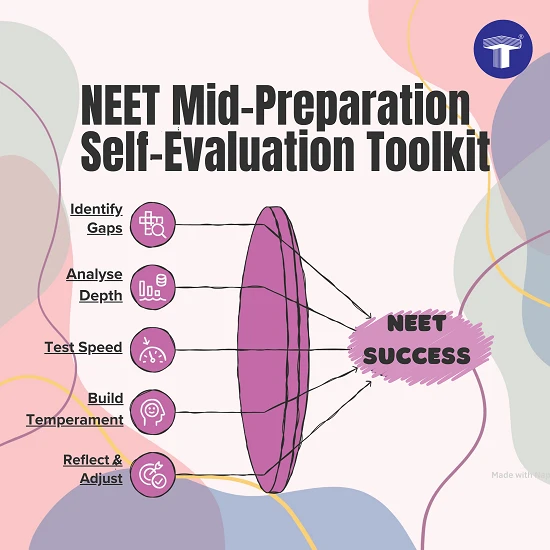
NEET Mid-Preparation Self-Evaluation Toolkit
- Map Trends: 38 Years PSP → Identify evolution in questions and topics.
- Check Conceptual Depth: 13 Years PSP → Find strong and weak areas.
- Simulate Exams: Full-length papers → Test speed, accuracy, and temperament.
- Align with Latest Trends: NEET 2025 Trends → Focus on what’s relevant now.
- Reflect and Improve: All resources + logs→ Fine-tune strategy continuously.
Final Word
When used together, these tools form a 360° NEET Self-Evaluation Kit, one that combines past NEET test analysis, real-time testing, and trend-based strategy.
So instead of wondering, ‘Am I ready?’, you’ll know exactly where you stand, what to improve, and how close you are to your target score.
In short: Mid-preparation self-assessment is not just about solving questions; it’s about mapping trends, tracking weaknesses, testing under real conditions, adjusting strategies, and building mental readiness.
Frequently Asked Questions (FAQs)
1. How can I evaluate my NEET preparation effectively?
Ans: By analysing your performance in PYQs, mock tests, and topic-wise assessments to identify strengths, weaknesses, and progress trends.
2. What is a self-evaluation toolkit for NEET preparation?
Ans: It’s a structured set of processes using resources like PYQ books, mock tests, and analyses that help you measure progress, identify gaps, and refine your preparation strategy.
3. How do I know if my NEET preparation is on track?
Ans: If your mock test scores are consistently improving and your accuracy in high-weightage topics is rising, your preparation is on track.
4. What are the key parameters to evaluate NEET preparation?
Ans: Concept clarity, accuracy, speed, consistency, time management, and performance under exam conditions.
5. How often should I take mock tests for NEET?
Ans: At least one full-length NEET mock test every 10–15 days during mid-preparation, increasing to weekly tests as the exam approaches.
6. How to analyse NEET mock test results effectively?
Ans: Review every incorrect or skipped question to identify the root cause, conceptual error, guesswork, or time mismanagement and adjust your NEET self study plan accordingly.
7. What is the ideal NEET score during mid-preparation?
Ans: Scoring 450–500+ in mid-preparation mock tests indicates strong fundamentals and steady progress toward a 600+ final score target.