
Every parent has had that late-night thought: am I doing this right? During a toddler's development years, it is natural to wonder which parenting style will shape a successful child. It's very important to be kind to yourself here. Nobody hands us a manual, and everyone is learning by doing.
Psychologists explain most parenting styles with two simple ideas:
- One is warmth, meaning the love, comfort and responsiveness you offer.
- The other is rules, meaning the clear expectations you set.
Mix them differently and you get four distinct parenting styles.
The Four Parenting Styles at a Glance
Psychologist Diana Baumrind coined the first three parenting styles in the 1960s, and researchers later added a fourth. Here is how they compare.
| Style | Warmth | Rules | Child Often Shows |
| Authoritative | High | High | Confidence |
| Authoritarian | Low | High | Worry |
| Permissive | High | Low | Impulsiveness |
| Uninvolved | Low | Low | Insecurity |
1. Authoritative Parenting
In this style of parenting, you keep clear limits, explain the reasons, and still listen to your child's big feelings. Here, ‘We hold hands near the road because cars are fast’ works better than a plain ‘no’.
2. Authoritarian Parenting
It's when 'Because I said so' takes over gentle explanations. Authoritarian parenting style is strict with little reasoning. Toddlers may obey yet feel anxious about sharing their feelings.
3. Permissive Parenting
Permissive parents are loving, easy-going, and hate to see tears in their child's eyes. But, a few rules leave little ones without guardrails. Their bedtimes drift, snacks multiply and ‘no’ becomes ever harder to hear later.
4. Uninvolved Parenting
This parenting style leaves little ones to figure out life on their own, rarely coming from a lack of love. Parents' long shifts and exhaustion can leave little energy for play or chat. Toddlers need our attention most, so even small pockets of shared time matter a great deal.
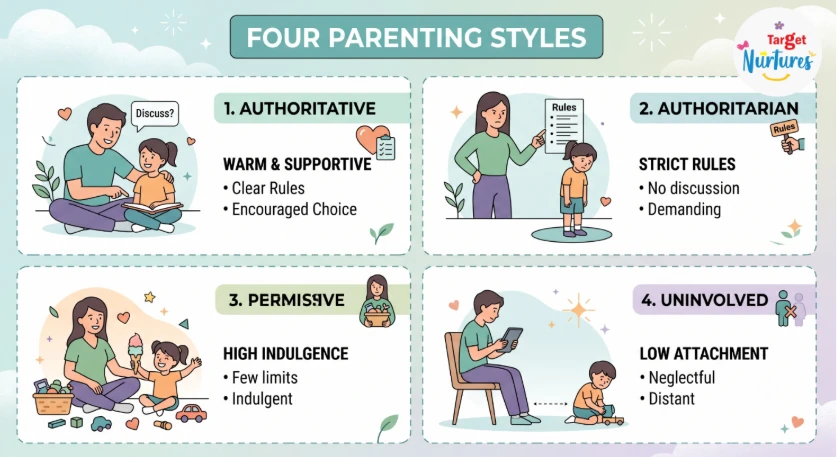
The four parenting styles at a glance
Which Parenting Style Shapes a Successful Child? What Research Says
A 2016 meta-analysis of 308 studies by Martin Pinquart, published in Educational Psychology Review, found that parental warmth and an authoritative style showed better school performance in later years. Authoritarian, permissive and neglectful styles were linked to lower achievement.
The effects were small, though. Parenting style is one important piece of the puzzle, alongside temperament and a child’s own personality. A child's success also depends on their confidence and kindness, supported by a warm and consistent parenting style.
How to Spot Your Parenting Style at Home
You do not need a psychology degree to understand this. Just notice your first instinct in a few everyday moments at home.
- Tantrum Time: Do you shout, give in, or ignore? Try to pause, name the feeling and hold the emotion so you can evaluate it easily.
- Story Time: Bedtime story books make feelings easy to talk about. Pause and ask, ‘How do you think the bear felt?’ This brings out the feelings of toddlers without asking a direct question.
- Play Time: Sit down with some colouring books and let your toddler lead. Shared play builds the connection that makes limits easier to accept, both for you and for your child.
Important Links
| Pre-primary Books | Activity Books |
| Alphabet Writing Books | Learning Kits |
Conclusion
So, which parenting style actually shapes a successful child? The evidence leans towards authoritative parenting that's warm, clear, and consistent. Yet the four parenting styles are guides, not labels. Most parents wander between them every single day.
Pick one small change this week, like explaining a rule or reading together at bedtime. To be successful, your toddler needs you, showing up with love and a few gentle boundaries.
Frequently Asked Questions
1. What is gentle parenting, and is it a parenting style?
Ans: Gentle parenting is an empathy-led approach. It is not one of the four parenting styles, but it matches authoritative parenting when limits stay firm.
2. Can I change my parenting style later?
Ans: Yes. Start small by adding one clear rule or one calm explanation. Children respond well to steady changes, and warmth helps them adjust easily.
3. Do both parents need the same parenting style?
Ans: Not exactly. Small differences in parenting are normal. What helps most is agreeing on the main rules and backing each other up in front of your toddler.
4. When do parenting styles matter?
Ans: From the earliest months. Babies and toddlers learn trust through how quickly and warmly we respond, so early routines and rules already shape their behaviour later.
5. Do parenting styles work the same across cultures?
Ans: Mostly. A review found more similarities than differences across cultures, though family values and community norms still shape what feels normal for each child.