
Hello NEET aspirants!
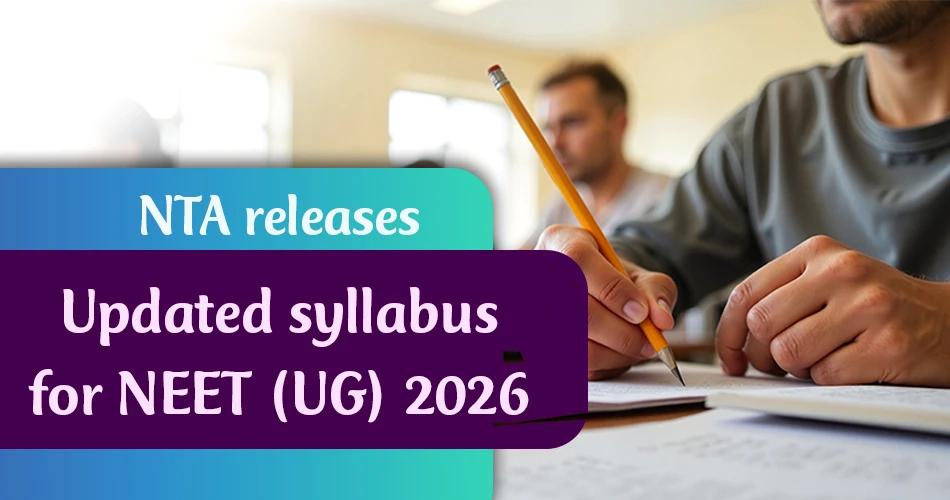
The National Medical Commission (NMC) has officially released an important update regarding NEET syllabus 2026. Through a notice dated 22 December, 2025, the Under Graduate Medical Education Board (UGMEB) has confirmed that the NMC has finalised and released the NEET (UG) 2026 syllabus on its website.
Official NEET 2026 Updated Syllabus Notice
If you are preparing for NEET UG 2026, this NEET updated syllabus 2026 directly impacts what you study, how you plan your NEET preparation, and the NEET study material you rely on.
Let’s break it down clearly.
NEET (UG) Updated Syllabus 2026: What Aspirants Should Note Down
1. NEET (UG) 2026 Updated Physics Syllabus
Physics is one of the challenging sections of the NEET (UG) 2026 exam, and understanding the syllabus thoroughly is the first step towards mastering it.
The NEET 2026 Physics syllabus, prescribed by the NMC, is largely based on Class 11 and Class 12 NCERT Physics, with a strong focus on conceptual clarity, numerical problem-solving, and real-life applications.
The NMC syllabus for NEET 2026 covers a wide range of topics including Mechanics, Thermodynamics, Electrodynamics, Optics, Modern Physics, and Experimental Skills. Questions in NEET Physics syllabus 2026 test not just formula application, but also a student’s ability to analyse situations, interpret graphs, and apply concepts logically under time pressure.
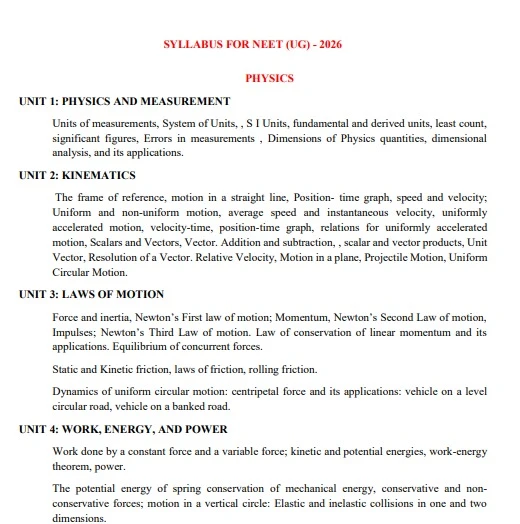
In this section, you’ll find the complete and updated NEET (UG) 2026 Physics syllabus, organised unit-wise for easy understanding and effective preparation. Whether you are planning your study timetable, identifying high-weightage chapters, or aligning your preparation with NCERT, this syllabus breakdown will help you stay focused and exam-ready.
| Unit Name | Unit Sub-Topics |
| UNIT 1: PHYSICS AND MEASUREMENT | Units of measurement; system of units; SI units; fundamental and derived units; least count; significant figures; errors in measurement; dimensions of physical quantities; dimensional analysis and its applications. |
| UNIT 2: KINEMATICS | Frame of reference; motion in a straight line; position–time graph; speed and velocity; uniform and non-uniform motion; average speed and instantaneous velocity; uniformly accelerated motion; velocity–time and position–time graphs; relations for uniformly accelerated motion; scalars and vectors; vector addition and subtraction; scalar and vector products; unit vector; resolution of a vector; relative velocity; motion in a plane; projectile motion; uniform circular motion. |
| UNIT 3: LAWS OF MOTION | Force and inertia; Newton’s first law of motion; momentum; Newton’s second law of motion; impulse; Newton’s third law of motion; law of conservation of linear momentum and its applications; equilibrium of concurrent forces; static and kinetic friction; laws of friction; rolling friction; dynamics of uniform circular motion – centripetal force and its applications: vehicle on a level circular road and vehicle on a banked road. |
| UNIT 4: WORK, ENERGY AND POWER | Work done by a constant force and a variable force; kinetic and potential energies; work–energy theorem; power; potential energy of a spring; conservation of mechanical energy; conservative and non-conservative forces; motion in a vertical circle; elastic and inelastic collisions in one and two dimensions. |
| UNIT 5: ROTATIONAL MOTION | Centre of mass of a two-particle system; centre of mass of a rigid body; basic concepts of rotational motion; moment of a force; torque; angular momentum; conservation of angular momentum and its applications; moment of inertia; radius of gyration; moments of inertia for simple geometrical objects; parallel and perpendicular axes theorems and their applications; equilibrium of rigid bodies; rigid body rotation and equations of rotational motion; comparison of linear and rotational motion. |
| UNIT 6: GRAVITATION | Universal law of gravitation; acceleration due to gravity and its variation with altitude and depth; Kepler’s laws of planetary motion; gravitational potential energy and gravitational potential; escape velocity; motion of a satellite; orbital velocity; time period and energy of a satellite. |
| UNIT 7: PROPERTIES OF SOLIDS AND LIQUIDS | Elastic behaviour; stress–strain relationship; Hooke’s law; Young’s modulus; bulk modulus; modulus of rigidity; pressure due to a fluid column; Pascal’s law and its applications; effect of gravity on fluid pressure; viscosity; Stokes’ law; terminal velocity; streamline and turbulent flow; critical velocity; Bernoulli’s principle and its applications; surface energy and surface tension; angle of contact; excess pressure across a curved surface; applications of surface tension – drops, bubbles and capillary rise; heat and temperature; thermal expansion; specific heat capacity; calorimetry; change of state; latent heat; heat transfer – conduction, convection and radiation. |
| UNIT 8: THERMODYNAMICS | Thermal equilibrium; zeroth law of thermodynamics; concept of temperature; heat, work and internal energy; first law of thermodynamics; isothermal and adiabatic processes; second law of thermodynamics – reversible and irreversible processes. |
| UNIT 9: KINETIC THEORY OF GASES | Equation of state of a perfect gas; work done in compressing a gas; kinetic theory of gases – assumptions; concept of pressure; kinetic interpretation of temperature; RMS speed of gas molecules; degrees of freedom; law of equipartition of energy and its applications to specific heat capacities of gases; mean free path; Avogadro’s number. |
| UNIT 10: OSCILLATIONS AND WAVES | Oscillations and periodic motion – time period, frequency and displacement as a function of time; periodic functions; simple harmonic motion (SHM) and its equation; phase; oscillations of a spring – restoring force and force constant; energy in SHM – kinetic and potential energies; simple pendulum – derivation of expression for its time period; wave motion; longitudinal and transverse waves; speed of a travelling wave; displacement relation for a progressive wave; principle of superposition of waves; reflection of waves; standing waves in strings and organ pipes; fundamental mode and harmonics; beats. |
| UNIT 11: ELECTROSTATICS | Electric charges and conservation of charge; Coulomb’s law; forces between two and multiple point charges; superposition principle and continuous charge distribution; electric field and electric field lines; electric dipole and electric field due to a dipole; torque on a dipole in a uniform electric field; electric flux; Gauss’s law and its applications; electric potential and potential difference; equipotential surfaces; electrical potential energy of a system of charges; conductors and insulators; dielectrics and electric polarization; capacitors and capacitance; combination of capacitors in series and parallel; capacitance of a parallel plate capacitor with and without dielectric; energy stored in a capacitor. |
| UNIT 12: CURRENT ELECTRICITY | Electric current; drift velocity and mobility; Ohm’s law; electrical resistance; V–I characteristics of ohmic and non-ohmic conductors; electrical energy and power; electrical resistivity and conductivity; series and parallel combinations of resistors; temperature dependence of resistance; internal resistance; potential difference and emf of a cell; combination of cells in series and parallel; Kirchhoff’s laws and their applications; Wheatstone bridge; metre bridge. |
| UNIT 13: MAGNETIC EFFECTS OF CURRENT AND MAGNETISM | Biot–Savart law and its application to a current-carrying circular loop; Ampere’s law and its applications; force on a moving charge in uniform magnetic and electric fields; force on a current-carrying conductor in a uniform magnetic field; force between two parallel current-carrying conductors – definition of ampere; torque on a current loop; moving coil galvanometer – sensitivity and conversion to ammeter and voltmeter; magnetic dipole moment; bar magnet as an equivalent solenoid; magnetic field lines; torque on a magnetic dipole; para-, dia- and ferromagnetic substances; effect of temperature on magnetic properties. |
| UNIT 14: ELECTROMAGNETIC INDUCTION AND ALTERNATING CURRENTS | Electromagnetic induction; Faraday’s laws; induced emf and current; Lenz’s law; eddy currents; self and mutual inductance; alternating current; peak and RMS values of AC; reactance and impedance; LCR series circuit; resonance; power in AC circuits; wattless current; AC generator and transformer. |
| UNIT 15: ELECTROMAGNETIC WAVES | Displacement current; electromagnetic waves and their characteristics; transverse nature of electromagnetic waves; electromagnetic spectrum – radio waves, microwaves, infrared, visible, ultraviolet, X-rays and gamma rays; applications of electromagnetic waves. |
| UNIT 16: OPTICS | Reflection of light; spherical mirrors and mirror formula; refraction of light at plane and spherical surfaces; thin lens formula and lens maker’s formula; total internal reflection and its applications; magnification; power of a lens; combination of thin lenses in contact; refraction through a prism; microscope and astronomical telescope (reflecting and refracting) and their magnifying powers; wave optics – wavefront and Huygens’ principle; interference; Young’s double-slit experiment; diffraction; polarization and Brewster’s law; uses of plane-polarized light and Polaroid. |
| UNIT 17: DUAL NATURE OF MATTER AND RADIATION | Dual nature of radiation; photoelectric effect; Hertz and Lenard’s observations; Einstein’s photoelectric equation; particle nature of light; matter waves; de Broglie relation. |
| UNIT 18: ATOMS AND NUCLEI | Alpha-particle scattering experiment; Rutherford’s atomic model; Bohr model; energy levels and hydrogen spectrum; composition and size of nucleus; atomic masses; mass–energy relation; mass defect; binding energy per nucleon; nuclear fission and fusion. |
| UNIT 19: ELECTRONIC DEVICES | Semiconductors; semiconductor diode; I–V characteristics in forward and reverse bias; diode as a rectifier; I–V characteristics of LED; photodiode; solar cell; Zener diode and its use as a voltage regulator; logic gates – OR, AND, NOT, NAND and NOR. |
| UNIT 20: EXPERIMENTAL SKILLS | Familiarity with experimental approach and observations: Vernier calipers; screw gauge; simple pendulum; metre scale; Young’s modulus of elasticity; surface tension of water; coefficient of viscosity; speed of sound in air; specific heat capacity; resistivity using metre bridge; resistance using Ohm’s law; galvanometer; focal length of convex mirror, concave mirror and convex lens; angle of deviation versus angle of incidence; refractive index of a glass slab; p–n junction diode characteristics; Zener diode characteristics; identification of diode, LED, resistor and capacitor. |
Did you know many NEET aspirants prepare for Boards at the same time?
Juggling Board exams while covering the NEET 2026 updated syllabus requires smart planning. If this resonates with you, check out our guide in balancing your Board and NEET preparation effectively.
2. NEET (UG) 2026 Updated Chemistry Syllabus
Chemistry plays a decisive role in boosting scores in the NEET (UG) 2026 exam, especially for students aiming for top ranks. The NEET 2026 Chemistry syllabus is also based entirely on Class 11 and Class 12 NCERT Chemistry.
The syllabus is divided into three core sections: Physical Chemistry, Organic Chemistry, and Inorganic Chemistry. While Physical Chemistry syllabus focuses on numerical problem-solving and concepts, Organic Chemistry syllabus tests reaction mechanisms and application-based thinking. Inorganic Chemistry syllabus demands strong memory and NCERT line-by-line understanding.
NEET Chemistry syllabus questions are known for being direct yet tricky, often framed from NCERT examples, tables, and statements. A clear understanding of the complete NEET (UG) 2026 Chemistry syllabus helps students prioritise important chapters, avoid unnecessary topics, and prepare in a structured, exam-oriented manner.
In this section, you’ll find the latest, unit-wise NEET Chemistry syllabus for 2026, aligned with NCERT and designed to help you plan your preparation smartly and confidently. If you’re looking for NEET Organic Chemistry syllabus, p block NEET syllabus, and Inorganic Chemistry syllabus, you’ll find it below.
| Unit Name | Unit Sub-Topics |
| UNIT 1: SOME BASIC CONCEPTS OF CHEMISTRY | Matter and its nature; Dalton’s atomic theory; concept of atom, molecule, element and compound; laws of chemical combination; atomic and molecular masses; mole concept, molar mass, percentage composition; empirical and molecular formula; chemical equations and stoichiometry. |
| UNIT 2: STRUCTURE OF ATOM | Discovery of electron, proton and neutron; atomic number, isotopes and isobars; Thomson’s model and its limitations; Rutherford’s model and its limitations; Bohr’s model and its limitations; concept of shells and subshells; dual nature of matter and light; de Broglie’s relation; Heisenberg uncertainty principle; concept of orbitals; shapes of s, p and d orbitals; quantum numbers; electronic configuration of atoms; Aufbau principle, Pauli exclusion principle and Hund’s rule. |
| UNIT 3: STATES OF MATTER – GASES AND LIQUIDS | Three states of matter; intermolecular interactions; types of bonding; gaseous state – Boyle’s law, Charles’ law, Gay-Lussac’s law, Avogadro’s law, Dalton’s law of partial pressures; ideal gas equation; kinetic theory of gases; deviation from ideal behaviour; liquefaction of gases; liquid state – vapour pressure, viscosity and surface tension. |
| UNIT 4: THERMODYNAMICS | System and surroundings; types of systems; extensive and intensive properties; state functions; first law of thermodynamics – internal energy and enthalpy, heat capacity, Hess’s law of constant heat summation; enthalpy of bond dissociation, combustion, formation, atomization, sublimation, phase transition, ionization, solution and dilution; second law of thermodynamics; entropy; Gibbs free energy; spontaneity. |
| UNIT 5: EQUILIBRIUM | Chemical equilibrium; law of mass action; equilibrium constant; factors affecting equilibrium; ionic equilibrium – acids, bases and salts; ionization of acids and bases; pH scale; common ion effect; buffer solutions; solubility product; hydrolysis of salts. |
| UNIT 6: REDOX REACTIONS | Oxidation and reduction; redox reactions in terms of electron transfer; oxidation number; balancing redox reactions; applications of redox reactions. |
| UNIT 7: CLASSIFICATION OF ELEMENTS AND PERIODICITY IN PROPERTIES | Modern periodic law and periodic table; periodic trends in properties – atomic radii, ionic radii, ionization enthalpy, electron gain enthalpy, electronegativity and valency. |
| UNIT 8: GENERAL PRINCIPLES AND PROCESSES OF ISOLATION OF ELEMENTS | Principles of metallurgy; concentration of ores; extraction of crude metal; refining; thermodynamic and electrochemical principles involved in the extraction of metals. |
| UNIT 9: HYDROGEN | Position of hydrogen in the periodic table; isotopes; preparation, properties and uses of hydrogen; hydrides; water and hydrogen peroxide; heavy water; hydrogen economy. |
| UNIT 10: S-BLOCK ELEMENTS (ALKALI AND ALKALINE EARTH METALS) | Group 1 and Group 2 elements – electronic configuration, occurrence, properties, trends in properties; anomalous behaviour of lithium and beryllium; compounds of alkali and alkaline earth metals. |
| UNIT 11: SOME P-BLOCK ELEMENTS | Group 13 and Group 14 elements – general introduction; electronic configuration; occurrence; oxidation states; trends in properties; important compounds. |
| UNIT 12: D AND F BLOCK ELEMENTS | General properties of transition elements; electronic configuration; oxidation states; trends in properties; coordination compounds; lanthanoids and actinoids – properties and applications. |
| UNIT 13: COORDINATION COMPOUNDS | Werner’s theory; ligands; coordination number; nomenclature; isomerism; bonding; crystal field theory; applications of coordination compounds. |
| UNIT 14: BASIC PRINCIPLES OF ORGANIC CHEMISTRY | Tetravalency of carbon; hybridization; structural representations; functional groups; homologous series; nomenclature (IUPAC); electronic effects – inductive, resonance and hyperconjugation; reaction intermediates – carbocations, carbanions and free radicals. |
| UNIT 15: HYDROCARBONS | Alkanes – preparation, properties and reactions; alkenes – preparation, properties and reactions; alkynes – preparation, properties and reactions; aromatic hydrocarbons – benzene, aromaticity and electrophilic substitution reactions. |
| UNIT 16: HALOALKANES AND HALOARENES | Classification; nomenclature; nature of C–X bond; preparation; physical and chemical properties; uses; environmental effects. |
| UNIT 17: ALCOHOLS, PHENOLS AND ETHERS | Preparation; properties and reactions of alcohols, phenols and ethers; distinction tests. |
| UNIT 18: ALDEHYDES, KETONES AND CARBOXYLIC ACIDS | Nomenclature; preparation; properties and reactions; uses of aldehydes, ketones and carboxylic acids. |
| UNIT 19: AMINES | Classification; nomenclature; preparation; properties and reactions of amines; diazonium salts and their reactions. |
| UNIT 20: BIOMOLECULES | Carbohydrates – classification and reactions; proteins – structure and functions; enzymes; vitamins; nucleic acids. |
| UNIT 21: POLYMERS | Classification; natural and synthetic polymers; polymerization; properties and uses. |
| UNIT 22: CHEMISTRY IN EVERYDAY LIFE | Chemicals in medicines; food additives; cleansing agents; soaps and detergents. |
Heads up! Not all NEET syllabus topics carry equal weight in the actual exam. Worry not, refer to our NEET 2026 chapter-wise weightage breakdown to understand which units tend to appear most frequently and plan your revision accordingly.
3. NEET (UG) 2026 Updated Biology Syllabus
Biology is the highest-scoring and lengthiest section in the NEET (UG) 2026 exam, with 90 questions, making it the section that contributes the majority of marks. A strong grasp of this section is crucial for aspirants aiming for top ranks.
The NEET Biology syllabus 2026 is entirely based on Class 11 and Class 12 NCERT Biology, making NCERT textbooks the most important resource for preparation.
The section covers a wide array of topics including Diversity of the Living World, Structural Organisation in Animals and Plants, Cell Structure and Function, Genetics, Human Physiology, Plant Physiology, Ecology, Biotechnology, and Reproduction. NEET Biology syllabus questions are designed to test both conceptual clarity and the ability to apply knowledge to diagrams, processes, and experimental scenarios.
By understanding the complete NEET (UG) 2026 Biology syllabus, students can plan their preparation efficiently, focus on high-weightage chapters, and strengthen both theoretical knowledge and diagram-based learning. This section provides the latest, unit-wise NEET Biology syllabus for 2026, aligned with NCERT, to help aspirants prepare in a structured and confident manner.
NEET Botany syllabus 2026, Anatomy of flowering plants NEET syllabus 2026, Structural organisation in animals NEET syllabus 2026, NEET Biology syllabus 2026 chapter-wise are all included below:
| Unit Name | Unit Sub-Topics |
| UNIT 1: DIVERSITY IN LIVING WORLD | Diversity of living organisms; classification; five-kingdom classification; salient features and classification of plants – algae, bryophytes, pteridophytes, gymnosperms and angiosperms; angiosperms – classification up to class, characteristic features and examples. |
| UNIT 2: STRUCTURAL ORGANISATION IN PLANTS AND ANIMALS | Morphology and modifications of root, stem, leaf, inflorescence, flower, fruit and seed; anatomy of flowering plants – tissues and tissue systems; anatomy of dicot and monocot root, stem and leaf. |
| UNIT 3: CELL STRUCTURE AND FUNCTION | Cell theory and cell as the basic unit of life; structure of prokaryotic and eukaryotic cells; cell envelope, cell membrane and cell wall; cell organelles – nucleus, mitochondria, endoplasmic reticulum, Golgi apparatus, lysosomes, ribosomes, plastids, vacuoles, centrosome and cilia; cytoskeleton, microtubules, microfilaments and intermediate filaments; nuclear division – mitosis and meiosis. |
| UNIT 4: PLANT PHYSIOLOGY | Transport in plants – diffusion, facilitated diffusion and active transport; water relations, transpiration and mass flow hypothesis; mineral nutrition – macro and micronutrients, deficiency symptoms; photosynthesis – light reaction, Calvin cycle and factors affecting photosynthesis; respiration – glycolysis, Krebs cycle and electron transport system; plant growth and development – growth regulators, photoperiodism and vernalization. |
| UNIT 5: REPRODUCTION IN PLANTS | Sexual reproduction in flowering plants – flower structure, microsporogenesis and megasporogenesis, pollination, fertilization, seed and fruit development, apomixis and polyembryony. |
| UNIT 6: HUMAN PHYSIOLOGY | Digestion and absorption; breathing and exchange of gases; body fluids and circulation; excretory products and their elimination; locomotion and movement; neural control and coordination; chemical coordination and integration. |
| UNIT 7: REPRODUCTION | Reproduction in organisms; sexual reproduction in flowering plants (overview); human reproduction – male and female reproductive systems, gametogenesis, menstrual cycle, fertilization, implantation, pregnancy and parturition; reproductive health. |
| UNIT 8: GENETICS AND EVOLUTION | Heredity and variation; Mendelian inheritance; incomplete dominance and co-dominance; multiple alleles; chromosomal theory of inheritance; linkage and recombination; sex determination; mutation; genetic disorders; molecular basis of inheritance – DNA, RNA, transcription and translation; evolution – origin of life, evidences of evolution and natural selection. |
| UNIT 9: BIOLOGY AND HUMAN WELFARE | Health and diseases; immunity; pathogens; cancer; drugs and alcohol abuse; microbes in human welfare – fermentation, antibiotics, vaccines and sewage treatment. |
| UNIT 10: BIOTECHNOLOGY AND ITS APPLICATIONS | Principles and processes of biotechnology; genetic engineering; recombinant DNA technology; applications of biotechnology in medicine, agriculture and industry. |
| UNIT 11: ECOLOGY AND ENVIRONMENT | Organisms and populations; ecosystem – structure and function; energy flow; ecological pyramids; nutrient cycles; biodiversity and conservation; environmental issues – pollution, global warming and ozone depletion. |
Deleted Syllabus of NEET UG 2026?
Despite some rumors online, the official NEET UG 2026 syllabus released by NMC has no deleted topics. All chapters and sub-topics from Physics, Chemistry, and Biology remain exactly the same as NEET 2025.
This means you should continue to prepare the full NCERT-based syllabus as per last year from Class 11 and Class 12. NMC has finalised the NEET 2026 syllabus and no chapters were removed in any subject.
Any claims of ‘deleted’ chapters are unofficial and not confirmed by NMC.
Now that you know the NMC updated syllabus for NEET UG 2026, you can start practising topic-wise with our NEET Test Series, designed to help you master each unit and boost your scores.
Summary
The NEET UG syllabus 2026 is your roadmap to scoring well, with Biology being the highest-scoring and lengthiest section, and Physics and Chemistry requiring focused conceptual understanding.
By knowing the NEET syllabus unit-wise, you can plan your preparation strategically, focus on high-weightage chapters, and integrate topic-wise practice with mock tests for maximum results.
NMC has released the NEET UG 2026 syllabus for planning preparations so that you study smart, practise consistently, and revise efficiently.
With a structured approach, clear priorities, and regular practice, you can tackle the NEET UG 2026 syllabus confidently and maximise your score potential.
Frequently Asked Questions about NEET Syllabus 2026
1. Is the NEET UG 2026 syllabus reduced?
Ans: No, the NEET UG 2026 syllabus has not been reduced. As per the official update by the National Medical Commission (NMC), the syllabus remains unchanged from NEET 2025, with no chapters or topics removed from Physics, Chemistry, or Biology.
2. Who releases the NEET 2026 syllabus?
Ans: The NEET 2026 syllabus is officially released by the National Medical Commission (NMC) through its Undergraduate Medical Education Board (UGMEB). You should always rely on the official NMC website for accurate syllabus updates.
3. Is NCERT enough for NEET 2026 preparation?
Ans: Yes, NCERT books for Class 11 and Class 12 are essential and sufficient, especially for Biology and Inorganic Chemistry. However, for Physics and Physical Chemistry, students should also practice numerical problems and refer to additional NEET study material for better conceptual clarity.
4. What subjects are included in the NEET UG 2026 syllabus?
Ans: The NEET UG 2026 syllabus includes three core subjects:
- Physics
- Chemistry
- Biology (Botany + Zoology)
All topics are based on the NCERT curriculum of Classes 11 and 12.
5. Has the NEET 2026 syllabus changed from 2025?
Ans: No, there are no changes in the NEET 2026 syllabus compared to NEET 2025. The National Medical Commission has confirmed that the syllabus remains the same, so students can continue preparing with existing study material. NEET Chemistry, Biology, and Physics syllabus remains unchanged.
6. Which subject has the highest weightage in NEET 2026?
Ans: Biology has the highest weightage in NEET 2026, contributing 90 questions out of 180, making it the most scoring section. Physics and Chemistry each contribute 45 questions.
7. How many chapters are there in the NEET 2026 syllabus?
Ans: The NEET 2026 syllabus covers all major chapters from Class 11 and 12:
Physics: ~20 units
Chemistry: ~22 units
Biology: ~11 units
You should prepare the entire NEET syllabus 2026 PDF by NTA official website without skipping topics.
8. What are the most important chapters for NEET 2026?
Ans: Some high-weightage topics include:
- Physics: Mechanics, Current Electricity, Modern Physics
- Chemistry: Organic Chemistry, Chemical Bonding, Coordination Compounds
- Biology: Genetics, Human Physiology, Ecology
However, NEET can include questions from any part of the Chemistry, Biology, and Physics syllabus.
9. How should I start preparing for the NEET 2026 syllabus?
Ans: Start by:
- Completing NCERT line-by-line
- Making short notes
- Practising previous year questions (PYQs)
- Taking regular mock tests
A structured study plan based on the NMC NEET 2026 syllabus is key to scoring well.
10. Are deleted topics from previous years coming back in NEET 2026?
Ans: No, there are no new additions or reintroduced deleted topics in NEET 2026. The NMC syllabus remains consistent with NEET 2025, as confirmed by the National Medical Commission.
11. Is NEET 2026 expected to be tough?
Ans: The difficulty level of NEET 2026 is expected to be moderate to challenging, similar to recent years. The focus will likely be on conceptual clarity, NCERT-based questions, and application skills.
12. Where can I download the NEET 2026 syllabus PDF?
Ans: You can download the official NEET exam date 2026 syllabus PDF from the website of the National Medical Commission (NMC). Always refer to official sources to avoid outdated or incorrect information.
Source
Official Notice by NMC, 22 December, 2025: click here to read.
Kindly note that any and all information is subject to change as per the NMC, Education Ministry, and Government of India.