


If you're feeling uncertain about where to begin your preparation for NEET (UG) 2026, this blog is exactly what you need. It provides a comprehensive NEET (UG) Chapter-wise Weightage breakdown for the exam. But before you get into the details, let's first cover some important information you should know about NEET (UG) 2026.
NEET (UG) Exam 2026 Overview
NEET (UG) is India’s premier medical entrance exam held annually. Success in this exam opens the doors to prestigious medical institutions like AIIMS and JIPMER.
Age Limit for NEET-UG Exam:
You must be 17 years old by the time of admission or before 31 December of the year you are seeking admission to the first year of the undergraduate medical course.
Educational Qualification:
You should have completed or be in the process of completing your Class 12 Board Exam or an equivalent exam, with Chemistry, Physics, Biology, and English as core subjects. The minimum marks required to apply for NEET (UG) are as follows:
- General: 50%
- SC/ST/OBC: 40%
- PwD: 45%
Click here to download the official information brochure for 2025 to view more details regarding the NEET (UG) exam.
We will update the link as soon as the NEET (UG) information brochure 2026 becomes available.
Now, let’s explore the NEET (UG) Chapter-wise Weightage for 2026.
NEET (UG) Chapter-wise Weightage 2026
In the academic year 2025, the National Testing Agency (NTA) revised the NEET (UG) paper pattern. They stated that the NEET (UG) 2025 exam will no longer include optional questions. As a result, the exam will consist of 180 mandatory questions, and you will have 180 minutes (3 hours) to complete the test.
Since there have been no updates to the NEET(UG) 2025 syllabus since then, the same syllabus will be followed for NEET (UG) 2026.
Note: Should there be any changes to the NEET (UG) 2026 syllabus, we will promptly update this Chapter-wise Weightage blog accordingly.
This NEET (UG) Chapter-wise Weightage 2026 will guide you in focusing on key areas for a strategic study approach. The NEET (UG) syllabus consists of three subjects: Physics, Chemistry, and Biology. These subjects are divided into various units.
NEET (UG) Chapter-wise Weightage 2026 for Physics
Based on analysis of previous years’ NEET (UG) papers, the Physics section is considered to have a moderate to difficult difficulty level. Using the NEET (UG) Physics Chapter-wise Weightage 2026 can help simplify your preparation.
| Unit | Number of Questions |
| Units and Measurements | 29 |
| Motion in a Straight Line | 18 |
| Motion in a Plane | 26 |
| Laws of Motion | 41 |
| Work, Energy and Power | 34 |
| System of Particles and Rotational Motion | 42 |
| Gravitation | 37 |
| Mechanical Properties of Solids | 16 |
| Mechanical Properties of Fluids: Viscosity & Tension | 28 |
| Thermal Properties of Matter | 15 |
| Thermodynamics | 22 |
| Kinetic Theory | 28 |
| Oscillations | 27 |
| Waves | 28 |
| Electric Charges and Fields | 26 |
| Electric Potential and Capacitance | 37 |
| Current Electricity | 54 |
| Moving Charges and Magnetism | 38 |
| Magnetism and Matter | 18 |
| Electromagnetic Induction | 22 |
| Alternating Current | 36 |
| Electromagnetic Waves | 31 |
| Ray Optics and Optical Instruments | 43 |
| Wave Optics | 34 |
| Dual Nature of Radiation and Matter | 39 |
| Atoms | 28 |
| Nuclei | 10 |
| Semiconductor Electronics: Materials, Devices and Simple Circuits | 47 |
| Experimental Skills | 2 |
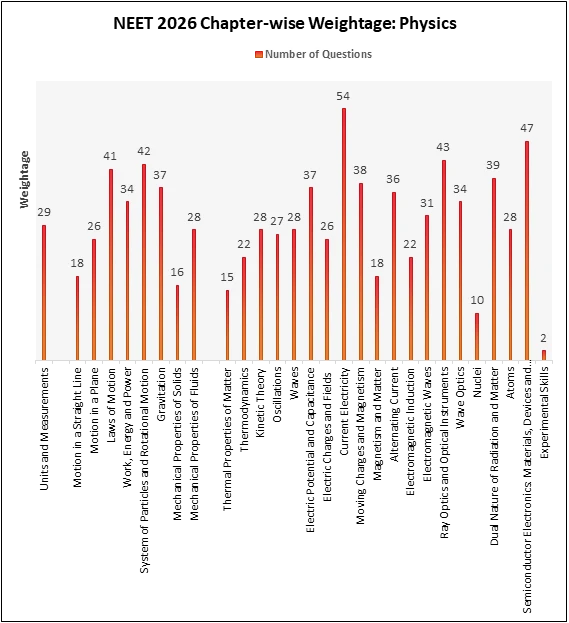
NEET (UG) Chapter-wise Weightage 2026: Physics
NEET (UG) Chapter-wise Weightage 2026 for Chemistry
From the analysis of the NEET (UG) Chemistry Chapter-wise Weightage for 2026, it’s evident that important topics include Chemical Bonding, Equilibrium, Hydrocarbons, Aldehydes, Ketones, and Carboxylic Acids.
| Unit | Number of Questions |
| Some Basic Concepts of Chemistry | 23 |
| Structure of Atom | 30 |
| Classification of Elements and Periodicity in Properties | 18 |
| Chemical Bonding and Molecular Structure | 45 |
| Thermodynamics | 32 |
| Equilibrium | 54 |
| Redox Reactions | 13 |
| The p-Block Elements (group 13 and 14) | 14 |
| Electrochemistry | 39 |
| Organic Chemistry– Some Basic Principles and Techniques | 42 |
| Hydrocarbons | 51 |
| Haloalkanes and Haloarenes | 29 |
| Solutions | 38 |
| Chemical Kinetics | 39 |
| Principles Related to Practical Chemistry | 9 |
| Alcohols, Phenols and Ethers | 39 |
| Aldehydes, Ketones and Carboxylic Acids | 43 |
| Biomolecules | 26 |
| Coordination Compounds | 48 |
| d and f-Block Elements | 42 |
| p-Block Elements (Group 15 to 18) | 16 |
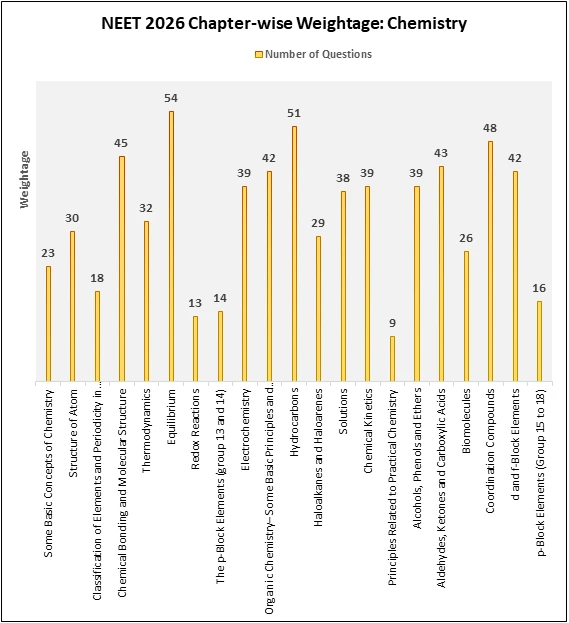
NEET (UG) Chapter-wise Weightage 2026: Chemistry
NEET (UG) Chapter-wise Weightage 2026 for Biology
NEET (UG) Biology is divided into Botany and Zoology, with 100 questions totaling 360 marks. The vast syllabus makes it crucial to focus on the high-weightage topics.
| Unit | Number of Questions |
| The Living World | 11 |
| Biological Classification | 48 |
| Plant Kingdom | 56 |
| Animal Kingdom | 65 |
| Morphology of Flowering Plants | 62 |
| Anatomy of Flowering Plants | 50 |
| Structural Organisation in Animals | 53 |
| Cell: The Unit of Life | 75 |
| Biomolecules | 61 |
| Cell Cycle and Cell Division | 61 |
| Photosynthesis in Higher Plants | 40 |
| Respiration in Plants | 26 |
| Plant Growth and Development | 38 |
| Breathing and Exchange of Gases | 32 |
| Body Fluids and Circulation | 43 |
| Excretory Products and Their Elimination | 28 |
| Locomotion and Movement | 36 |
| Neural Control and Coordination | 16 |
| Chemical Coordination and Integration | 50 |
| Sexual Reproduction in Flowering Plants | 76 |
| Human Reproduction | 61 |
| Reproductive Health | 47 |
| Principles of Inheritance and Variation | 91 |
| Molecular Basis of Inheritance | 109 |
| Evolution | 57 |
| Human Health and Diseases | 54 |
| Microbes in Human Welfare | 35 |
| Biotechnology: Principles and Processes | 79 |
| Biotechnology and its Applications | 54 |
| Organisms and Populations | 50 |
| Ecosystem | 33 |
| Biodiversity and Conservation | 49 |
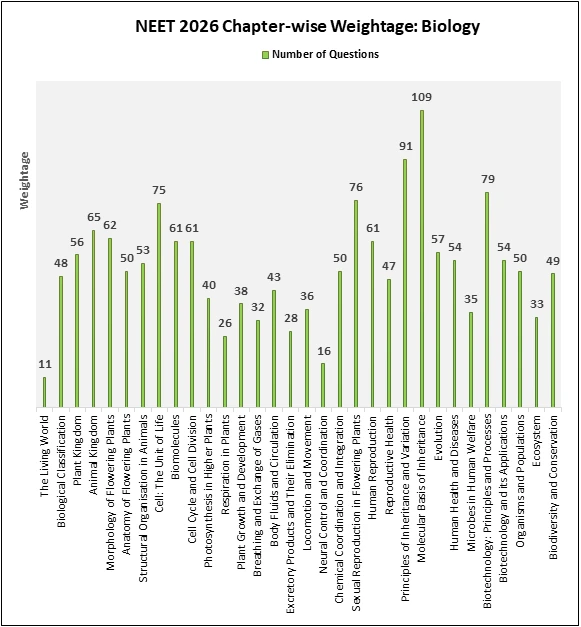
NEET (UG) Chapter-wise Weightage 2026: Biology
Key Chapters for NEET (UG) 2026: A Summary
Though you should aim to study all topics in the NEET (UG) syllabus, beginning with high-weightage chapters will give you a strong foundation for a streamlined study approach. Here are the most important chapters for each subject.
Most Important Chapters for NEET (UG) Physics 2026:
- Magnetism and Matter
- Atoms
- Laws of Motion
- Electric Charges, Fields, and Potential
- Electromagnetic Induction and Alternating Current
- Ray Optics and Optical Instruments
- Current Electricity
- Semiconductor Electronics: Materials, Devices, and Simple Circuits
- Electrostatics: Capacitance
Most Important Chapters for NEET (UG) 2026 Chemistry:
- Hydrocarbons
- Organic Chemistry: Some basic Principles and techniques
- Chemical Bonding and Molecular Structure
- Aldehydes, Ketones, and Carboxylic Acids
- Hydrocarbons
- Electrochemistry
- Equilibrium
- d-Block and f-Block Elements
Important Chapters for NEET (UG) 2026 Biology:
Botany:
- Plant Kingdom
- Animal Kingdom
- Morphology of Flowering Plants
- Cell Cycle and Cell Division
- Molecular Basis of Inheritance
- Principles of Inheritance and Variation
Zoology:
- Structural Organisation in Animals (Animal Tissues)
- Biomolecules
- Reproductive Health
- Biotechnology: Principles and Processes
- Biotechnology and its Applications
- Animal Kingdom
NEET (UG) Exam 2025 Question Paper Analysis
The NEET (UG) 2025 exam had a blend of difficulty levels across various subjects. [Text Wrapping Break]Physics, Chemistry, Botany, and Zoology included a mix of easy, moderate, and challenging questions.
Physics:
The difficulty level of NEET (UG) 2025 Physics was moderate. The Physics section of NEET 2025 proved to be the most challenging. It included 45 questions, with a strong focus on numerical problems from topics such as Optics, Modern Physics, and Electrostatics from the Class 12 syllabus, as well as Gravitation and Mechanics from Class 11.
Chemistry:
The Chemistry section of NEET 2025 had a difficulty level ranging from moderate to tough. This section was primarily made up of NCERT-based questions, with 45 questions in total, many of which were theoretical in nature. Organic Chemistry and Physical Chemistry carried more weightage, while Inorganic Chemistry had less weightage.
Biology:
The Biology section of NEET 2025 was moderate to difficult. Additionally, some questions included diagrams from the NCERT textbook. A notable portion of the questions focused on topics related to Genetics and Biotechnology.
How to Incorporate NEET (UG) Chapter-wise Weightage 2026 into Your Study Plan
- Start with the Syllabus: Familiarise yourself with the NEET (UG) 2026 syllabus, so you can use the Chapter-wise Weightage effectively.
- Make a Plan: Prioritise high-weightage chapters but also make time for the lower-weightage ones. Use the right NEET (UG) study material to help you prepare well.
- Time Management: Set a schedule with more time for high-weightage topics and ensure regular revision by attempting NEET (UG) mock tests.
- Revision: Focus your revision around high-weightage topics.
- Seek Guidance: For difficult topics, don’t hesitate to ask teachers or peers for clarification.
In conclusion, understanding the NEET (UG) Chapter-wise Weightage for 2026 will help you strategise your NEET (UG) study plan effectively. By concentrating on high-priority chapters and practising NCERT-based questions, you can maximise your potential for success in NEET (UG) 2026.