

The Cabinet Committee on Economic Affairs (CCEA), chaired by the Honourable Prime Minister Shri Narendra Modi, has recently approved the opening of 57 new Kendriya Vidyalayas (KVs) under the civil sector across India. This strategic move aims to cater to the educational needs of Central Government employees and expand quality schooling in under-served regions all over India.
Let us understand about the key details regarding the establishment of these 57 new Kendriya Vidyalayas.
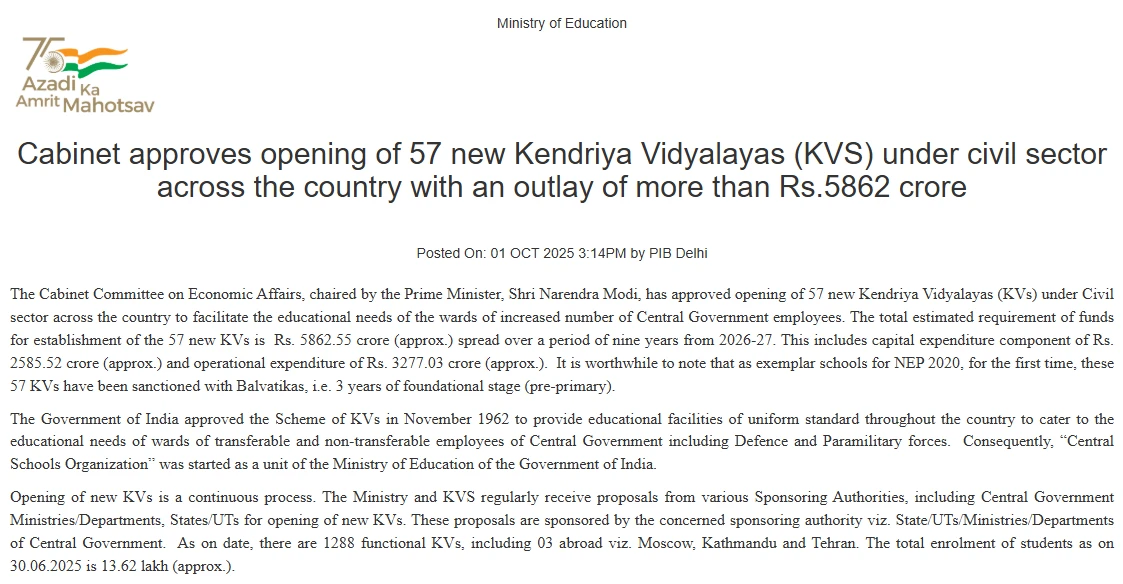
Cabinet approves 57 new Kendriya Vidyalayas
History of Kendriya Vidyalayas in India
The Government of India first approved the Scheme of Kendriya Vidyalayas in November 1962 with the objective to provide uniform educational facilities throughout the country. This move aims to meet the education needs of Central Government employees, including those in Defence and Paramilitary forces, both transferable and non-transferable.
Consequently, the Central Schools Organisation was established as part of the Ministry of Education, ensuring that every child of a Central Government employee had access to a standardised education system.
Existing Kendriya Vidyalayas and Estimation for the New KVs in India
The opening of new KVs is an ongoing process. The Central and State Governments are the sponsoring authorities with the support of other various departments and ministries.
Currently, there are 1288 functional Kendriya Vidayalays in India, including 3 international schools in Moscow, Kathmandu, and Tehran. The total enrollment as of 30 June, 2025 is approximately 13.62 lakh students.
The total estimated expenditure for establishing these schools is approximately Rs. 5862.55 crore spread over 9 years, beginning from 2026–27. Of this, Rs. 2585.52 crore is allocated for capital expenditure and Rs. 3277.03 crore for operational expenditure.
Notably, for the first time, 57 KVs have been sanctioned with Balvatikas (foundational stage pre-primary classes) as per the National Education Policy (NEP) 2020.
Expansion and Importance of the New Kendriya Vidayalays Across India
The latest proposal ensures a balanced pan-India expansion with 7 KVs sponsored by the Ministry of Home Affairs and 50 by the State/Union Territories authorities.
Among the total 57 KVs, 20 are proposed in districts without existing KVs, addressing significant gaps for Central Government employees’ children.
Furthermore, 14 KVs are planned in Aspirational districts, 4 in Left-Wing Extremism (LWE) affected districts, and 5 in North-Eastern Region/Hilly regions.
The establishment of new KVs ensures to reach even the remotest and strategically important regions through:
- Growth in the Eastern region
- Balanced representation across North, South, East, and West India
- Strengthening the inclusivity and national integration
Employment Opportunities with the Establishment of 57 New KVs
- Each Kendriya Vidyalaya caters to approximately 1,520 students, benefiting a total of 86,640 students.
- A Kendriya Vidyalaya from Balvatika to Std. 12 will provide employment to 81 people per school. With the approval of 57 KVs, approximately 4,617 direct permanent employment opportunities will be generated across India.
- Construction and allied activities associated with enhanced facilities in all KVs are expected to create employment opportunities for both skilled and unskilled workers.
Conclusion
The expansion of KVs is a step towards quality education in every corner of India. Parents and students can expect smoother access from Balvatika to standard 12 schooling, while teachers can anticipate enhanced employment and professional growth opportunities.
Source
Press Release by Press Information Bureau, India, 01 October, 2025, click here to read.
Kindly note that any and all information is subject to change as per the Press Information Bureau, Ministry of Education, and Government of India.