
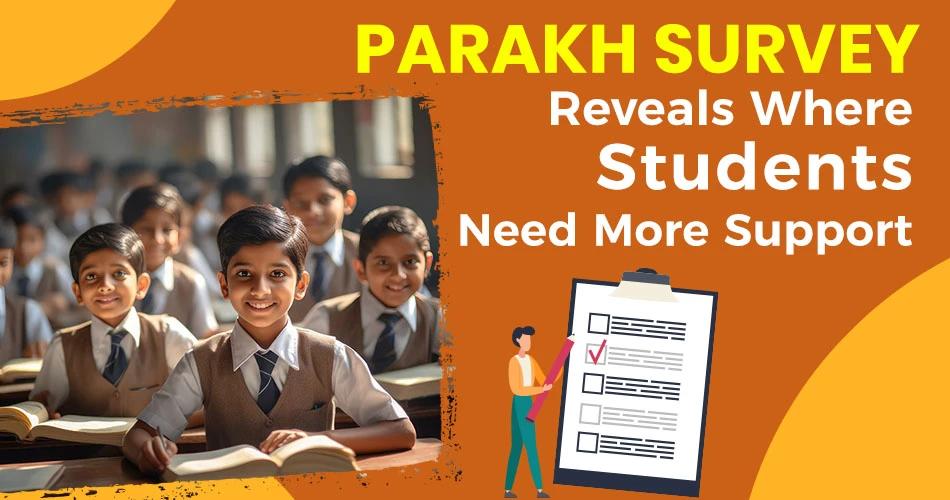
When it comes to learning, the early years matter the most. And according to the latest government survey, there's still a long way to go in ensuring strong foundational skills among school students across the country.
Understanding PARAKH: India’s National Survey on Student Learning
PARAKH (Performance Assessment, Review and Analysis of Knowledge for Holistic Development) was formerly known as the National Achievement Survey (NAS).
It is a government-led survey which sheds light on how well students across India are grasping foundational skills in subjects like Language, Mathematics, Science, and Social Science.
Conducted in December 2024, the assessment covered over 21 lakh students from Grades 3, 6, and 9, across 700+ districts, including government, aided, and private schools.
Let’s take a look at the insights this survey provided.
Understanding the Basics is Still a Challenge
Across all grades, many students struggled with fundamental concepts. Here we will understand the subject-wise performance of students across different classes:
-
Mathematics:
Basic tasks like identifying simple patterns, understanding fractions, or applying operations such as addition and subtraction were difficult for over half the students surveyed.
54% of Class 6 students were unable to read or work with large numbers, fractions, or basic math operations. In Class 3, 60% of students showed math proficiency.
This dropped to 46% in Class 6 and further down to 37% in Class 9.
Girls scored better than boys in Class 3 and 6, while Class 9 scores were almost even.
-
Language:
43% of Class 9 students were unable to apply reading skills to draw inferences or understand ideas in texts.
In Class 3, 65% of students could meet language competency benchmarks. This dropped to 57% in Class 6, and 54% in Class 9, indicating a decline as students progress.
Girls outperformed boys across all grades in language ability.
What About Science and Social Studies?
-
Science:
Class 6 and 9 students were assessed on their ability to explain real-world scientific and social concepts. While most could recall facts, many found it hard to connect or interpret data from maps, charts, and visuals.
About 51% of Class 3 students could answer questions in the ‘World Around Us’ (Science for Grade 3) section, which tested real-life science knowledge.
The ability to describe physical properties, interpret subtractions or understand natural phenomena like soil formation was limited.
In Grade 6 Science, 57% students met expected competency levels; it fell to 56% in Grade 9.
-
Social Science:
For Grade 6, 55% of students performed satisfactorily.
In Grade 9, around 39% met the benchmark, indicating difficulty in drawing conclusions from texts and interpreting visuals or maps.
What Can We Take Away from the PARAKH Survey?
These results are about highlighting where support is needed. Learning gaps like these, if caught early, can be addressed through focused teaching strategies, better teacher training, engaging learning resources, and community support.
As India moves ahead with the National Education Policy (NEP) 2020, data like this serves as a helpful mirror.
It helps us ask: ‘how can we support our children better in the classroom and at home?’ ‘How can we make learning not just accessible—but meaningful?’
Because building strong foundations today can change futures tomorrow.
Let us know what you think about the outcome of this survey in the comments below!
Source
Official PARAKH report by Ministry of Education, click here to read.
Kindly note that any and all information is subject to change as per the Ministry of Education and Government of India.