
For anyone who has dreamt of becoming a doctor in India, a medical entrance exam has always been the deciding point. Until a few years ago, aspirants prepared for the All India Pre-Medical Test (AIPMT). The exam now, has been replaced by the National Eligibility cum Entrance Test (NEET) conducted by the National Testing Agency (NTA). But why the shift from AIPMT to NEET?
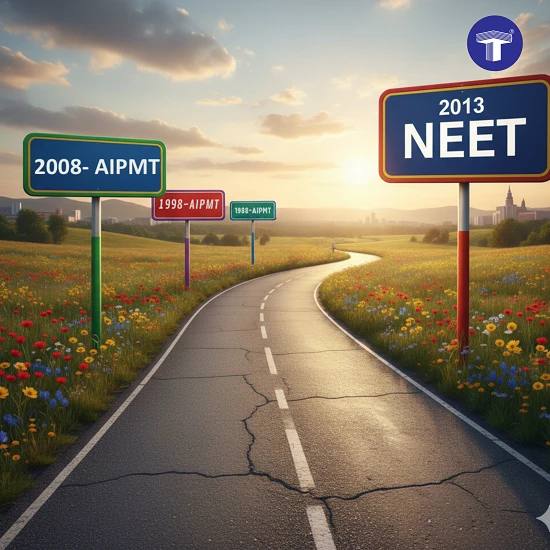
Tracing the journey from AIPMT to NEET
Let’s understand why the change happened, how are the two exams different from one another, and how did the change impact the colleges and aspiring doctors.
What is AIPMT?
The All India Pre-Medical Test (AIPMT) was conducted by the Central Board of Secondary Education (CBSE) from 1988 until 2013. This exam was the pathway for students to get admitted into undergraduate MBBS and BDS courses in medical and dental colleges across India.
Eligibility, Paper Pattern, and Admission Process through AIPMT Exam
Eligibility
As mentioned earlier, the AIPMT was conducted by CBSE and students of standard 12 with subject combination of Physics, Chemistry, and Biology were eligible to take the AIMPT examination.
Syllabus and Paper Pattern
The exam was wholly based on Class 11 and 12 NCERT syllabus of Physics, Chemistry, and Biology. The exam consisted of a total of 180 multiple-choice questions, with 4 marks awarded for each correct answer and 1 mark deducted for each incorrect answer. The total marks for AIPMT were 720. The total duration of examination was 180 minutes, that is, 3 hours. There were 45 questions for both for Physics and Chemistry, and 90 questions for Biology.
Admission Process
A total of 15% of seats in MBBS and BDS government colleges across India fell under the category of All India Quota (AIQ). This meant that students from any state can apply for these seats, irrespective of their domicile. This was executed through a centralised counseling process conducted by the Medical Counselling Committee (MCC).
The remaining seats (85%) are filled through the state-level exams, based on the state merit lists.
Why was AIMPT Replaced with NEET?
Before the introduction of NEET, students had to compete for multiple state-level medical entrance examinations. This led to financial and mental stress on students as well as the executing bodies. Lack of transparency and consistent difficulty across states led to unfair results.
To streamline the entire process of examination, the Medical Council of India (MCI) and the Government of India introduced NEET in 2013. This resulted into a single medical entrance exam for students all over India.
Now, let us take a look at what the NEET exam is like and how does it stand different from the AIPMT exam.
Eligibility, Paper Pattern, and Admission Process through NEET Exam
Eligibility
The NEET exam is conducted by NTA and is now the only entrance exam for MBBS, BDS, AYUSH, and other undergraduate medical courses in India. Students of standard 12 with subject combination of Physics, Chemistry, and Biology were eligible to take the NEET examination.
Syllabus and Paper Pattern
The exam is completely based on Class 11 and 12 NCERT syllabus of Physics, Chemistry, and Biology. Indian Nationals, Foreign Nationals, NRI, PIO, and OCI , and students of standard 12 with subject combination of Physics, Chemistry, and Biology are eligible to take the NEET exam. The exam consists of a total of 180 multiple-choice questions, with 4 marks awarded for each correct answer and 1 mark deducted for each incorrect answer. This brings the total marks to 720. The total duration of examination was 180 minutes, that is, 3 hours. There were 45 questions for both for Physics and Chemistry, and 90 questions for Biology. The mode of examination is offline.
Note: In 2025, the paper pattern for NEET (UG) exam reverted to pre-COVID format.
Important topics for NEET examination that every student must cover:
- Physics: Mechanics, Thermodynamics, Electrodynamics, and Modern Physics
- Chemistry: Organic, Inorganic, and Physical Chemistry concepts
- Biology: Diversity of Living Organisms, Genetics, Ecology, Human Physiology, and Biotechnology
Need a detailed list of important topics for each subject? We have already covered that for you!
Click to view the chapter-wise weightage for Physics, Chemistry, and Biology.
Admission Process
A total of 15% of seats in MBBS and BDS government colleges across India are filled by the Medical Counselling Committee (MCC) under the All India Quota. The remaining 85% of seats are filled through the state counselling authorities.
under the category of All India Quota (AIQ). This meant that students from any state can apply for these seats, irrespective of their domicile.
This was executed through a centralised counselling process conducted by the Medical Counselling Committee (MCC). Now, you can get into the college of your dreams through a single exam. Want to know about the top colleges accepting NEET scores? Click here for a simplified breakdown.
The remaining seats (85%) are filled through the state-level exams, based on the state merit lists. Admissions to deemed universities, private medical and dental colleges, and central institutions also take place through NEET scores.
The counselling takes place through multiple rounds and some vacancy rounds.
How Is NEET Different from AIPMT?
| Particulars | AIPMT | NEET |
| Conducting Body | Central Board of Secondary Education (CBSE) | National Testing Agency (NTA) |
| Admission | 15% All India Quota + separate state/private exams | Single exam for all seats (AIQ + state + private) |
| Number of exams | Students had to take multiple exams | Students have to take a single exam |
| Transparency | Varied across states | Uniform nationwide |
Benefits due to Shift from AIMPT to NEET
- Students no longer need to prepare for multiple exams, reducing stress and time pressure.
- The NEET exam proves to be cost effective for both students and the executing bodies, saving travel costs and exam conducting expenditure.
- A single exam, ensures fairness providing equal opportunity to all students.
- A centralised counselling system reduces confusion simplifying the admission process and ensuring uniformity.
Conclusion
The shift from AIPMT to NEET marked a significant milestone in the history of medical entrance exams. While AIPMT served its purpose for decades, the introduction of NEET made the process more student-friendly, transparent, and efficient.
If you are a medical aspirant, and looking forward to NEET (UG) 2026, remember that NEET is not just an exam but an opportunity to showcase your hard work. And to crack this exam, you need the right study material with the right strategy and determination.
Still confused how to begin your preparation? Here is your NEET 2026 preparation roadmap.
Frequently Asked Questions (FAQs)
1. Why did the government replace AIPMT with NEET?
Ans: The AIPMT was replaced by NEET in 2013 in order to bring uniformity and transparency in the examination for students pursuing career in medical.
2. How did NEET benefit students compared to AIPMT?
Ans: NEET is a single exam conducted for admissions into medical and dental colleges across India. Students no longer need to prepare for multiple exams, reducing stress and time pressure.
3. What was the purpose of AIPMT before NEET was introduced?
Ans: NEET serves the same purpose as AIPMT, that is, to admit students qualifying the examination into medical and dental colleges across India.