

If you are preparing for NEET (UG) 2026, chances are Physics feels like both a challenge and an opportunity. Biology may dominate the paper, but Physics often becomes the deciding factor between a good score and a great score.
The very first doubt most aspirants face is this: ‘Where should I start?’
That’s where NEET physics chapterwise weightage comes in. Instead of spreading your time thin over so many chapters, knowing the importance of each chapter helps you focus where it truly matters. This isn’t about ignoring chapters, but about smart prioritisation. Something every NEET topper swears by.
In this blog, we’ll break down the chapter-wise weightage of Physics in NEET 2026, explain how you should use it, and give you practical strategies to make your preparation both efficient and effective.
NEET Physics Chapterwise Weightage Matters More Than You Think
Every NEET aspirant knows the physics chapterwise syllabus is vast. However, some topics repeatedly appear with higher frequency in NEET previous years’ papers, while others show up occasionally. For example, questions from Electromagnetic Induction and Alternating Current are far more common than those from, say, Electrostatics: Capacitance.
Understanding this pattern gives you three advantages:
- Smarter Time Management: You can prioritise your study hours while still covering every chapter.
- Confidence in Exam: Since the majority of questions come from NEET Physics high-weightage chapters, you’ll feel more familiarity and ease while attempting them.
- Well-Rounded Preparation: You ensure that crucial chapters get the right attention without neglecting the smaller but still valuable ones.
However, even with the NEET Physics chapterwise weightage, think of it like preparing for a cricket match: while you give extra practice to batting if the game hinges on it, you’d never skip fielding or bowling. Because every skill contributes to the team’s win.
NEET Physics Chapter-wise Weightage 2026
Based on analysis of over 13 previous year NEET papers (2013-2025) from our NEET Physics previous solved papers book, here’s how the NEET Physics chapterwise weightage generally looks like:
| Sr. No. | Std. 11 Topic Name | Total |
| 1 | Units and Measurements | 26 |
| 2 | Motion In a Straight Line | 22 |
| 3 | Motion In a Plane | 23 |
| 4 | Laws of Motion | 38 |
| 5 | Work, Energy and Power | 35 |
| 6 | System of Particles and Rotational Motion | 41 |
| 7 | Gravitation | 38 |
| 8 | Mechanical Properties of Solids | 13 |
| 9 | Mechanical Properties of Fluids | 27 |
| 10 | Thermal Properties of Matter | 14 |
| 11 | Thermodynamics | 22 |
| 12 | Kinetic Theory | 28 |
| 13 | Oscillations | 28 |
| 14 | Waves | 20 |
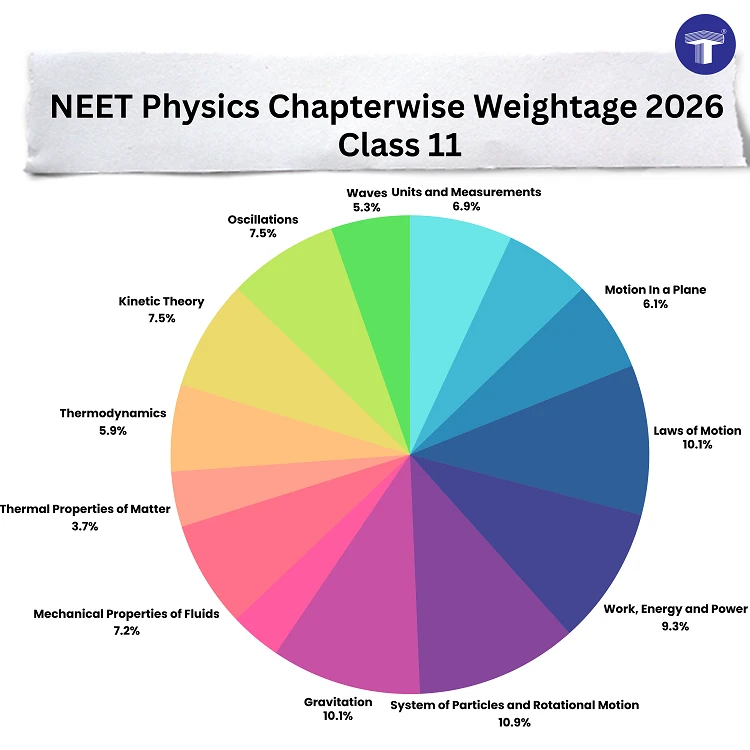
NEET Physics Chapterwise Weightage 2026 for Class 11
| Sr. No. | Std. 12 Topic Name | Total |
| 1 | Electric Charges and Fields | 21 |
| 2 | Electrostatic Potential and Capacitance | 42 |
| 3 | Current Electricity | 54 |
| 4 | Moving Charges and Magnetism | 38 |
| 5 | Magnetism and Matter | 18 |
| 6 | Electromagnetic Induction | 20 |
| 7 | Alternating Current | 36 |
| 8 | Electromagnetic Waves | 28 |
| 9 | Ray Optics and Optical Instruments | 45 |
| 10 | Wave Optics | 33 |
| 11 | Dual Nature of Radiation and Matter | 39 |
| 12 | Atoms | 26 |
| 13 | Nuclei | 10 |
| 14 | Semiconductor Electronics: Materials, Devices and Simple Circuits | 46 |
| 15 | Experimental Skills | 11 |
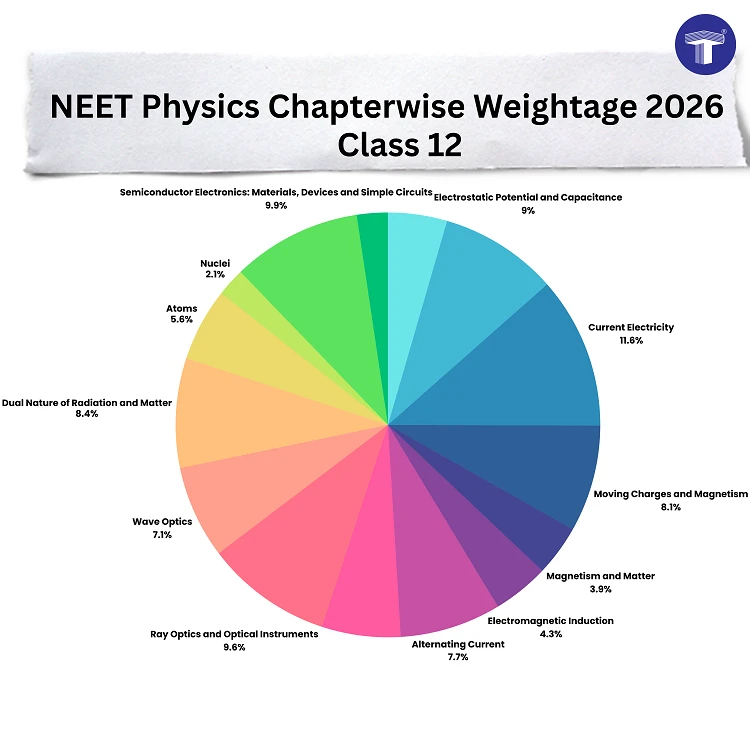
NEET Physics Chapterwise Weightage 2026 for Class 12
Knowing which chapters are important is step one. Step two? Practising them till you’re perfect. That’s exactly what our NEET Physics previous solved papers book gives you i.e. NEET Physics weightage and chapter-wise MCQs in one place.
How to Use This Physics 2026 Chapter-wise Weightage in Your NEET Preparation
Now that you know the distribution, the real question is: How do you study smarter using it?
Looking at this chapter-wise weightage from the past 13 years, here’s what stands out and how you should approach it for NEET 2026:
Std. XI Physics (Class 11)
1. Highest Weightage Chapters
- System of Particles and Rotational Motion (41)
- Laws of Motion (38)
- Gravitation (38)
- Work, Energy and Power (35)
These 4 chapters alone account for a bulk of XI’s scoring potential. They’re heavily concept-based, and you’ll get both direct formula questions and tricky conceptual numericals.
2. Moderate Weightage Chapters (20–30)
- Motion in a Plane (23)
- Thermodynamics (22)
- Kinetic Theory (28)
- Oscillations (28)
- Mechanical Properties of Fluids (27)
These are your mid-tier important chapters. Easy-to-moderate difficulty, but highly consistent.
3. Low Weightage but Must-Attempt Chapters (<20)
- Units and Measurements (26—not ‘low’ but usually 1–2 Questions)
- Waves (20)
- Mechanical Properties of Solids (13)
- Thermal Properties of Matter (14)
These chapters mainly account for approximately 2 questions but skipping them is dangerous. Why? Because chapters like Units and Measurements form the foundation of Physics. Units and Measurements underpins accuracy and error analysis across the subject, while Waves connects directly with Oscillations, Sound, and even parts of Modern Physics in NEET. Ignoring them creates gaps that show up in multiple areas.
Also, remember: NEET toppers never skip chapters. Especially if you’re aiming for elite top institutes like AIIMS, where seats are extremely limited, every single mark carries weight. In such high-stakes competition, even the so-called ‘smaller’ chapters can become the difference between securing a seat and falling short.
Std. XII Physics (Class 12)
1. High-Weight Chapters
- Current Electricity (54)
- Semiconductors (46)
- Ray Optics and Optical Instruments (45)
- Electrostatics (42)
Current Electricity is one of the NEET physics high weightage chapters. One chapter accounts for 3–4 questions almost every year.
These four form the core of XII strategy. Master them and you’re securing a large chunk of Physics marks.
2. Moderate but Consistent Weightage Chapters (30–40)
- Moving Charges and Magnetism (38)
- Dual Nature of Radiation and Matter (39)
- Alternating Current (36)
- Wave Optics (33)
These chapters are PYQ-driven. Trends show 2–3 questions each year.
3. Low-Weight Chapters (10–20)
- Nuclei (10)
- Experimental Skills (11)
- Magnetism and Matter (18)
- EM Induction (20)
- EM Waves (28)
Here’s how you should structure your preparation based on weightage trends:
Weightage tells you where to start, but revision keeps it all fresh. Build weekly NEET study schedules that cycle through high and medium weightage Physics chapters first, with quick reviews of low-weight chapters.
Final Thoughts
Every NEET aspirant has moments of doubt, ‘Am I studying the right way? Am I wasting time on the wrong topics?’ Understanding NEET Physics weightage removes that uncertainty.
This clarity doesn’t just save time; it reduces anxiety. And when anxiety goes down, focus and confidence rise. Chapterwise weightage of physics in NEET gives you a clear NEET preparation roadmap—one that balances effort with return.
So, as you begin or refine your NEET 2026 preparation, remember this:
High-weightage chapters for NEET 2026 Physics are your core. Master them first.
Medium-weightage chapters are your boosters. Study them with care.
Low-weightage chapters for NEET Physics are your safety nets. Don’t neglect them entirely.
Preparation isn’t just about how many hours you study; it’s about where you put those hours. With this weightage guide, you have a smarter way forward.