


For most NEET (UG) aspirants, Biology is more than just another subject—it’s the deciding factor. With 90 questions carrying 360 marks, Biology alone makes up half of the exam. That means your performance here can single-handedly push your rank up or pull it down.
But here’s the dilemma: Biology isn’t like Physics or Chemistry, where formulas and problem-solving dominate. It feels like an endless ocean of NCERT chapters, diagrams, and factual details. Some students look at it as the scoring lifeline, while others get overwhelmed by its sheer volume.
So how do you approach it? Do you try to memorise everything line by line? Or do you take a smarter route? This is where NEET Biology chapterwise weightage comes in.
Understanding which Biology chapters have the maximum weight in NEET helps you build a strategy that balances effort with impact. It doesn’t mean ignoring smaller chapters, but it ensures you don’t spend equal time on topics that don’t carry equal importance.
NEET Biology Chapterwise Weightage Advantages
If you’ve ever felt lost flipping through NCERT Biology, chapter wise weightage is the map that brings direction. It helps in achieving the following outcomes:
- Determining what to study first and most.
- Attempting the exam with a sense of familiarity and control.
- Securing marks from both big and small chapters without burning out.
By referring to NEET Biology high weightage chapters, you focus your time where it matters most, while still revising Biology important chapters for NEET 2026 for overall coverage.
NEET Biology Chapterwise Weightage 2026
When it comes to NEET preparation, guesswork has no place—strategy does. One of the smartest ways to build that strategy is by studying how questions have been distributed across chapters in previous years. The table below brings together 13 years of NEET Biology chapterwise distribution for Class 11 chapters, showing you exactly how often each topic has been tested.
| Sr. No. | Std. 11 Topic Name | Total |
| 1 | The Living World | 11 |
| 2 | Biological Classification | 48 |
| 3 | Plant Kingdom | 56 |
| 4 | Animal Kingdom | 65 |
| 5 | Morphology of Flowering Plants | 62 |
| 6 | Anatomy of Flowering Plants | 50 |
| 7 | Structural Organisation in Animals | 53 |
| 8 | Cell: The Unit of Life | 75 |
| 9 | Biomolecules | 61 |
| 10 | Cell Cycle and Cell Division | 61 |
| 11 | Photosynthesis in Higher Plants | 40 |
| 12 | Respiration in Plants | 26 |
| 13 | Plant Growth and Development | 38 |
| 14 | Breathing and Exchange of Gases | 32 |
| 15 | Body Fluids and Circulation | 43 |
| 16 | Excretory Products and Their Elimination | 28 |
| 17 | Locomotion and Movement | 36 |
| 18 | Neural Control and Coordination | 16 |
| 19 | Chemical Coordination and Integration | 50 |
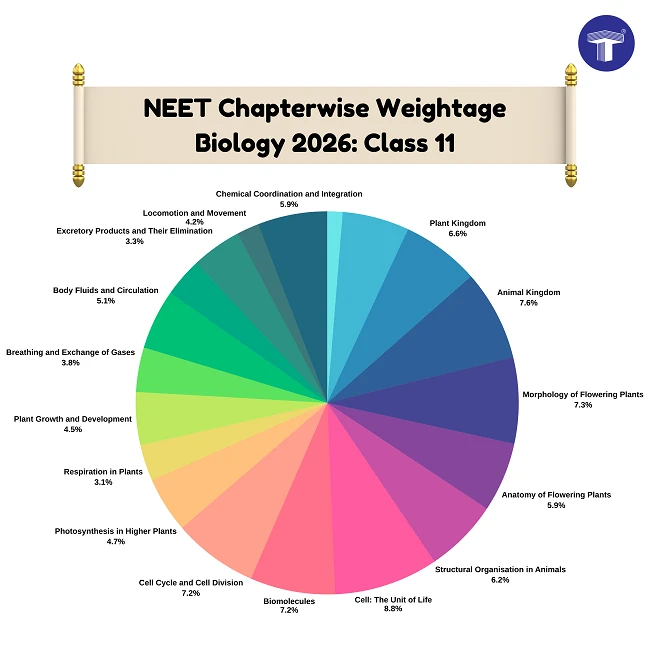
NEET Biology 2026 Chapter-wise Weightage Class 11
| Sr. No. | Std. 12 Topic Name | Total |
| 1 | Sexual Reproduction in Flowering Plants | 76 |
| 2 | Human Reproduction | 61 |
| 3 | Reproductive Health | 47 |
| 4 | Principles of Inheritance and Variation | 91 |
| 5 | Molecular Basis of Inheritance | 109 |
| 6 | Evolution | 57 |
| 7 | Human Health and Diseases | 54 |
| 8 | Microbes in Human Welfare | 35 |
| 9 | Biotechnology Principles and Processes | 79 |
| 10 | Biotechnology and its Application | 54 |
| 11 | Organisms and Populations | 50 |
| 12 | Ecosystem | 33 |
| 13 | Biodiversity and Conservation | 49 |
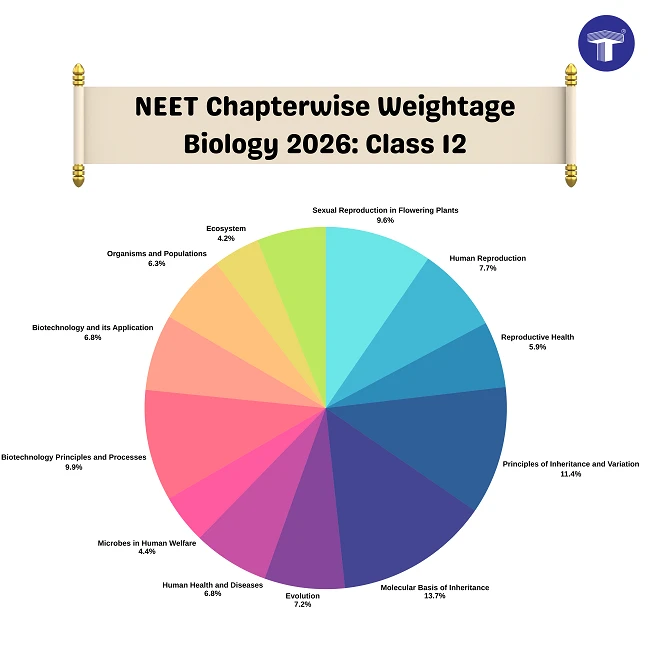
NEET Biology 2026 Chapter-wise Weightage Class 12
Why is this important? Because past data offers more than just numbers. It highlights patterns. Chapters like Cell: The Unit of Life and Animal Kingdom consistently are chapters containing the most weightage for NEET Biology, while others such as Neural Control and Coordination appear less frequently. By understanding these trends, you can decide where to devote maximum effort and where a lighter touch will do.
Knowing the NEET Biology chapter list 2026 helps you prioritise high-yield topics without ignoring smaller chapters that often include easy one-mark questions.
Weightage tells you where to begin, but practice determines where you’ll end up. With our 13 Years NEET Biology Previous Solved Papers, complete with chapter-wise questions and solutions, you get the perfect resource to strengthen your preparation.
Here’s how the trends usually break down between Class 11 and Class 12 based on analysis of past NEET papers:
NEET Biology Chapterwise Weightage Analysis
When it comes to Biology, NCERT is your ultimate guide but not every chapter carries the same importance in the exam. Based on the analysis of previous years’ NEET papers, here’s how the chapter-wise weightage usually splits between Class 11 and Class 12.
Class 11 Biology
Class 11 lays the foundation for your NEET Biology preparation. Many of the concepts you learn here connect directly to Class 12 topics, making them doubly important.
High-Weightage Chapters
- Cell: The Unit of Life
- Biomolecules
- Cell Cycle and Cell Division
- Animal Kingdom
- Morphology of Flowering Plants
Medium-Weightage Chapters
- Plant Kingdom
- Chemical Coordination and Integration
- Structural Organisation in Animals and Plants
- Biomolecules
- Anatomy of Flowering Plants
Low-Weightage Chapters
- The Living World
- Respiration in Plants
- Neural Control and Coordination
Class 12 Biology
Compared to Class 11, Class 12 Biology contributes a larger portion of questions in NEET. Most high-weightage topics here are fact-heavy, making them scoring if you revise consistently.
High-Weightage Chapters
- Molecular Basis of Inheritance
- Principles of Inheritance and Variation
- Sexual Reproduction in Flowering Plants
- Biotechnology Principles and Processes
Medium-Weightage Chapters
- Human Reproduction
- Evolution
- Human Health and Diseases
- Biotechnology and its Application
Low-Weightage Chapters
- Ecosystem
- Microbes in Human Welfare
- Biodiversity and Conservation
Based on past NEET trends, Class 11 Biology builds the foundation with chapters like Cell: The Unit of Life, Biomolecules, and Cell Cycle and Cell Division carrying high weight.
While topics such as The Living World and Neural Control and Coordination appear less frequently. Class 12 contributes a larger share of questions, with high-weightage chapters in NEET Biology including Molecular Basis of Inheritance, Principles of Inheritance and Variation, and Sexual Reproduction in Flowering Plants.
Medium-weight chapters like Human Reproduction and Evolution support steady scoring, while low-weightage topics such as Ecosystem and Microbes in Human Welfare are useful for quick revisions and bonus marks.
To Sum it Up
Preparing for NEET isn’t about drowning in endless facts; it’s about knowing where to place your energy. The chapterwise weightage gives you a clear lens, showing which Biology topics can tip the scales in your favour and which ones simply need a quick polish. Class 11 builds your base, Class 12 sharpens your edge, and together they make Biology the deciding subject in your NEET score.
Approach it with balance, revisiting NEET Biology high-weightage chapters, strengthening mid-level ones, and keeping the smaller ones in your back pocket. You’ll move from anxious guesswork to confident preparation.
Remember, NEET isn’t cleared by random effort; it’s cleared by effort channelled in the right direction. With this chapterwise weightage in hand, you’re not just studying Biology, you’re strategising for success.
Frequently Asked Questions (FAQs)
1. How many questions are usually asked from Class 11 Biology in NEET?
Ans: On average, about 45% of Biology questions come from the Class 11 syllabus, making it equally important as Class 12 based on the analysis of NEET Biology chapterwise weightage.
2. Is Class 12 Biology more important than Class 11 for NEET preparation?
Ans: Yes, Class 12 contributes slightly more and includes most weightage chapters for NEET Biology, which often carry higher marks.
3. Can I crack NEET if I focus only on high-weightage Biology chapters?
Ans: Not really. NEET Biology high-weightage chapters boost scores, but low-weightage ones often carry marks that can make a big difference in ranks.
4. How should I divide my study time between Botany and Zoology for NEET?
Ans: Maintain a balanced split between Botany and Zoology while following the NEET Biology chapter list 2026 to ensure full syllabus coverage.
5. What percentage of NEET Biology questions come directly from NCERT?
Ans: Around 85–90% of Biology questions are NCERT-based, making NCERT your primary resource.
6. Where can I check the NEET Biology marks distribution for each chapter?
Ans: Refer to the NEET Biology chapterwise marks distribution above to prioritise high-scoring chapters and plan your revision effectively.
7. Which Biology chapters are considered the most important for NEET 2026?
Ans: Focus on the Biology most important chapters for NEET 2026, as these consistently appear in previous years’ papers and carry significant marks.