

Hey there, NEET aspirant! Are you ready to crack the Chemistry section for NEET 2025? Whether you find Chemistry interesting or tricky, understanding the Chemistry Chapterwise Weightage for NEET 2025 can be a major catalyst for you.
NEET (UG) Exam 2025 Overview
The National Eligibility cum Entrance Test (NEET) is one of the most competitive exams organised by the National Testing Agency (NTA) for aspiring medical students in India.
Before we explore the NEET Chemistry Chapterwise Weightage 2025, you can refer to the NEET-UG 2025 Syllabus.
NEET (UG) 2025 Chapterwise Weightage for Chemistry
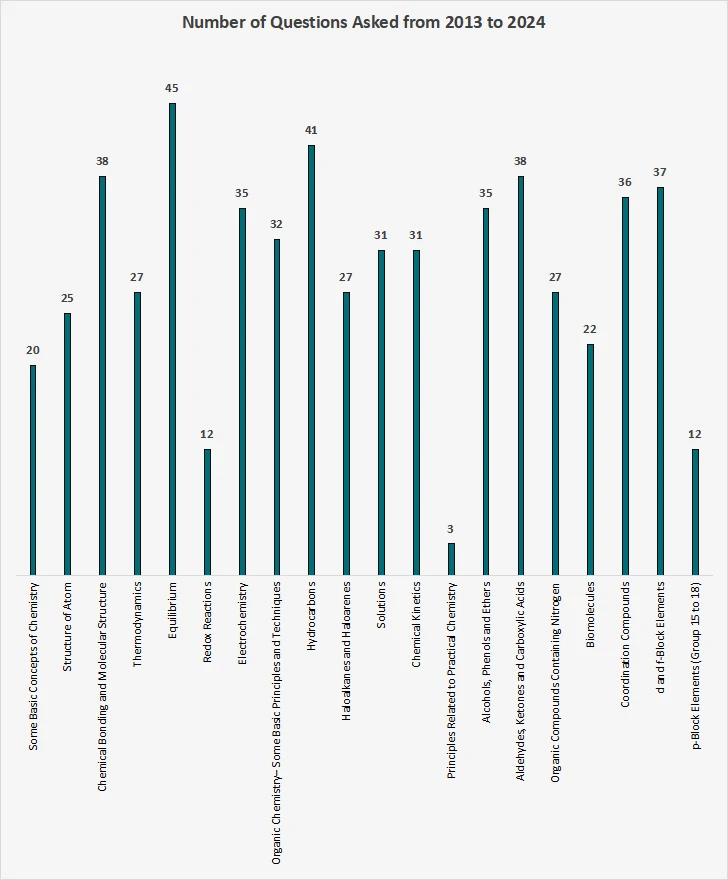
Chemistry accounts for 45 out of the 180 questions in the NEET 2025 Exam. As you run through the following NEET Chemistry Chapterwise Weightage 2025, you will notice that Equilibrium, Chemical Bonding and Molecular Structure, Hydrocarbons, Aldehydes, Ketones and Carboxylic Acids are key topics to focus on.
| Unit | Number of Questions | NEET Chemistry Chapterwise Weightage |
| Some Basic Concepts of Chemistry | 20 | 3.33% |
| Structure of Atom | 25 | 4.17% |
| Chemical Bonding and Molecular Structure | 38 | 6.33% |
| Thermodynamics | 27 | 4.5% |
| Equilibrium | 45 | 7.5% |
| Redox Reactions | 12 | 2% |
| Electrochemistry | 35 | 5.83% |
| Organic Chemistry: Some Basic Principles and Techniques | 32 | 5.33% |
| Hydrocarbons | 41 | 6.83% |
| Haloalkanes and Haloarenes | 27 | 4.5% |
| Solutions | 31 | 5.17% |
| Chemical Kinetics | 31 | 5.17% |
| Principles Related to Practical Chemistry | 3 | 0.5% |
| Alcohols, Phenols and Ethers | 35 | 5.83% |
| Aldehydes, Ketones and Carboxylic Acids | 38 | 6.33% |
| Organic Compounds Containing Nitrogen | 27 | 4.5% |
| Biomolecules | 22 | 3.67% |
| Coordination Compounds | 36 | 6% |
| d and f-Block Elements | 37 | 6.17% |
| p-Block Elements (Group 15 to 18) | 12 | 2% |
You can take a look at the NEET 2024 Chemistry Paper Analysis to understand this years’ chapterwise weightage.
NEET 2025 Chemistry Important Topics
For the sake of simplifying preparation, NEET Chemistry can be divided into three major sections: Physical Chemistry, Organic Chemistry, and Inorganic Chemistry.
Below is a detailed breakdown of the Chapterwise Weightage for NEET Chemistry.
1. Physical Chemistry (35-40%)
Physical Chemistry Chapterwise Weightage for NEET encourages you to focus on conceptual clarity and numerical problem-solving. From our analysis, focusing on the following will fetch higher scores:
- Mole Concept and Stoichiometry
- States of Matter: Numerical problems on Gas Laws and Kinetic Theory
- Thermodynamics: Enthalpy, Entropy, and Gibbs Free Energy
- Equilibrium: Chemical and Ionic Equilibria with pH and Solubility
- Redox Reactions: Balancing Equations and Electrode Potentials
- Solutions: Colligative Properties and Concentration Terms
- Electrochemistry: Faraday's Laws, Nernst Equation, and Electrochemical Cells
- Chemical Kinetics: Rate Laws, Activation Energy, and Reaction Mechanisms
- Surface Chemistry: Absorption, Catalysis, and Colloids
2. Organic Chemistry (30-35%)
In Organic Chemistry Chapterwise Weightage for NEET, the main focus is on reaction mechanisms and functional group behavior. Hence, pay close attention to the following:
- Basic Principles and Techniques: IUPAC Nomenclature and Reaction Intermediates
- Hydrocarbons: Reactions and Properties of Alkanes, Alkenes, and Alkynes
- Haloalkanes and Haloarenes: Substitution and Elimination Reactions
- Alcohols, Phenols, and Ethers: Properties, Preparation, and Reactions
- Aldehydes, Ketones, and Carboxylic Acids: Nucleophilic Addition and Acid Derivatives
- Amines: Classification, Preparation, and Chemical Properties
- Biomolecules: Carbohydrates, Proteins, and Enzymes
- Polymers: Polymerisation and Types of Polymers
- Chemistry in Everyday Life: Drugs, Detergents, and Biomolecules
3. Inorganic Chemistry (25-30%)
The NEET Inorganic Chemistry Chapterwise Weightage, questions are focused on factual recall and periodic trends.
- Periodic Table and Periodicity: Atomic Radii, Electronegativity, and Ionisation Energy
- Chemical Bonding: High-weightage chapter with questions on Hybridisation, VSEPR Theory, and Molecular Orbital Theory
- Coordination Compounds: Nomenclature, Isomerism, and Crystal Field Theory
- Block Elements (s, p, d, f): Properties, Trends, and Uses of Elements
- Hydrogen: Hydrides, Properties, and Uses of Hydrogen
- Environmental Chemistry: Pollutants, Ozone Depletion, and Greenhouse Gases
Analysis of NEET-UG 2024 Chemistry Paper
The questions from NEET-UG 2024 Chemistry were application-based and based on direct concepts from the NCERT textbooks. There were nine numerical-based questions, seven match the following questions, and five statement-based questions. ‘Organic Chemistry: Some Basic Principles and Techniques’ had the highest weightage in Chemistry 2024 question paper.
Conclusion
By focusing on the NEET 2025 syllabus and Chemistry Chapterwise Weightage , you can maximise your scores in NEET. Allocate time strategically, balancing all sections while prioritising important topics. Mock tests and revision are also a good method of practice.
FAQs
1. What is the significance of knowing the Chapterwise Weightage of Chemistry in NEET?
Ans: Chapterwise Weightage can be used to understand the importance of each topic in a chapter. It can provide a foundation for structuring your timetable and study routine.
2. Which chapter has more weightage in NEET Chemistry?
Ans: The chapter of Equilibrium has the most weightage according to this NEET 2025 Chemistry Chapterwise Weightage.
3. Which is the toughest chapter in NEET Chemistry?
Ans: The chapter of Equilibrium, particularly, Ionic Equilibrium is considered the toughest due to complicated concepts, difficult calculations, and in-depth understanding of logarithmic functions.
4. Which is the easiest chapter in Chemistry?
Ans: The difficulty level of chapters can be subjective but topics like Atomic Structure, Polymers, Environmental Chemistry, Metallurgy, Amines, etc. can be considered comparatively easy.
5. How can I improve my performance in challenging chemistry chapters?
Ans: By regular practice, mock tests, finding concept clarity, solving numerical problems, maintaining a study schedule, etc., you can certainly improve your performance in NEET 2025.