


As the competition intensifies each year, the National Eligibility cum Entrance (NEET) 2025 demands not just hard work but also a smart, well-structured preparation strategy.
This blog provides a detailed roadmap for NEET (UG) 2025 preparation. Plus, we’ll share a curated list of NEET exam tips and book recommendations to help you succeed in the exam.
NEET 2025 Preparation Strategy
Before diving into preparation, familiarise yourself with the NEET (UG) 2025 exam pattern and syllabus.
1. NEET (UG) 2025 Exam Paper Pattern
| NEET (UG) 2025 Exam Paper Pattern | |
| Mode of Exam | Pen and paper-based (offline mode) |
| Duration | 3 hours |
| Number of Questions | 180 compulsory questions |
| Type of Questions | Multiple-choice questions (MCQs) |
| Total Sections | 1 |
| Number of Questions in Each Section | Physics: 45, Chemistry: 45, Biology: 90 |
| Total Marks | 720 |
| Marking Scheme |
|
| Languages | 13 Languages |
For a detailed explanation of the NEET (UG) paper pattern, you can check out our NEET (UG) 2025 Paper Pattern blog.
2. NEET (UG) 2025 Syllabus
The NEET (UG) 2025 syllabus covers topics from Physics, Chemistry, and Biology (Botany and Zoology). This table shows the subject-wise division of the NEET (UG) 2025 syllabus
| NEET Syllabus 2024-25 | ||
| Physics | Chemistry | Biology |
| UNIT 1: Physics and Measurements | UNIT 1: Some Basic Concepts in Chemistry | UNIT 1: Diversity in Living World |
| UNIT 2: Kinematics | UNIT 2: Atomic Structure | UNIT 2: Structural Organisation in Animals and Plants |
| UNIT 3: Laws Of Motion | UNIT 3: Chemical Bonding and Molecular Structure | UNIT 3: Cell Structure and Function |
| UNIT 4: Work, Energy, and Power | UNIT 4: Chemical Thermodynamics | UNIT 4: Plant Physiography |
| UNIT 5: Rotational Motion | UNIT 5: Equilibrium | UNIT 5: Human Physiology |
| UNIT 6: GRAVITATION | UNIT 6: Redox Reactions and Electrochemistry | Unit 6 – Reproduction |
| UNIT 7: Properties of Solids and Liquids | UNIT 7: Solutions | Unit 7 – Genetics & Evolution |
| UNIT 8: Thermodynamics | UNIT 8: Chemical Kinetics | Unit 8 – Biology and Human Welfare |
| Unit 9: Kinetic Theory of Gases | UNIT 9: Classification of Elements and Periodicity in Properties | Unit 9 – Biotechnology and its Applications |
| UNIT 10: Oscillation and Waves | UNIT 10: P- Block Elements | Unit 10 – Ecology and Environment |
| UNIT 11: Electrostatics | UNIT 11: D - and F - Block Elements | - |
| UNIT 12: Current Electricity | UNIT 12: Co-ordination Compounds | - |
| UNIT 13: Magnetic Effects of Current and Magnetism | UNIT 13: Purification and Characterisation of Organic Compounds | - |
| UNIT 14: Electromagnetic Induction and Alternating Currents | UNIT 14: Some Basic Principles of Organic Chemistry | - |
| UNIT 15: Electromagnetic Waves | UNITS 15: Hydrocarbons | - |
| UNIT 16: Optics | UNIT 16: Organic Compounds Containing Halogens | - |
| UNIT 17: Dual Nature of Matter and Radiation | UNIT 17: Organic Compounds Containing Oxygen | - |
| UNIT 18: Atoms and Nuclei | UNIT 18: Organic Compounds Containing Nitrogen | - |
| UNIT 19: Electronic Devices | UNIT 19: Biomolecules | - |
| UNIT 20: Experimental Skills | UNIT 20: Principles Related to Practical Chemistry | - |
Gain an in-depth understanding of the syllabus and important topics from our blog on the NEET Updated Syllabus 2024-25.
3. Assess Chapter-wise Weightage and Create a Timetable
A well-organised study plan will be the backbone of NEET (UG) preparation.
- Take time and go through previous years’ papers to determine the chapters and topics with higher weightage. Creating a priority list based on this analysis will enable you to streamline your efforts.
If you’re short on time, we have analysed 12 years’ of NEET (UG) previous papers and deduced the important topics in our blog: NEET (UG) 2025 Detailed Paper Analysis.
- Prioritise core topics: Focus on chapters that carry more weightage in exams. Break down each subject into sub-topics and plan to tackle specific those topics each day.
- Study hours: Organise your timetable so you can dedicate equal attention to all subjects. Aim for 2–3 hours per subject per day. If you find certain topics are more challenging, dedicate more time to them. However, don't neglect the others.
4. Study Thoroughly:
With your timetable now ready, it’s time to start studying in a structured manner. You have most probably covered the entire syllabus of Class 12 during the course of the year. At this stage, studying means solidifying your understanding of any concept from Class 11 or 12 that you still find confusing. Why? Because the NEET (UG) exam tests understanding of concepts rather than rote memorisation. Here’s a checklist of how to ‘study’ effectively:
- Physics: Understand theories and practise solving numerical problems. Use diagrams and flowcharts to visualise concepts.
- Chemistry: Pay attention to reaction mechanisms, periodic table, and chemical bonding.
- Biology: Focus on diagrams, definitions, and applications of biological concepts.
- Seek guidance from reliable sources: Take help from peers, teachers, and parents in case of any difficulties. You can also check out our topic explanations for free on our YouTube Channel.
- Set achievable targets: At the beginning of each week, identify which chapters or topics you want to complete. Be realistic and ensure that the goals are measurable. For example, you could set a target to finish a chapter and complete practice problems related to it by the end of the week.
- Track your progress: Use a study planner or an mobile app to mark completed tasks and adjust for the following week if you’ve fallen behind or excelled.
- End-of-the-day revision: Set aside time every day or every other day for revising what you’ve learned. This could be in the form of quick revision notes or summary sheets. Focus on important formulae, reactions, and concepts that need revising.
5. Revision
Use sticky notes and colourful pens to make quick notes that are visually appealing. Condense the information into concise points that can be easily revisited and revised in a short span of time. This will help not only in the retention of crucial information but also in rapid recall.
6. Practice
- Use question banks to solve all types of multiple choice questions (MCQs).
- Practise solving a variety of questions, such as match the following, assertion and reasoning, calculation-based questions, statement-based questions, and diagram-based questions.
- In NEET, you get just one minute per question—no time to second-guess. That’s where muscle memory comes in. With consistent practice, you’ll train your mind to recognise patterns, recall concepts faster, and thus, solve questions with confidence.
Sharpen your problem-solving skills year-round with our NEET Absolute series—your ultimate practice companion.
7. Mock Tests
- Once you have compiled your notes and grasped solving every question type, start solving mock tests. This increases your speed as well as accuracy.
- Schedule time-bound full-length mock tests every weekend to simulate exam conditions. After each mock test, spend time reviewing your answers. Identify topics where you made mistakes and focus on them. Mock tests can highlight weak spots in your knowledge and help you prioritise revision accordingly.
Previous Years’ Question Papers
- If you are short on time, you can skip taking mock tests and directly start solving NEET (UG) past papers.
- This will help you familiarise yourself with the exam's pattern and structure.
- Like mock tests, it will also improve your speed and confidence.
Download FREE NEET (UG ) Previous Years’ Question Papers.
A well-structured approach can make all the difference in optimising your efforts during these last 45 days. Explore insights and tips that might just help in making the most of this crucial time from our the Ultimate 45-Day Preparation Plan blog.
9. Stay Healthy and Motivated
While focusing on your studies, do not neglect your overall well-being. Include breaks, physical exercise, and adequate sleep in your daily schedule. Keep reminding yourself of your goal to stay motivated. Maintain a balanced, nutritious diet, ensuring that you drink enough water. Adequate sleep is essential for every student, so aim for a minimum of six hours of quality sleep each night. A recommended technique is studying for around 1.5 hours followed by a 15-minute break. This approach prevents mental fatigue and enhances your overall efficiency.
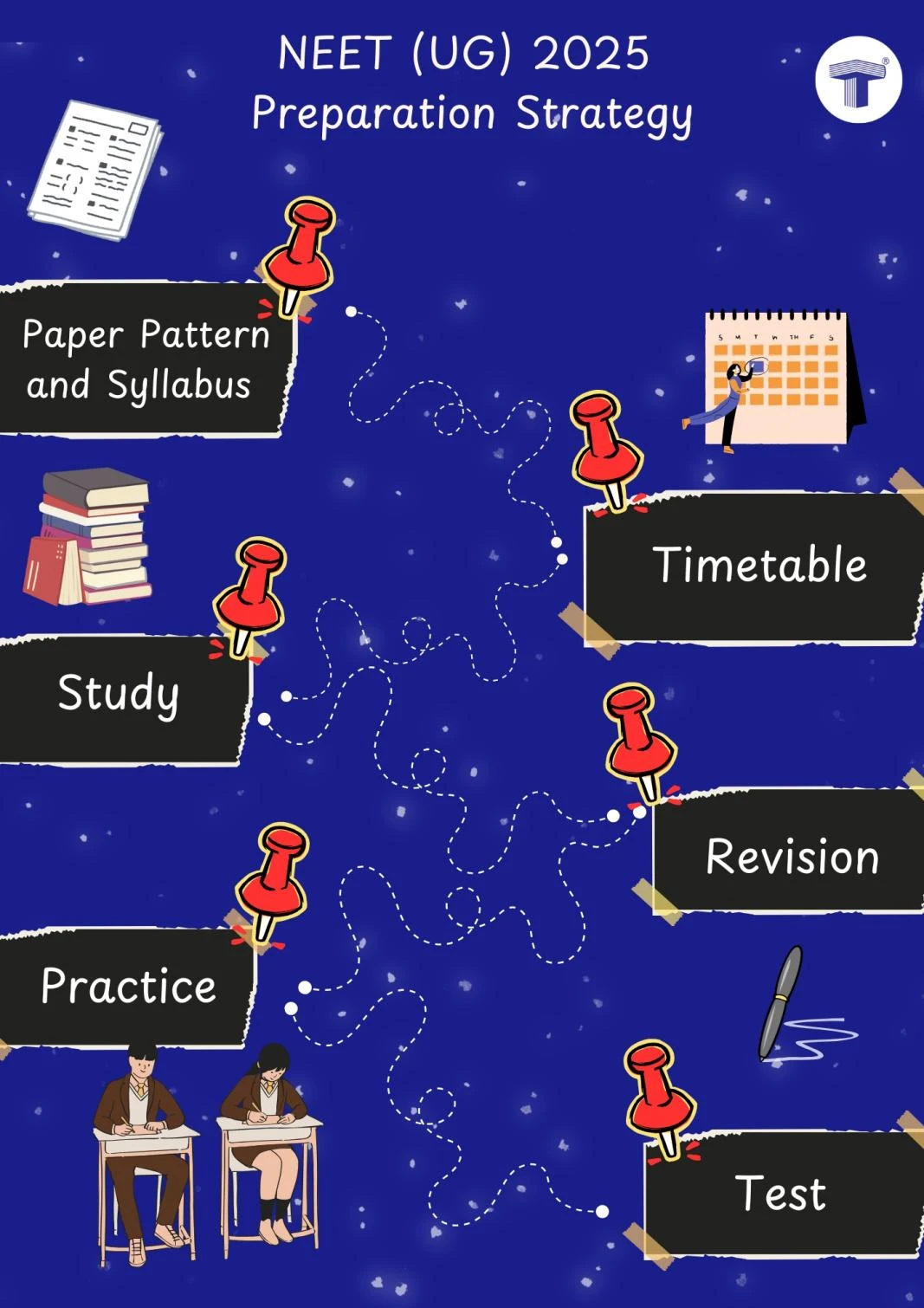
NEET (UG) 2025 Preparation Strategy Overview
NEET 2025 Recommended Books and Other Material
Remember to rely on the National Council of Educational Research and Training (NCERT) textbooks as a fundamental resource. Avoid overburdening yourself with numerous NEET exam study material, as it often leads to confusion and a lack of clarity regarding what to study.
Some of the NEET exam study material that we recommend are:
Physics Books
- NCERT Physics Class 11 and 12
- Concepts of Physics by H.C Verma
- Problems in General Physics by I.E Irodov
- NEET (UG) 12 Previous Years Solved Papers With Solutions by Target Publications
Chemistry Books
- NCERT Chemistry Class 11 and 12
- Organic Chemistry by Morrison and Boyd
- NEET (UG) PCB Test Series with Answer Key and Solutions by Target Publications
- Physical Chemistry by Peter Atkins
- Physical Chemistry by O.P. Tandon
Biology Books:
- NCERT Biology Class 11 and 12
- A textbook of Biology by A.P. Singh
- Trueman's Elementary Biology (Volume 1 and 2) by M.P. Tyagi
- 37 Years NEET (UG) Biology Previous Solved Papers PSP by Target Publications
Other material
- SATHEE app by Ministry of Education, India
- NEETprep Course Youtube channel for NCERT based NEET preparation
- Let's Crack NEET UG Youtube channel by Unacademy
Conclusion
Now that you’ve read this blog, you know exactly what it takes to successfully gear up for the NEET (UG) 2025 exam. Whether you’re a first-time aspirant or a repeater aiming to upgrade your rank, the key to success lies in staying consistent and using the right NEET exam strategy.
NEET (UG) 2025: Frequently Asked Questions (FAQs)
1. When should I start preparing for NEET 2025?
Ans: You can start your NEET (UG) preparation right after the end of Class 10 or from the starting of Class 11.
2. How important is the NCERT syllabus for NEET 2025 preparation?
Ans: It is very important as the NCERT textbooks form an important foundation for NEET (UG) 2025 preparation.
3. What are some effective time management strategies for NEET preparation?
Ans: Practise solving mock tests and previous years’ question papers within a time limit to learn effective time management for NEET preparation.
4. How can I improve my problem-solving skills for NEET?
Ans: Focus on understanding the NEET (UG) concepts thoroughly and practise solving a variety of question types regularly to improve your problem-solving skills.
5. What role does revision play in NEET preparation?
Ans: Revision of topics help in the retention of important information in the 2025 NEET preparation.
6. How can I manage stress during NEET preparation?
Ans: Make a study plan that includes breaks to keep things manageable, and don’t forget to take care of yourself, sleep well, eat healthy, and stay active. Engaging in your favourite hobbies like music, sports, painting, etc. can also help you manage stress during the NEET preparation.