
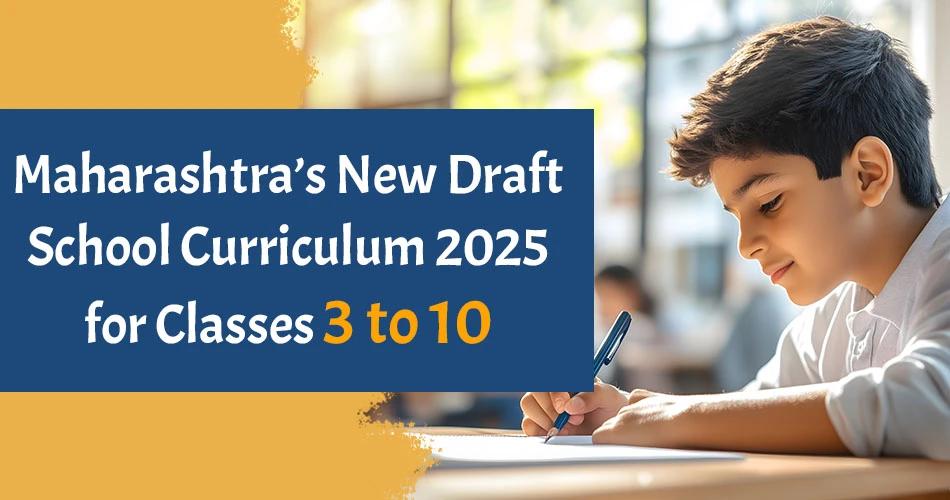
The State Council of Educational Research and Training (SCERT), Maharashtra has released a Draft Curriculum 2025 for Classes 3 to 10. This new syllabus goes beyond just textbooks and exams. It's about life skills, critical thinking, and preparing students for the real world.

Draft School Curriculum for Classes 3 to 10 (2025)
Here's everything you need to know.
What’s New in the 2025 Draft Maharashtra Curriculum?
1. Alignment with NEP 2020 and NCF 2023
The new draft syllabus is based on:
- National Education Policy (NEP) 2020
- National Curriculum Framework (NCF) 2023
- State Curriculum Framework (SCF) 2024
That means: more hands-on learning, interdisciplinary approaches, and skills for life—not just for exams.
2. Updated Subjects
Students will now learn a broader range of subjects in Maharashtra State Board Books with greater depth and purpose:
Languages
- Marathi: Focus on oral communication, expression, reading, and applied usage.
- English: A shift from grammar-heavy lessons to functional English for real-life communication, creativity, and reflection.
Mathematics
Emphasis on logic, reasoning, visualisation, and connecting Mathematics with daily life. Includes Indian mathematical heritage and contributions.
The World Around Us (TWAU) (Classes 3–5)
Replacing ‘Comprehensive Studies’, TWAU is split into two parts:
- Part 1: Science + Geography
- Part 2: History + Civics
The learning journey moves from local (Class 3) to district (Class 4) to national (Class 5)—helping students understand the world by starting with their own surroundings.
3. New and Emerging Subjects
Here’s where Maharashtra’s new curriculum takes a leap forward:
- Vocational Education (from Class 6): Includes gardening, poultry, mechanics, robotics, tourism, food processing, and more.
- Environmental Education: Focus on sustainability, climate change, and conservation.
- Social Service: Encourages empathy, community involvement, and personality development.
- Traffic Safety and Civil Protection: Builds road sense and emergency readiness.
- Defence Science: Covers India's national security system and preparedness.
4. Interdisciplinary Education
Some subjects combine multiple perspectives for holistic learning:
- Class 9: Individuals in Society
- Class 10: Environmental Education
These subjects promote moral reasoning, historical awareness, social consciousness, and active citizenship.
5. Arts and Physical Education
- Arts Education: Integration of theatre, music, dance, and visual arts with technology.
- Physical Education: Goes beyond fitness to cover life skills, emotional balance, and teamwork.
6. Humanities
- History: Ancient to modern India, global history, and influence of systems like Maya.
- Geography: From local to global environmental understanding.
- Political Science: In-depth learning about the Indian Constitution and democratic values.
- Economics: Introduction to the Indian economy, sectors, trade, and entrepreneurship.
7. Focus on Local and Indian Knowledge Systems
Agriculture, Indian contributions to science and culture, and ancient economic systems are now embedded across subjects in the proposed Maharashtra school education curriculum draft 2025.
Teaching and Assessment Reimagined
Learning isn’t just about what is taught—it’s also about how it’s taught and assessed. Recognising this, SCERT Maharashtra has taken a big step toward transforming both teaching methods and student evaluation.
Here’s what’s changing:
Grade-wise Learning Materials
- Content will now be designed according to students’ developmental stages, ensuring it matches their learning pace and abilities.
Innovative Teaching Strategies
- Teachers will be encouraged to go beyond traditional methods. The focus will shift to interactive, hands-on, and experience-based teaching that helps students connect concepts to real life.
Holistic Assessment Tools
Evaluation won’t just be about marks anymore. SCERT proposes:
- 360-degree holistic progress cards that reflect not only academic performance but also skills, creativity, values, and behaviour.
- Formative assessments that track growth continuously, not just at the end of the term.
- Teacher autonomy in assessments, allowing educators to use their judgment and professional expertise to guide learning.
Public Participation Invited
The State Council of Educational Research and Training (SCERT), Maharashtra, invites all education experts, teachers, scholars, parents, students, officials, organisations, and concerned citizens to share their valuable feedback on the Proposed School Education Curriculum Draft 2025.
Deadline for feedback submission: 27 August, 2025
Submit your comments online via maa.ac.in. Your insights can help shape the future of education in Maharashtra.
If you’re a parent, teacher, or student, now’s the time to explore how this new syllabus will shape the future of learning in Maharashtra.
Source
Official Notice by SCERT, 27 July, 2025: click here to read.
Official Draft Curriculum by SCERT, 27 July, 2025: click here to read.
Kindly note that any and all information is subject to change as per the SCERT, Education Ministry, and Government of India.