
If your little one runs away the moment you say ‘maths,’ you are definitely not alone. Most toddler parents feel that exact mix of amusement and mild panic. The good news? Maths for preschoolers does not have to mean sitting with a worksheet. It can be messy, giggly, and something your child actually asks for.
Hands-on maths activities for preschoolers work because toddlers learn best through touch, play, and exploration. When numbers feel like a game, curiosity takes over. Let us walk through some fun ways to bring maths alive at home.
Hands-On Maths Activities for Preschoolers at Home
When Should You Start Maths Activities for Preschoolers?
Children begin absorbing mathematical concepts from as early as 18 months. By ages 2 to 3, they are already comparing sizes, noticing patterns, and counting without realising it.
- Toddlers (18 months to 2 years): In this age, children should focus on matching and simple sorting.
- Early preschoolers (2 to 3 years): Such children should be introduced to counting with objects, big vs small.
- Preschoolers (3 to 5 years): Preschoolers are ready for number recognition, simple patterns, and basic addition using physical objects.
There is no ‘too early’ when learning happens through play. The key is keeping it light and age-appropriate.
Fun Counting Activities for Preschoolers Using Everyday Objects
This is where the magic really happens. Counting activities for preschoolers do not need fancy tools. Your kitchen, garden, or even a bowl of buttons can do the trick.
- Count and Drop: Drop pebbles, coins, or blocks into a container one by one while counting aloud. Children learn best through repetition.
- Snack Counting: Line up five grapes and count together before eating. It’s sneaky yet effective maths!
- Stair Counting: Count each step as you climb. This builds number sequence naturally.
- Number Scavenger Hunt: Ask your child to find ‘3 red things’ or ‘2 soft toys.’ This blends counting with observation.
Pairing these activities with learning materials, like number writing books or counting boards, makes the experience richer and more memorable for little learners.
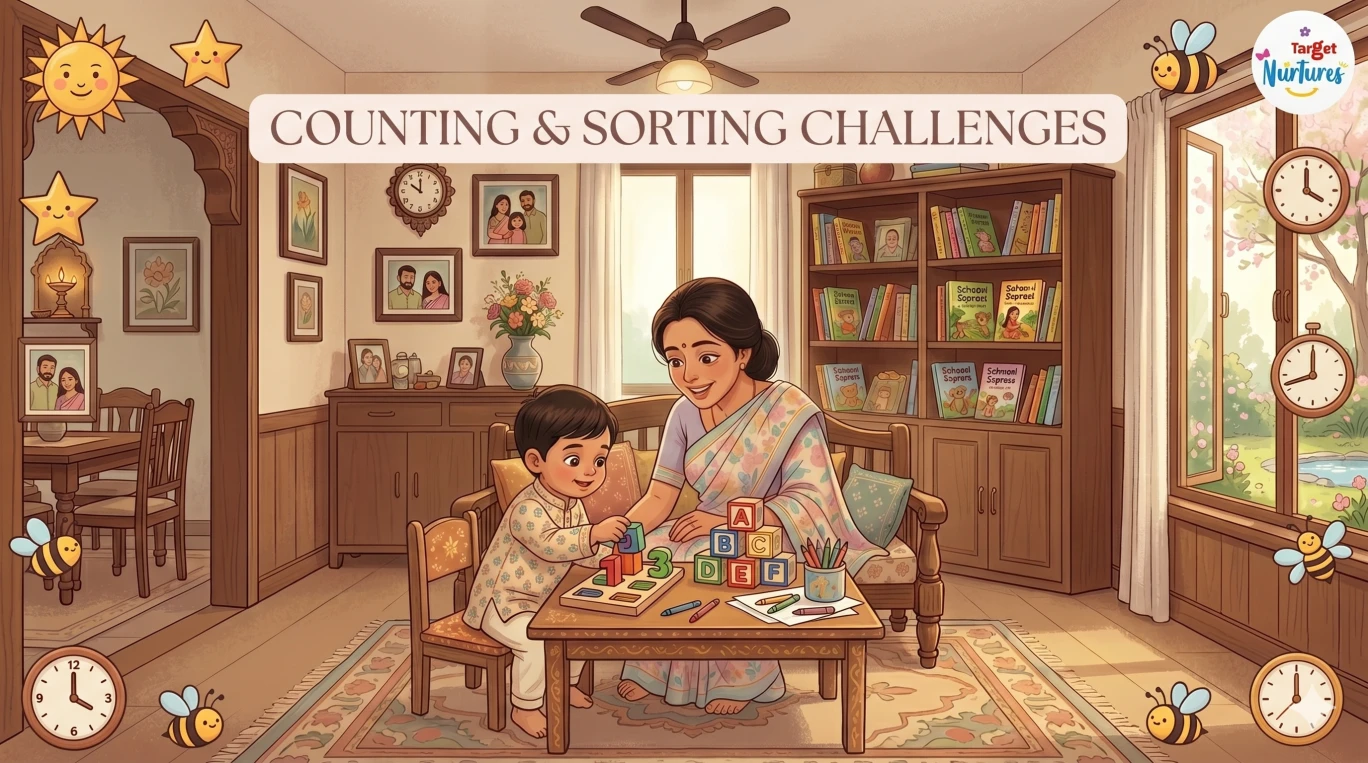
Simple Sorting and Patterns Activities that Teach Early Maths
Sorting and pattern activities for preschoolers lay the groundwork for logical thinking and early algebra, even at age 3!
-
Colour Sorting:
Give your child coloured pom-poms or socks to sort by colour into bowls. Simple, satisfying, and educational for toddlers.
-
Shape Sorting:
Use household objects like spoons, coins, or erasers, and ask your toddler to sort them by shape. This builds geometry awareness early in young children.
-
ABAB Patterns:
Create a simple pattern (red block, blue block, red block) and ask your child to continue it. It helps build an understanding of mathematical complexity gradually.
A Vanderbilt University study found that preschool patterning skills were strong predictors of math achievement later (e.g., in 5th grade).
How Maths Play Activities Support Overall Child Development
Hands-on maths does far more than teach numbers. When preschoolers engage in maths play activities, they build a whole set of life skills quietly in the background.
- Language Development: Counting aloud and describing shapes builds vocabulary.
- Problem-Solving: Figuring out where a shape fits or how to continue a pattern sharpens critical thinking.
- Fine Motor Skills: Picking up small objects and stacking strengthen little fingers.
- Confidence: Small wins like ‘I counted to 10!’ build a child’s belief in their own abilities.
Conclusion
Helping your preschooler fall in love with numbers is one of the greatest gifts you can give. The best part? It fits right into your everyday routine. Whether sorting socks or counting stairs, every little moment counts.
You do not need to be a maths expert to make this work. Just curiosity, patience, and the willingness to get your child on the floor and play.
Frequently Asked Questions
1. What is the best age to start maths activities for preschoolers?
Ans: Children can begin simple maths play from 18 months. Focus on sorting and counting objects rather than formal learning at this stage.
2. How long should a maths activity session be for a toddler?
Ans: Keep sessions to 10–15 minutes. Toddlers have short attention spans, so brief, fun bursts of activity work far better than longer structured sessions.
3. Do I need to buy special toys for preschool maths activities?
Ans: Not at all! Everyday items like spoons, stones, fruits, and socks work brilliantly. Structured learning kits can add variety.
4. How do I know if my child is ready for number recognition?
Ans: If your child can count 3 to 5 objects with one-to-one correspondence, they are likely ready to begin recognising written numbers between 1 and 5.
5. Can hands-on maths activities replace traditional preschool worksheets?
Ans: For ages 2 to 5, play-based learning is actually more effective than worksheets. Hands-on activities build deeper understanding and make learning enjoyable.