You must have seen your 2-year old get excited when given a blank sheet, filling it with colourful scribbles in no time. But does it ever concern you that when will those scribbles turn into something more meaningful and legible? Surprisingly, the scribbles mean a lot more than one might understand!
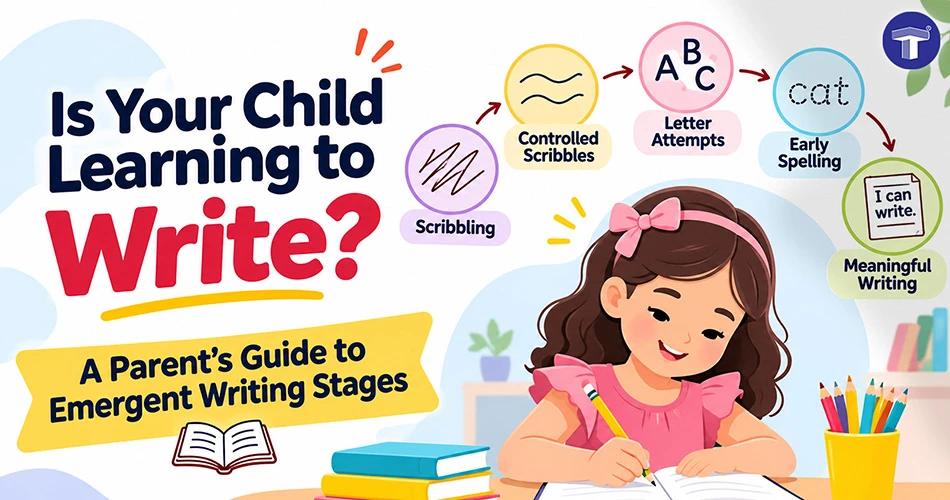
This is the beginning of emergent writing, when children discover how to put their thoughts onto paper. Understanding the stages of emergent writing will help you appreciate those tiny achievements without rushing towards perfect handwriting.
What Is Emergent Writing?
Emergent writing describes the early attempts children make to communicate through drawings, marks, symbols, and eventually words. A tiny dot might refer to a person, while a row of lines could be a shopping list. The important discovery is that these marks actually try to convey something.
From Scribbles to Sentences: The Stages of Emergent Writing
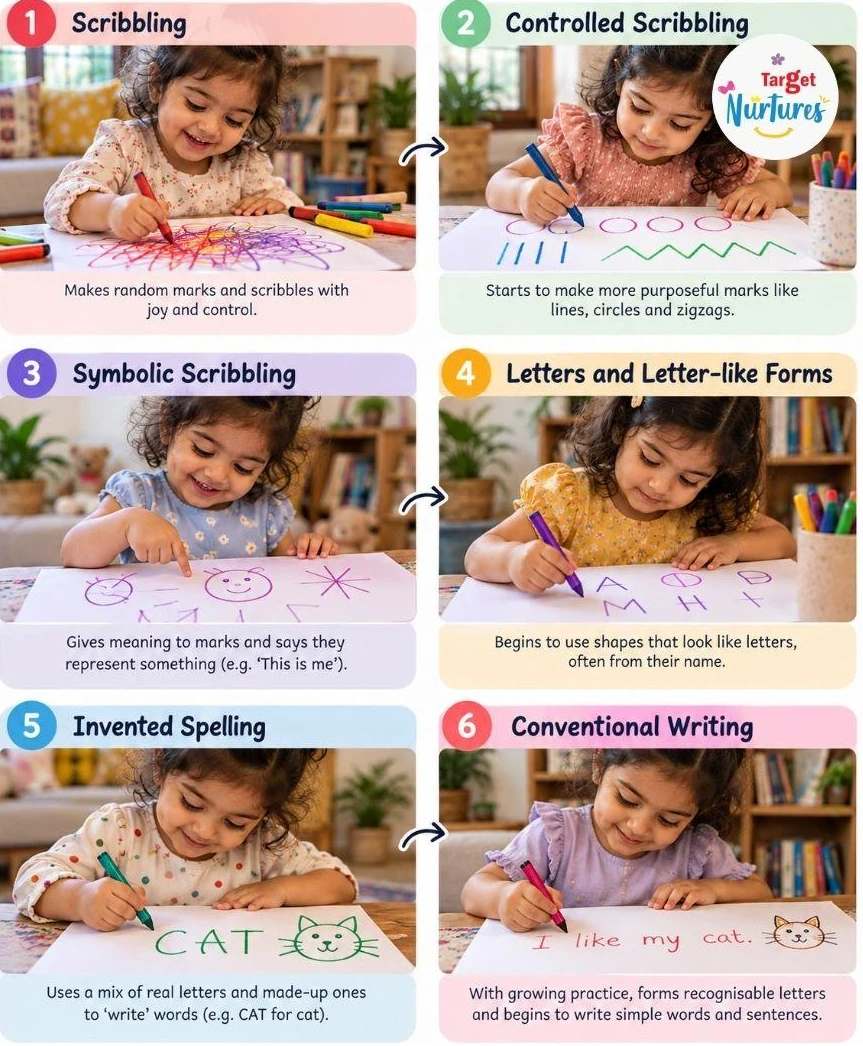
Stages of Emergent Writing for a Toddler
Stage 1: Scribbling, Their First Writing Attempts
First, crayons travel everywhere! These joyful, seemingly random marks help toddlers explore movement and develop their motor skills. Ask them, ‘What have you written?’ and let your child’s creativity surprise you.
Stage 2: Controlled Marks, Lines, and Curves
Soon, scribbles become deliberate strokes, loops, and circles. Your child may repeat a favourite pattern or try staying within a space. Engaging pre-writing skills activities can make this exploration even more inviting.
Stage 3: Symbolic Forms and Pretend Writing
Those mysterious squiggles start resembling grown-up handwriting. Children might fill a page with invented symbols, pretending to write a letter or sign a birthday card. They are noticing what written language looks like.
Stage 4: Letter Formation and Familiar Names
Then appear recognisable letters, often borrowed from the child’s own name. Some letters may appear backwards or upside down. But they can be practiced through alphabet tracing and writing practice books to support curiosity without turning playtime into a test.
Stage 5: Invented Spelling and First Words
Now phonological awareness kicks in, with sounds meeting letters. A child might write ‘KT’ for ‘cat’ or ‘BK’ for ‘bike’. This invented spelling shows that they are listening closely to words, even when the spelling is unconventional.
Stage 6: Early Conventional Writing and Sentences
With growing experience, children write more recognisable words and short messages. Spacing and spelling in sentence writing improve gradually. These early writing skills overlap, so not every child will go through each stage strictly, it’s just a guide.
Research offers reassurance: the National Association for the Education of Young Children notes that children as young as two may imitate writing through drawings and symbolic marks. Their early attempts matter for later literacy.
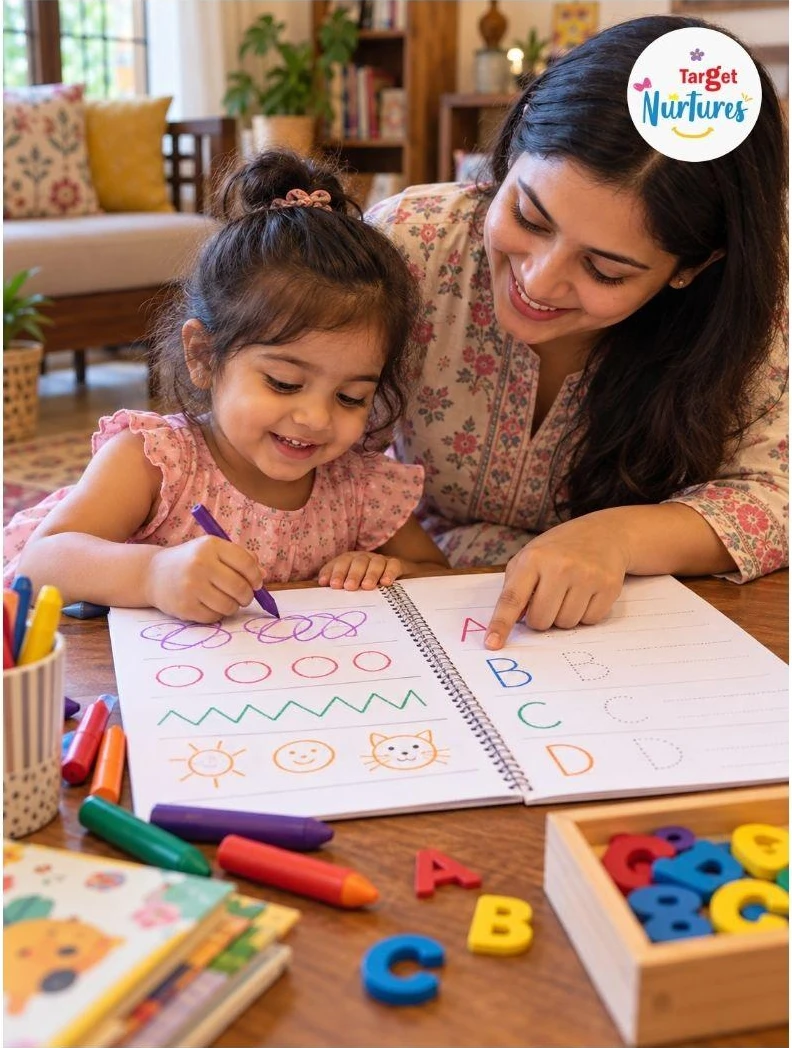
Preschooler Practising Emergent Writing With a Parent
Fun Emergent Writing Activities to Try at Home
Finger Tracing and Crayon Play
Start with tracing curvy roads in flour, painting giant circles, or following playful paths with chunky crayons. This will easily merge playtime with early learning.
Name Writing Activities with Familiar Letters
Write your child’s name on a card and ask them to spot its letters elsewhere. Appreciate them for participation, even if only one letter appears.
Everyday Writing Activities with a Purpose
Invite your child to ‘write’ a grocery list, label a drawing, or make a birthday card. This encourages them to convey their feelings through words, however faint to understand. Eventually, this will contribute to improving your child’s handwriting.
Conclusion
Your toddler does not initially need neat letters to be a budding writer. Each scribble, pretend word, doodle, and little message is part of their developing understanding of language.
Give them paper, patience, and plenty of chances to experiment and play. When you celebrate their efforts, emergent writing becomes something joyful to explore together, one mark at a time.
Important Links
Frequently Asked Questions
1. At what age should a child start holding a pencil?
Many toddlers begin exploring crayons before pencils. Offer chunky, easy-to-grip tools first, and let comfort and interest guide the transition to pencils.
2. Should I correct my preschooler’s backwards letters?
Occasional reversals are common while children learn letter shapes. Model the correct form gently, without interrupting their excitement about sharing a message.
3. Can emergent writing happen in two languages?
Yes. Children can explore marks, letters, and sounds across languages. Encourage storytelling in whichever language feels comfortable during the stages of emergent writing.
4. What if my child refuses tracing worksheets?
That is fine. Try drawing outdoors, making pretend menus, or tracing in sand instead. Playful choices often feel more welcoming to kids than worksheets.
5. How can I tell if my child is ready to start writing letters?
Look for signs like drawing of controlled shapes, pattern recognition, and showing interest in writing their name. This is when you need to start focusing on building their pre-writing skills.