
The dream of donning that white coat and serving humanity begins with cracking NEET. For some, coaching institutes might not be a feasible path due to several reasons. Did you know? A significant number of NEET toppers every year prove that with dedication, smart strategies, and the right approach, you can absolutely conquer NEET 2026 through self-study.
This comprehensive guide is for every aspiring medical professional who believes in their own potential and is ready to embark on a self-guided journey to NEET (UG) success. So, how to prepare for NEET without coaching? Well, before we dive into the 'how', let's understand the inherent strengths of self-study.
The Self-Study Advantage: Why It Works
- Flexibility: You dictate your pace, adapting it to your learning style and personal commitments. No more scrambling to catch that bus or living by rigid class timings—just roll out of bed and learn at your own pace.
- Deep Understanding: Without the pressure of keeping up with a class, you can spend more time on challenging topics. It ensures true conceptual clarity rather than superficial memorisation.
- Cost-Effective: You can save a significant amount of money on coaching fees, which can instead be invested in quality NEET study materials.
- Self-Discipline and Ownership: This journey fosters incredible self-discipline and accountability, qualities crucial for a successful career in medicine. You become the architect of your own success.
So, is coaching necessary for NEET? Many successful NEET candidates have proved that with a disciplined self-study plan and the right resources, NEET preparation at home without coaching is entirely achievable.
Laying the Foundation: Your Pre-Preparation Blueprint
Success in self-study isn't about aimless studying; it's about strategic planning. Here's how to prepare for NEET from Class 11 without coaching.
1. Understanding the NEET (UG) 2026 Exam
-
Syllabus Deep Dive:
The NEET (UG) 2026 syllabus is derived from Class 11 and 12 Physics, Chemistry, and Biology (Botany and Zoology). Download the official syllabus from the NTA website (once released, typically aligned with NMC's prescribed syllabus). Go through each topic meticulously. Don't just skim!
-
Exam Pattern and Marking Scheme:
Familiarise yourself with the NEET (UG) 2026 exam pattern.
| Physics | Chemistry | Biology | |
| Number of questions | 45 questions | 45 questions | 90 questions |
| Marks per subject | 180 marks | 180 marks | 360 marks |
| Marking Scheme |
+4 for each correct answer -1 for each incorrect answer 0 for unattempted questions |
||
-
Weightage Analysis (Previous Year Papers):
This is important, as it will help you prioritise your study. Analyse previous years' NEET papers (at least the last 5 years) to identify high-weightage chapters and frequently asked topics in Physics, Chemistry, and Biology.
2. Choosing the Right Study Material
A significant portion of NEET questions are directly or indirectly based on NCERT. Read it multiple times. But it's not the only book you'll need. NEET self study books like NEET (UG) Notes and Previous Year Question Papers (PYQs) can prove helpful.
Many reputable websites, NEET (UG)-related YouTube channels, and educational apps offer free and paid resources like video lectures, practice questions, and concept explanations. Use them judiciously to clarify doubts and supplement your learning.
3. The Execution: Your Smart Self-Study Strategy
Now that you have your plan and the necessary material, let's talk execution.
A. Crafting Your Personalised Study Schedule
This is where your self-discipline comes into play. A rigid, unrealistic schedule is bound to fail. Design one that is realistic. Don't plan for 15 hours of study if you can only manage 8 hours. Remember, quality over quantity.
Allocate sufficient time for all three subjects (Physics, Chemistry, Biology). Often, students neglect Physics and Chemistry for Biology. Don't! As these subjects are equally important.
Avoid studying one subject for too long. Rotate between Physics, Chemistry, and Biology to keep your mind fresh and engaged. A good approach is to dedicate focused blocks (e.g., 2–3 hours) to each subject daily. Your schedule must include dedicated slots for revision and solving questions daily.
Remember, life happens. Include buffer time for unexpected events.
Sample Self Study Time Table for NEET Preparation (Customise as per Your Study Style)
- Morning (5:00 a.m. to 8:00 a.m.)
Dive into conceptual reading, memorisation techniques, and mastering diagrams. This is the best time to absorb new information.
- Break (8:00 a.m. to 9:00 a.m.)
Take a short break with a healthy breakfast, light exercise, and a moment to refresh your mind for the next study session.
- Late Morning (9:00 a.m. to 12:00 p.m.)
Work on concept understanding and solve numerical problems to strengthen your application of the theory.
- Lunch and Rest (12:00 p.m. to 1:30 p.m.)
Enjoy a relaxing lunch and take some rest. A good break helps recharge your energy and prepares you for the second half of the day.
- Afternoon (01:30 p.m. to 4:30 p.m.)
Quickly review all the concepts you studied this morning and continue with your studies. Focus on understanding key concepts and reactions.
- Short Break (4:30 p.m. to 5:00 p.m.)
Take a brief break to relax and refresh before the evening study session.
- Evening (5:00 p.m. to 7:00 p.m.)
Solve multiple-choice questions (MCQs) from all subjects. Use this time to clear any doubts and reinforce concepts.
- Dinner and Relaxation (7:00 p.m. to 8:30 p.m.)
Have a nutritious dinner and take time to relax. This is essential to unwind and prepare for the night revision.
- Night (8:30 p.m. to 10:00 p.m.)
Revise the topics studied during the day. Make concise short notes for quick review and solidify your learning.
- Sleep (by 10:30 to 11:00 p.m.)
Aim for a good night’s sleep to help with retention and memory consolidation. A rested mind performs better in the long run.
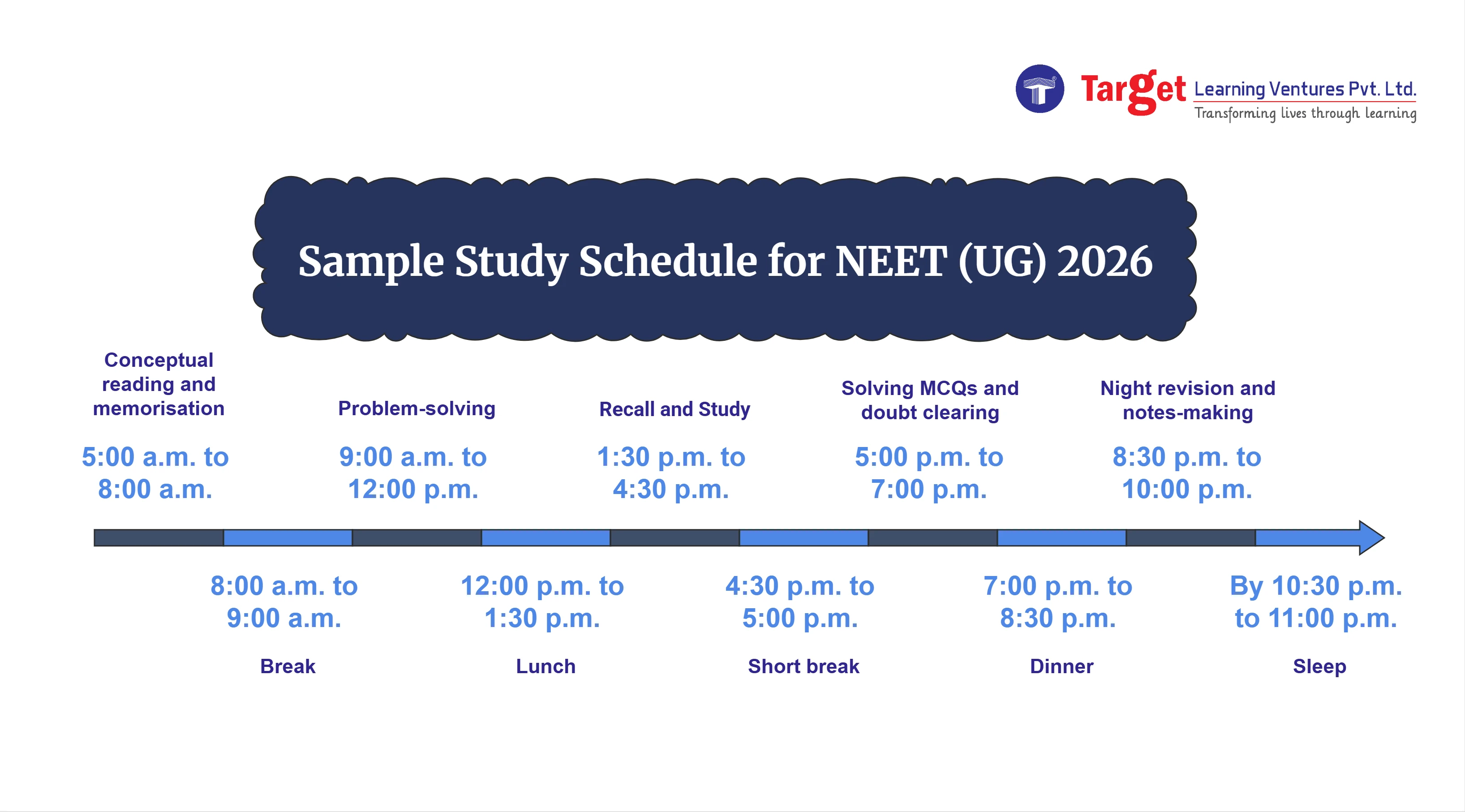
Sample Study Schedule for NEET (UG) 2026
B. Master the Art of Active Learning
Now, let’s learn how to start NEET preparation from zero. Passive reading won't cut it for NEET. Embrace active learning techniques. Don't just memorise formulas or facts. Understand why things work the way they do. If you're stuck, refer to online resources, educational videos, or even reach out to a friend or senior for clarification. You can also try the following methods for memorisation, which are quite easy to follow.
- Note-Making: Create your own concise, point-wise notes while studying. Include formulas, key concepts, tricky points, and common mistakes. These will be invaluable for quick revision.
- Mind Maps and Flowcharts: Especially for Biology and Organic Chemistry, visual aids like mind maps and flowcharts help in organising complex information and improving recall. Let’s take a look at the mind map provided in our Class 12 notes as an example. You can refer to it for inspiration and create your own on various concepts.
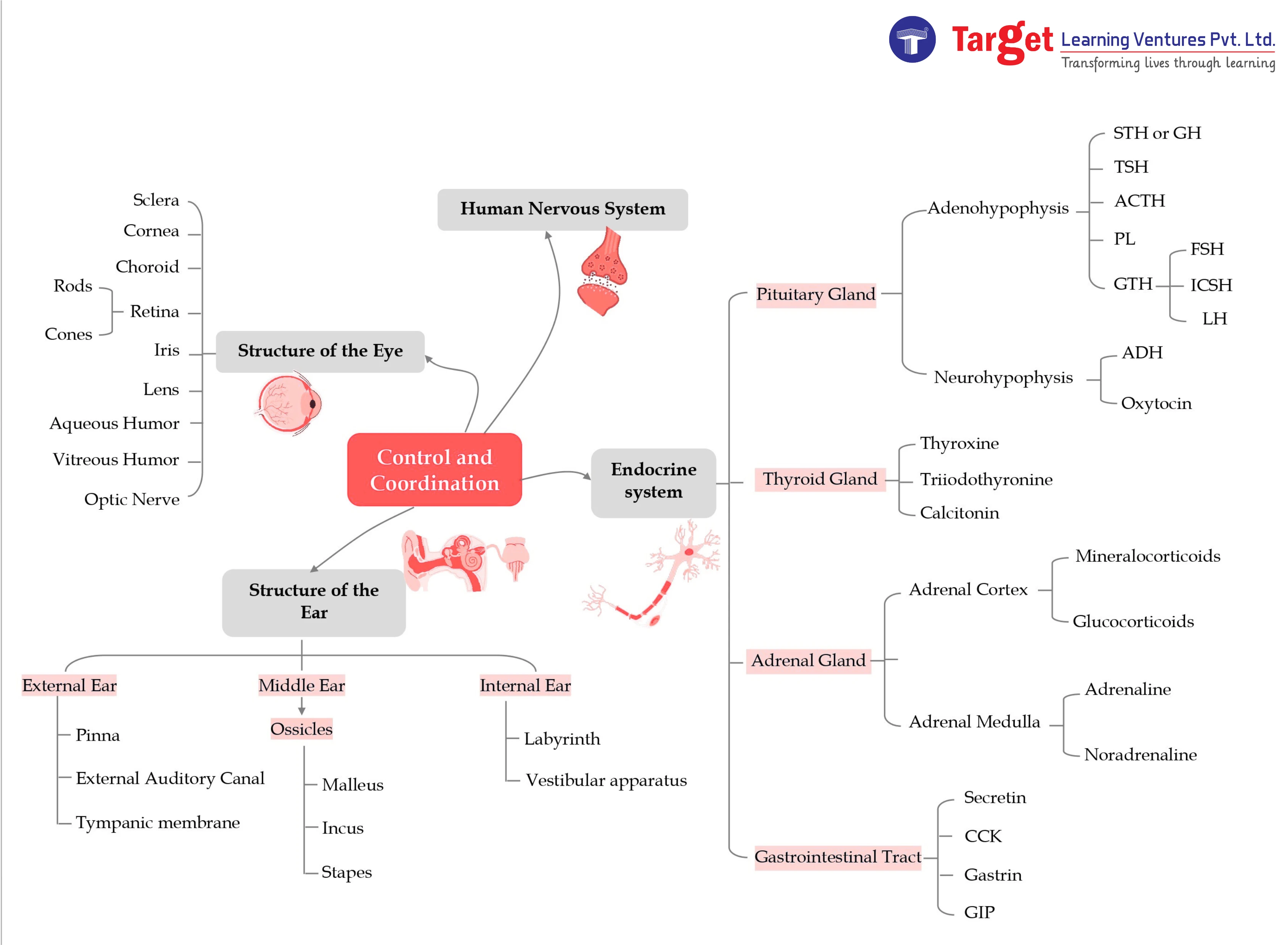
Example: Mind Map on NEET (UG) Biology
- Self-Quizzing: After studying a topic, close your book and try to explain it aloud to yourself or a wall. This immediately highlights areas where your understanding is weak.
- Teach Someone Else: If you can explain a concept clearly to another person, it means you've truly understood it. Find a study partner or simply explain it to an imaginary audience.
C. The Power of Practice
When it comes to achieving success in the NEET exam, there’s one factor that truly stands out: practice. While knowledge is crucial, it’s the consistent practice of MCQs, PYQs, problem-solving techniques, and time management that shapes your ability to perform under pressure.
- Solve Topic-Wise MCQs: As you complete each chapter, immediately solve a good number of MCQs related to that topic from your reference books and objective question banks. Moreover, dedicate a specific time each day to solving MCQs across all three subjects.
- Learn from PYQs: Previous years’ NEET papers give you an idea of how to solve different types of questions.
- Analyse Your Mistakes: This is the most critical part of practice. Don't just see the correct answer. Understand why your answer was wrong. Was it a conceptual error, a silly mistake, or a time management issue? Maintain a ‘Mistake Logbook’ to jot down recurring errors and revisit them regularly.
D. Revision: The Key to Retention
You can't remember everything you study unless you revise it regularly. Don't wait until the end. Implement a revision schedule.
- Daily Revision: Briefly review what you studied that day before going to bed.
- Weekly Revision: Dedicate a day (e.g., Sunday) to revise all topics covered during the week.
- Monthly Revision: A more comprehensive review of topics covered in the entire month.
- Short Notes and Flashcards: Use your self-made short notes and flashcards for quick and efficient revision.
- Formula Sheets: Maintain separate sheets for all important formulas in Physics and Chemistry.
E. The Mock Test Advantage
Mock tests are undoubtedly one of the most effective tools for NEET exam preparation in 2026. They serve as the perfect simulation of the real exam environment, allowing you to experience the pressure, time constraints, and format of the test long before exam day.
- Regular Mock Tests: Start taking full-length mock tests regularly (e.g., once every two weeks initially, then weekly as the exam approaches). Take mock tests in a quiet environment, strictly adhering to the 3-hour time limit. Use an OMR sheet to practise filling it accurately and quickly.
- Post-Mock Analysis: This is more important than the test itself. Review every question, not just the incorrect ones. Analyse your time management. Did you spend too much time on one section? Which section did you finish fastest? By answering these questions, you can identify your strong and weak areas.
4. Staying on Track: Maintaining Motivation and Well-being
How to self study for NEET? Understand that self-study can be a lonely and challenging journey. Thus, nurturing your mental and physical health is a very important part of the process. To prioritise your health, follow these steps:
- Set Achievable Micro-Goals: Instead of just ‘Crack NEET’, break it down into ‘Complete 2 chapters of Biology this week’ or ‘Solve 50 Physics numericals daily.’
- Reward Yourself: Celebrate small victories. Finished a tough chapter? Take a short break, listen to music, or indulge in a hobby.
- Stay Positive: There will be bad days. Don't let a low mock test score or a difficult concept derail you. Focus on learning from mistakes.
- Limit Distractions: Social media, excessive screen time, and unnecessary outings are productivity killers. Be disciplined about limiting these.
- Healthy Lifestyle: Sleep: 7–8 hours of quality sleep is non-negotiable for memory and concentration. Diet: Eat nutritious food. Avoid junk food. Exercise: Even 30 minutes of light exercise or a walk can significantly boost your mood and focus.
- Seek Support: Talk to your parents, trusted friends, or a mentor when you feel overwhelmed or demotivated. Share your struggles.
- Visualise Success: Regularly imagine yourself achieving your dream – getting into your desired medical college. This can be a powerful motivator.
Final Thoughts: Believe in Yourself
So, if you are thinking, ‘Is it possible to crack NEET without coaching?’ Cracking NEET 2026 without coaching is not just possible; it's a testament to your grit and determination. It requires immense self-discipline, smart planning, and consistent effort. Embrace the journey, learn from every mistake, and keep your eyes fixed on your goal.
Remember, the journey of a thousand miles begins with a single step. Start today, stay consistent, and you will undoubtedly carve your own path to medical success. Good luck!
Frequently Asked Questions (FAQs)
1. How many hours should I study daily for NEET without coaching?
Ans: Aim to study for 6–8 hours a day, depending on your comfort and consistency. Make sure to break these hours into focused study sessions with regular breaks. You can start with 6 hours and gradually increase as you progress. The key is quality over quantity—ensure you're focusing during your study time rather than just spending hours.
2. How can I stay motivated without coaching classes?
Ans:
- Set realistic goals: Breaking your preparation into smaller, achievable milestones will keep you motivated.
- Track your progress: Keep a study log to monitor your improvement and stay positive.
- Visualise your success: Imagine achieving your NEET goal to stay inspired.
- Stay connected with like-minded people: Join online groups or communities where you can share progress and ask questions.
- Reward yourself: After hitting targets, reward yourself with something small to keep the momentum.
3. How do I practise solving MCQs and mock tests effectively?
Ans:
- Start with a topic-based approach: Begin solving MCQs after studying a specific chapter. Once you're comfortable, start taking full-length mock tests.
- Time yourself: During mock tests, simulate exam conditions by strictly adhering to the time limit.
- Analyse your mistakes: After each mock test, thoroughly review the wrong answers to understand the concepts you're missing.
- Gradually increase the difficulty: As you get better, tackle more challenging questions to push your limits.
4. How to manage Physics without coaching?
Ans:
- Refer to NCERT: Make NCERT your go-to resource; it forms the foundation for most NEET questions.
- Master the basics: Focus on understanding the fundamental concepts first, such as mechanics, thermodynamics, and electromagnetism.
- Use online resources: Websites and YouTube channels can provide clear explanations and tutorials for complex topics.
- Practise regularly: Physics requires problem-solving practice. Work on numericals and formulae-based questions.
- Stay persistent: Physics can be tricky without coaching, but with daily practice and a focused study routine, you can master it.
5. What’s the role of a timetable in self-study?
Ans: A timetable helps you stay organised and ensures balanced study time for all subjects. It breaks down your workload into manageable chunks and helps reduce procrastination. Stick to the timetable as much as possible but stay flexible—adjust it based on what’s working and what’s not. Consistency is key, and a good timetable ensures that every topic is revisited at the right intervals.
6. How to handle stress and avoid burnout?
Ans:
- Take regular breaks: Follow the Pomodoro technique (25 minutes of focused work followed by a 5-minute break).
- Stay active: Regular physical activity like walking or yoga can help reduce stress.
- Sleep well: Aim for 7–8 hours of sleep to ensure your brain is functioning at its best.
- Talk to someone: Sometimes, sharing your thoughts with friends or family can help alleviate stress.
- Balance work and relaxation: Don't just focus on studying—find time to relax and unwind.