

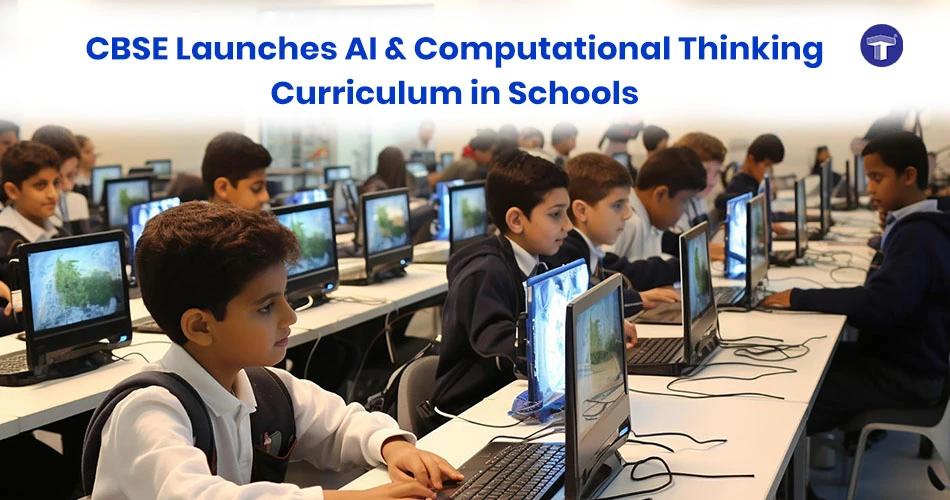
The Central Board of Secondary Education (CBSE) has rolled out a significant update that’s set to reshape classrooms across the country. Starting from the academic year 2026–27 academic session, CBSE schools will implement a structured Computational Thinking (CT) and Artificial Intelligence (AI) curriculum for students from Classes 3 to 8.
Here’s a simple breakdown of what this means for you and how to prepare.
What Is This New CBSE Circular About?
The circular announces the formal introduction of CT and AI learning in alignment with the National Education Policy (NEP) 2020 and the National Curriculum Framework (NCFSE 2023).
It is a full-scale implementation across all CBSE affiliated schools.
Key Highlights of Computational Thinking and Artificial Intelligence
- Applicable to Classes 3 to 8
- Effective from academic session 2026–27
- Curriculum available via official CBSE academic resources
- Schools are advised to initiate implementation steps immediately
Why This Shift Matters
The aim is clear, to move beyond rote learning and build future-ready learners.
The curriculum focuses on developing:
- Logical reasoning
- Problem-solving skills
- Pattern recognition
- Algorithmic thinking
- Digital literacy
- Ethical use of technology
It also encourages students to understand how AI connects to real-life applications, while nurturing creativity and innovation.
How the Curriculum Will Be Implemented in Schools
CBSE has designed training activities in schools structured around the following themes:
- Foundations of Computational Thinking (CT) and AI readiness
- From play to abstraction: Progressive pedagogy for Computational Thinking
- Mathematics as the cornerstone of Computational Thinking and AI readiness
- Interdisciplinary Connections: CT across subjects at middle stage
- AI in real-world contexts 6 assessments and pedagogy in CT and AI
- Ethics and responsible use of AI
This training aims to equip teachers with pedagogical strategies to integrate CT and AI concepts across subjects, foster ethical, responsible, and future-ready learning environment in schools.
The training will take place in 3 activity-based phases. The objectives and outcomes of the activities are as follows:
Objectives
- Build a strong foundation in Computational Thinking (CT) and Artificial Intelligence (AI) among teachers.
- Help educators integrate CT and AI concepts across subjects such as Mathematics, Science, Social Sciences, and Languages.
- Introduce AI in a responsible and age-appropriate manner, covering basic concepts, real-life applications, and ethical use of AI.
- Encourage interdisciplinary, project-based learning that connects CT and AI to everyday situations .
- Prepare students with future-ready skills relevant to higher education and careers.
- Identify and select the top three presentations or papers from each workshop (as per guidelines) for national-level review.
- Showcase the best work at the National Teachers’ Conference, as per future CBSE announcements.
Expected Outcomes
- A more supportive and inclusive environment for CT and AI learning across the schools.
- Teachers who are confident in creating hands-on, project-based learning experiences.
- Students who are more interested in AI, coding, data science, and interdisciplinary learning.
- Greater awareness of the ethical and responsible use of AI.
- Stronger development of 21st-century skills, including critical thinking, creativity, and problem-solving.
The names and modalities of each of the three activities are given below:
Activity 1: District-Level Deliberations on CT & AI (Workshop)
Modalities
- The workshop can be organised by any school, either individually through the Sahodaya School Complex or in collaboration with other interested schools
- It will be conducted offline, focusing on sharing and discussing best practices in CT and AI within the CBSE curriculum
- The duration will be one full day (6 hours) and will count as School-Based CPD under Domain II
- The organising school will be responsible for:
- Selecting the topic
- Arranging the venue
- Inviting experts
- Managing all logistics
- The focus should be on CT and AI for the Preparatory and Middle stages
- Schools must maintain proper training records
Activity 2: Expert - Led Talks on CT & AI in Schools
- These sessions will be organised by Lead Schools (schools that volunteer to host expert talks)
- They can be conducted online or offline on CT and AI topics based on the given sub-themes
- Sessions will be led by internal or external experts invited by the school
- The duration will be half a day (3 hours) and will count as School-Based CPD under Domain II
- Schools can also:
- Participate in online CT/AI sessions conducted by CBSE
- Watch educational programmes on CT/AI broadcast on DD PM e-Vidya Channel CBSE 15
- It is important to:
- Ensure active participation and attendance
- Maintain proper records for CPD hours
Activity 3. Regional Workshops / Orientations on CT & AI (Hosted by the Board)
- CBSE will organise Regional Workshops and Orientation Programmes through its Centres of Excellence (CoEs)
- Teachers can join by completing an online registration and paying a fee of ₹700
- Schools can nominate teachers based on their respective CoE region
- The workshop schedule will be shared by CBSE soon
- Teachers who attend these workshops will receive 6 CPD hours under Domain II
All CBSE affiliated schools are encouraged to organise the activities, nominate teachers.
Final Thoughts
This isn’t just a curriculum update, it’s a shift in how students learn and think.
By introducing AI and computational thinking early, CBSE is preparing students not just to use technology, but to understand and shape it responsibly.
Source
Official Notice by CBSE, 09 April, 2026: click here to read.
Kindly note that any and all information is subject to change as per the CBSE, Education Ministry, and Government of India.