
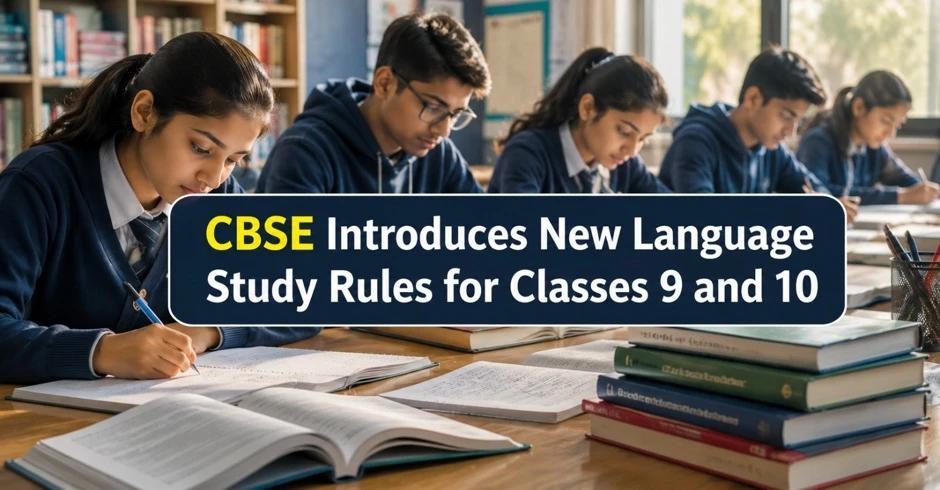
The Central Board of Secondary Education has announced significant changes to the Scheme of Studies for languages in Classes IX and X from the academic session 2026–27 onwards. The decision has been taken to align the Board’s curriculum structure with the recently released syllabus of National Council of Educational Research and Training and the broader vision of the National Education Policy (NEP) 2020 and National Curriculum Framework for School Education (NCF-SE) 2023.
The notification was issued through Circular No. Acad-33/2026 dated 15 May 2026 by the CBSE Academic Unit. The circular has been addressed to all heads of schools affiliated with CBSE across the country.
Language Structure
According to the revised policy, the study of three languages — R1, R2 and R3 — will become compulsory for Class IX students from 1 July 2026. The Board has clarified that at least two of these languages must be native Indian languages.
Students who wish to study a foreign language may opt for it only as the third language if the first two languages are native Indian languages. Alternatively, a foreign language may also be studied as an additional fourth language.
CBSE stated that the move is part of a transitional approach as the current academic session had already commenced in April 2026 before the release of the updated NCERT syllabus.
Curriculum Goals
The Board has advised school principals to carefully study the curricular goals, competencies and learning outcomes prescribed under NCF-SE 2023 for languages and other subjects.
CBSE noted that there is nearly 75 to 80 per cent overlap in core language competencies between the Middle Stage and Secondary Stage R3 curriculum. These competencies include oral communication, reading comprehension, written expression and grammatical awareness.
As a result, until dedicated R3 textbooks are introduced for the Secondary Stage, students of Class IX will use the Class VI R3 textbooks of the 2026–27 edition for the selected language.
Supplementary Material
The Board has also instructed schools to supplement these textbooks with suitable local or state literary material. Schools may choose short stories, poems or nonfiction works in the selected language to strengthen learning outcomes at the Secondary Stage.
CBSE stated that detailed guidelines regarding the selection and pedagogical use of supplementary literary material will be issued by 15 June 2026.
The Board further informed schools that Class VI R3 textbooks in 19 scheduled languages will be made available before 1 July 2026. For other native Indian languages, schools may continue using available SCERT and state-level learning resources as followed earlier.
Teacher Arrangements
CBSE has permitted schools to temporarily engage existing teachers from other subjects who possess functional proficiency in the concerned language for teaching R3 during the transition phase.
- Schools have also been encouraged to adopt collaborative and flexible arrangements like:
- Including inter-school resource sharing through Sahodaya clusters
- Virtual or hybrid teaching support
- Engagement of retired language teachers
- The use of suitably qualified postgraduate candidates.
Internal Assessment
In a major relief for students, CBSE clarified that no Board Examination will be conducted for R3 at the Class X level. All assessments related to the third language will remain entirely school-based and internal.
The Board stated that student performance in R3 will still be reflected in the final CBSE certificate. However, no student will be prevented from appearing in the Class X Board Examinations due to R3 requirements.
CBSE also announced that sample question papers and rubrics for internal assessment will be shared with schools shortly.
School Flexibility
Under the revised framework, schools may choose any language from the CBSE list of subjects provided that at least two of the three languages are native Indian languages.
The Board has additionally instructed schools to update their R3 language offerings for Classes VI to IX on the OASIS portal by 30 June 2026 in accordance with the new policy recommendations.
Special Provisions
Children with Special Needs (CwSN) will continue receiving relaxations under the Rights of Persons with Disabilities Act, 2016. These relaxations may include exemption from the second and third language requirements where applicable.
The circular also mentioned that CBSE-affiliated schools located outside India will receive exemptions under the policy. Additionally, foreign students returning to India may be granted exemptions from the requirement of studying two native Indian languages on a case-by-case basis.
Student Focus
The Board reiterated that these measures are transitional in nature and intended only to ensure alignment with national education policies while safeguarding student interests.
CBSE emphasised that no student should face disadvantage because of the curriculum alignment process.
Schools have been requested to communicate the provisions positively to teachers, students and parents while highlighting the long-term benefits of multilingual proficiency and cultural rootedness.
Source:
Official Press Release shared on CBSE board website, 15 May 2026: Click here to visit
Important Links:
CBSE Class 10 Admit Card 2026 Released for Second Board Exams
CBSE Class 10 Second Board Exams 2026 Date Sheet Released