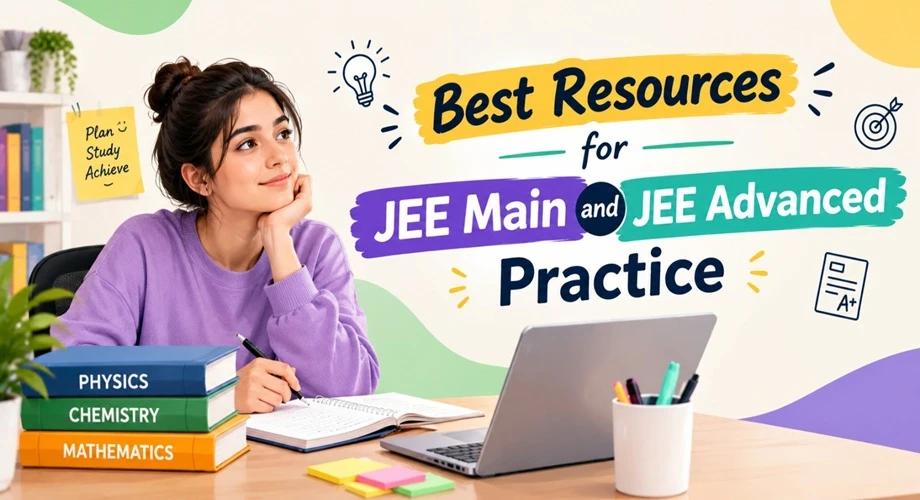
The best resources for JEE Main and JEE Advanced are NCERT textbooks, subject-wise practice books that provide chapter-wise PYQs practice, mock tests, and a reliable online course when extra guidance is needed.
JEE Main focuses on testing your understanding of concepts, speed, and accuracy across the syllabus, while JEE Advanced requires deeper conceptual understanding and the ability to solve complex, multi-concept problems.
You do not need separate books for every stage. Choose limited resources and study them thoroughly.
If you are preparing mainly through self-study, this JEE Main 2027 self-study guide for beginners can help you plan your schedule effectively.
Which Book is Best for JEE Main and Advanced?
Use resources according to their purpose:
| Resource | JEE Main | JEE Advanced |
| NCERT Textbooks | Build a strong foundation throughout the syllabus. | Strengthen fundamental concepts before attempting complex applications. |
| Concept Books | Understand key theories, formulae, and their applications. | Develop deeper conceptual understanding and connect multiple topics. |
| Practice Books | Improve problem-solving speed and accuracy through graded questions. | Practise challenging problems requiring analytical thinking and multiple concepts. |
| PYQs | Identify recurring question patterns and practise applying concepts to exam-level questions. | Understand complex questions and develop multi-concept problem-solving skills. |
| Mock Tests | Improve speed, time management, accuracy, and question selection under exam conditions. | Build exam stamina, manage time across both papers and practise complex questions. |
If you’re confused about best book for JEE Mains and Advanced, here’s a simple breakdown:
- Physics book for JEE Mains: Choose one that explains concepts before numerical problems. For Advanced, add tougher application-based problems.
- A good Chemistry book for JEE Mains should complement NCERT, particularly for question practice. For JEE Advanced Chemistry, you need stronger problem-solving in Physical and Organic Chemistry alongside detailed revision of Inorganic concepts.
- Your Maths book for JEE Mains should include graded chapter-wise problems. Advanced preparation needs questions that combine multiple ideas rather than only formula-based practice.
Before moving to difficult reference books, make sure your fundamentals are clear. This guide on how to build strong basics for IIT JEE explains how to strengthen concepts before advanced-level practice.
How Should You Use JEE Main and Advanced PYQs?
JEE Main PYQs chapterwise should be solved immediately after completing each chapter. They show the level of preparation, common question types, and areas requiring repeated revision.
Use JEE Advanced PYQs chapterwise after your fundamentals are strong. Do not check solutions too quickly. Spend time exploring different approaches because Advanced often tests how well you connect concepts.
Along with solving PYQs, study JEE previous year chapter-wise trends to identify chapters and concepts that have appeared repeatedly.
Are Online Courses Useful for JEE Main and Advanced Preparation?
Yes, but an online course is useful only when it solves a specific problem.
Choose one if you need:
- Structured concept teaching
- Doubt-solving support
- Regular tests
- Recorded lectures for revision
- Performance tracking
Before joining, attend demo classes and check whether the course separates JEE Main study material from deeper JEE Advanced study material.
Avoid watching lectures back-to-back without solving questions. After each lecture, practise related problems independently to check how well you have understood the concepts.
To organise your study time effectively, refer to daily routine for JEE aspirants and plan dedicated sessions for learning, question practice, and revision.
How Should You Use Mock Tests?
Start with chapter tests, then part-syllabus tests and finally full papers.
A JEE Main mock test series should help improve speed, accuracy, and question selection. A JEE Advanced mock test series should prepare you for both papers, changing question formats, and negative marking.
After every test, analyse incorrect, skipped, and time-consuming questions.
Since Physics, Chemistry, and Mathematics require different types of practice, you can also check the best sequence to study Physics, Chemistry and Mathematics for JEE while planning your study schedule.
Important Links
| Best Daily Routine For JEE Aspirants | JEE Advanced Chapter Wise Weightage 2026: Subject-Wise High Scoring Topics |
Conclusion
For JEE Main and Advanced, combine strong concepts with chapter-wise PYQs, graded practice and mock tests. Use online courses only when they improve understanding or structure, and avoid switching resources frequently.
FAQs
1. Is one book enough for JEE Main and Advanced?
Ans: One book may cover concepts, but you should also use PYQs and mock tests for complete practice.
2. Is NCERT enough for JEE Main?
Ans: NCERT is an important foundation, especially for Chemistry, but additional problem practice is recommended.
3. When should I start JEE Advanced practice?
Ans: Start once your chapter fundamentals and basic JEE Main-level questions are reasonably strong.
4. Are online courses compulsory for JEE?
Ans: No. They are useful for structure and guidance, but disciplined self-study can also work.
5. Should I use separate notes for Main and Advanced?
Ans: You can maintain common concept notes, while separately marking Advanced-level notes and difficult problems.