Have you ever attempted a JEE Main mock test and realised that time was running out while several questions were still unanswered? You may know the concepts and formulae, but spending too long on difficult questions can prevent you from completing the paper.
Effective JEE Main time management is not about solving every question quickly. It is about selecting the right questions, dividing time between subjects and knowing when to move ahead.
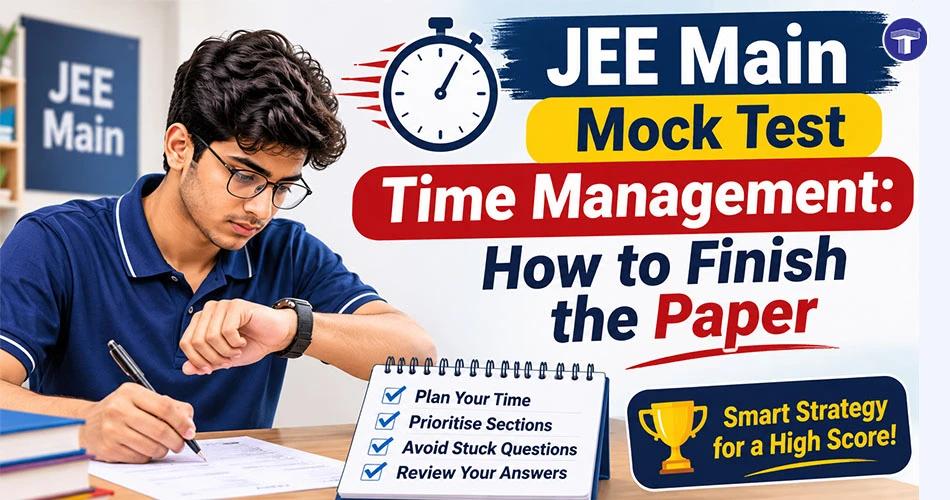
Here is a practical JEE Main mock test strategy to help you finish the paper on time without compromising accuracy.
Why Is Time Management Important In JEE Main?
JEE Main Paper 1 had 75 questions and a three-hour duration under the 2026 examination pattern. Both MCQs and numerical value questions carried negative marking.
This means you must balance speed with accuracy. Attempting more questions does not automatically improve your score if you make avoidable mistakes.
Mock tests help you identify whether you lose time because of lengthy calculations, weak concepts, poor question selection or repeated checking.
After identifying where time is being lost, use JEE previous-year chapter trends to plan additional question practice without treating past trends as fixed predictions.
JEE Main Time Management Strategy: 180-Minute Plan
A practical JEE Main exam time management strategy should divide the available time according to your strengths.
Here is a sample schedule for a three-hour paper:
| Subject/Activity | Suggested Time |
| Chemistry | 45 minutes |
| Physics | 55 minutes |
| Mathematics | 65 minutes |
| Final review | 15 minutes |
| Total | 180 minutes |
Test this allocation across several papers before finalising it. These JEE Main paper-attempting tips explain how question order, skipping difficult problems and regular time checks can affect paper completion.
How To Finish JEE Main Paper On Time
One useful JEE Main paper-solving strategy is to attempt questions in three rounds instead of solving them strictly in order.
| Round | Question Type | What You Should Do |
| Round 1 | Easy and familiar | Solve immediately |
| Round 2 | Moderate | Attempt questions requiring additional calculations |
| Round 3 | Difficult or lengthy | Revisit marked questions if time remains |
During the first round, avoid spending several minutes on an unfamiliar question. Mark it for review and continue. This JEE Main question solving strategy helps you secure manageable marks before attempting time-consuming questions.
You can also review these JEE Main tips for attempting the paper for additional question-selection strategies.
JEE Main First 30 Minutes Strategy
The first 30 minutes can set the pace for your entire paper.
Begin with the subject in which you consistently perform well during mock tests. Identify familiar questions and solve them without rushing.
Avoid checking the timer after every question. Instead, monitor your progress at planned intervals.
By the end of the first 30 minutes, you should have completed a useful set of questions and identified which ones need another attempt.
Subject-Wise Time Management For JEE Main
Each subject creates different time-management challenges. Your practice strategy should reflect these differences.
JEE Main Physics Time Management
Physics questions may require conceptual understanding, diagrams and numerical calculations. Before solving, identify the relevant concept and formulae. Avoid repeatedly changing methods if your initial approach is correct.
During mock tests, track questions where calculations or unit conversions take longer than expected.
For more intensive subtopic-wise question practice, the JEE Main Intensive Physics Vol. 1 & 2 Books include MCQs, numerical value questions, PYQs and detailed solutions that can support speed-building practice.
JEE Main Chemistry Time Management
Chemistry may offer opportunities to save time through strong NCERT-based preparation and quick recall. Attempt familiar theory-based questions first. Keep lengthy Physical Chemistry numericals for the next round if required.
For Organic Chemistry, revise reagents, reaction conditions and conversions to reduce hesitation during problem-solving. If hesitation in Chemistry is affecting your speed, JEE Main Chemistry Absolute Vol. 1 provides quick-review sections, formulae, MCQs and topic tests for focused practice.
JEE Main Maths Time Management
Mathematics questions can become lengthy even when the concepts are familiar. Practise recognising standard methods, useful substitutions and shortcuts. However, avoid using shortcuts without understanding the underlying concept.
If a question involves excessive algebra or repeated calculations, mark it for later rather than spending too much time immediately. JEE Main Mathematics Absolute Vol. 1 includes MCQs, numerical value questions, shortcuts and topic tests for self-assessment.
How To Improve Speed In JEE Main Mock Tests
Speed improves when you identify the reason behind slow solving.
For example, if you spend extra time recalling formulae, revise them more frequently. If calculation errors force you to solve questions twice, focus on accuracy before increasing speed.
Try timed sets of 10–15 questions from familiar chapters. Gradually include mixed questions to practise recognising concepts without chapter headings.
You can use JEE Main Mathematics Absolute Vol. 2 by Target Publications for subtopic-wise MCQs, numerical value questions, detailed solutions and topic tests.
These resources can help you practise individual topics before attempting full-length mocks.
Important Links
| JEE Main 2027: How Many Questions Should You Solve Daily? | 7 Best Revision Techniques for Entrance Examination | NEET, CET & JEE Mains |
Conclusion
JEE Main mock test time management improves when you combine sensible subject-wise allocation, question selection and regular analysis.
Practise solving easy questions first, reserve time for difficult questions and review mistakes after every test. Your goal should be to finish the paper with maximum possible accuracy, not simply the highest number of attempts.
FAQs
1. How Can I Finish JEE Main Paper On Time?
Ans: Divide your time between subjects, attempt familiar questions first and avoid spending too long on difficult problems. Practise your approach in mock tests.
2. What Is The Best JEE Main Mock Test Strategy?
Ans: A three-round strategy can work well. Attempt easy questions first, moderate questions next and return to difficult questions if time remains.
3. How Much Time Should I Spend On JEE Main Mathematics?
Ans: You may allocate approximately 60–65 minutes if Mathematics is your most time-consuming subject. Adjust this according to mock-test performance.
4. How Can I Improve Speed In JEE Main?
Ans: Practise timed question sets, revise formulae, improve calculation accuracy and analyse questions that consistently take longer than expected.
5. Should I Attempt All Questions In JEE Main?
Ans: Attempt questions according to your confidence and available time. Since incorrect answers attract negative marking under the 2026 pattern, accuracy is important.