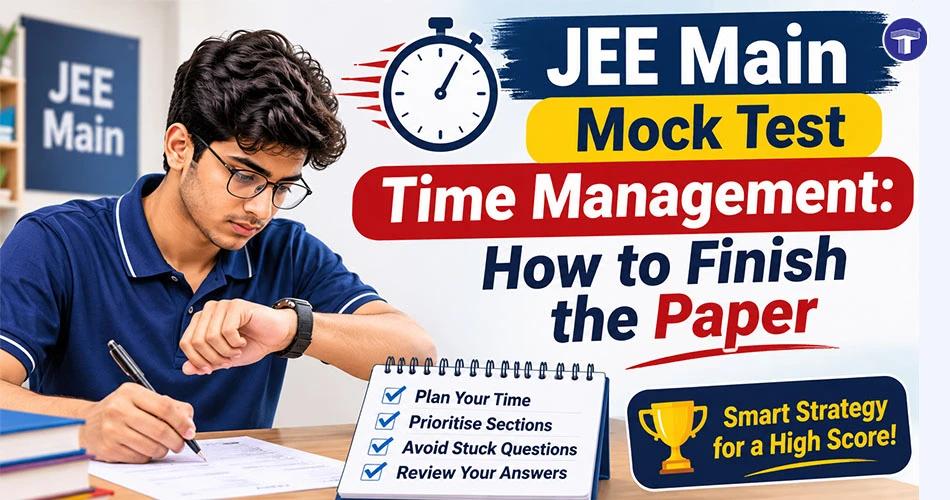

Have you ever spent five minutes solving one JEE Main Mathematics question, only to realise that several easier questions were left unanswered? This happens when you know the concepts but struggle with time allocation.
Effective JEE Main time management requires knowing when to solve, skip or revisit a question. Physics, Chemistry and Mathematics have different problem-solving demands, so spending equal time on every question may not work.
Here is how you can divide your examination time, improve question-solving speed and avoid rushing through the final minutes.
How Much Time Is Given Per Question In JEE Main?
Under the 2026 JEE Main Paper 1 pattern, you get 180 minutes to attempt 75 questions across Physics, Chemistry and Mathematics.
This gives an average of 2.4 minutes per question. However, this is only a mathematical average, not an official time limit for individual questions.
| Exam Detail | JEE Main 2026 Paper 1 |
| Total Duration | 180 minutes |
| Total Questions | 75 |
| Physics Questions | 25 |
| Chemistry Questions | 25 |
| Mathematics Questions | 25 |
| Average Time Per Question | 2.4 minutes |
The actual time required depends on question difficulty and your preparation level. Before building a timing strategy, understand the broader examination structure through this JEE Main 2027 guide.
JEE Main Exam Time Distribution: Subject-Wise Plan
A practical JEE Main time management strategy should allocate more time to subjects where calculations usually take longer.
You can begin with this sample plan and adjust it after attempting several mock tests.
| Subject | Suggested Time | Average Time Per Question |
| Chemistry | 40 minutes | 1.6 minutes |
| Physics | 50 minutes | 2 minutes |
| Mathematics | 70 minutes | 2.8 minutes |
| Final Review | 20 minutes | - |
| Total | 180 minutes | - |
These timings are flexible. You do not have to attempt every question in the allotted subject time. Your priority should be securing accurate answers. Use several mock tests before fixing these timings permanently.
Read how mock tests can help build a stronger rank to understand how repeated testing can improve speed, question selection and exam confidence.
JEE Main Physics Time Management
Physics questions often require conceptual understanding, diagrams, formulae and numerical calculations. For familiar questions, aim to solve within approximately 1.5-2 minutes during practice. More complex problems may require additional time.
Before calculating, identify the concept and check the given units. If you cannot determine the solving approach after a reasonable attempt, mark the question and move ahead. Regular numerical practice can help you reduce unnecessary calculation steps.
For additional Physics numerical and MCQ practice, explore JEE Main Physics books and focus on the chapters that consistently take you longer to solve.
JEE Main Chemistry Time Management
Chemistry can help you save examination time when your theory and reaction recall are strong. For direct NCERT-based questions, you may need less than a minute. Physical Chemistry numericals or multi-step Organic Chemistry questions may take longer.
During JEE Main Chemistry time management practice, attempt familiar theory questions first and reserve complicated calculations for another round. Revise reactions, exceptions and important formulae regularly to improve recall speed.
If Chemistry recall is slowing you down, JEE Main Chemistry books can support focused theory, formula and MCQ revision.
JEE Main Maths Time Management
Mathematics often becomes time-consuming because questions may involve lengthy algebra, calculations and multiple concepts. A practical target is to solve manageable questions within approximately 2–3 minutes. However, some questions may require four minutes or more.
If you cannot identify a useful method quickly, mark the question instead of continuing indefinitely. To improve JEE Main question-solving speed, practise standard techniques, useful substitutions and time-saving methods without compromising accuracy.
Mathematics speed improves mainly through repeated problem-solving. The JEE Main Mathematics Absolute Vol. 1 & 2 Books can be used for chapter-wise MCQs and numerical-value practice.
JEE Main Paper-Solving Strategy
Rather than solving questions strictly in order, use a three-round approach.
| Round | Questions To Attempt | Goal |
| Round 1 | Easy and familiar | Secure confident answers |
| Round 2 | Moderate and manageable | Improve total attempts |
| Round 3 | Lengthy or difficult | Use remaining time effectively |
This JEE Main paper-solving strategy helps you avoid wasting valuable minutes on difficult questions while leaving easier ones unanswered.
Remember that attempting more questions is useful only when your accuracy remains strong.
How To Improve JEE Main Speed And Accuracy
Speed develops through regular timed practice and mistake analysis.
Start with chapter-wise questions. Once your concepts are clear, attempt timed question sets and previous year papers.
After each session, identify whether you lost time due to calculations, forgotten formulae or difficulty understanding the question.
To structure these shorter practice sessions, this guide on how many questions you should solve daily for JEE Main can help you build consistent problem-solving practice.
JEE Main Time Management Tips
A common mistake is treating every question as compulsory to solve immediately. Instead, recognise when a question deserves more time and when you should return later.
During mock tests, follow these practical habits:
- Begin with your strongest subject.
- Avoid spending excessive time on one question.
- Keep rough calculations organised.
- Reserve approximately 15–20 minutes for pending questions and review.
- Track questions that repeatedly consume extra time.
These habits can help improve both speed and accuracy.
Important Links
| JEE Main 2026 Chapter Wise Weightage: Topics Covered in Physics, Chemistry and Mathematics | How To Build Strong Basics For IIT JEE: Preparation Tips And Roadmap |
Conclusion
JEE Main time per question should be treated as a flexible target rather than a fixed limit. Although the 2026 pattern gives an average of 2.4 minutes per question, Physics, Chemistry and Mathematics require different solving times.
Practise subject-wise time allocation, attempt familiar questions first and analyse your mock tests regularly. A balanced approach can help you finish the paper efficiently without sacrificing accuracy.
FAQs
1. How Much Time Should I Spend On Each JEE Main Question?
Ans: The 2026 pattern allows an average of 2.4 minutes per question. However, direct questions may take less time, while difficult calculations may require more.
2. Which Subject Should I Attempt First In JEE Main?
Ans: Begin with your strongest subject based on mock-test performance. This can help you secure confident answers before attempting more challenging sections.
3. How Much Time Should I Allocate To JEE Main Mathematics?
Ans: You can initially allocate around 65–70 minutes for Mathematics. Adjust this depending on your solving speed and question difficulty.
4. How Can I Improve My JEE Main Question-Solving Speed?
Ans: Practise timed questions, revise formulae, identify shorter reliable methods and analyse questions where you lose unnecessary time.
5. Is Accuracy More Important Than Speed In JEE Main?
Ans: Both matter. However, because incorrect answers attract negative marking under the 2026 pattern, rushing through questions without accuracy can reduce your score.