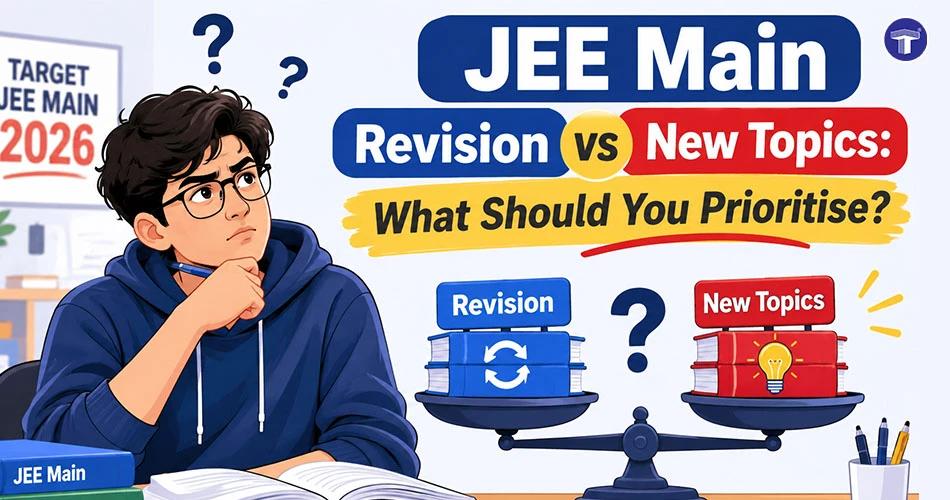
Your JEE Main exam is approaching, but several chapters are still pending. Should you complete those new topics or revise what you have already studied?
This is a common concern among JEE aspirants. Spending too much time on unfinished chapters may leave little room for revision. However, ignoring new topics completely could limit your preparation.
A practical JEE Main revision strategy should balance syllabus completion, concept retention and question practice. The right balance depends on how much time you have and how well you understand the completed chapters.
JEE Main Revision vs New Topics: Which Comes First?
Revision should generally receive more attention as the examination approaches. However, if an unfinished chapter is important for understanding other topics, learning it may still be worthwhile.
Consider your preparation stage before deciding.
| Preparation Stage | Revision Priority | New Topics Priority |
| 3-4 months remaining | Revise completed chapters regularly | Complete important pending topics |
| 1-2 months remaining | Increase revision and PYQ practice | Focus on manageable, important chapters |
| Final 2-3 weeks | Prioritise revision and mock tests | Avoid lengthy unfamiliar chapters |
| Final few days | Revise formulae, notes and mistakes | Avoid starting difficult new topics |
These are suggested priorities, not fixed rules. Adjust them according to your syllabus status and mock test performance. If time is limited, the JEE Main chapter-wise weightage analysis can provide an additional reference when deciding which pending chapters deserve attention first.
How To Prioritise Topics With An Incomplete Syllabus
If your syllabus is incomplete, trying to finish every chapter quickly may affect your understanding.
Instead, divide pending topics into three categories.
| Chapter Category | What You Should Do |
| Important and partially completed | Finish concepts and solve PYQs |
| Important but completely new | Check available time and learning difficulty |
| Less familiar and time-consuming | Keep for later if revision needs attention |
This approach makes your JEE Main revision plan for incomplete syllabus more realistic.
JEE Main Revision Timetable 2027
A good JEE Main revision timetable 2027 should allow you to revise completed chapters while making progress on selected pending topics.
If you have approximately six focused study hours available daily, consider this schedule:
| Study Activity | Suggested Time |
| Physics revision and numericals | 1 hour 15 minutes |
| Chemistry revision and MCQs | 1 hour 15 minutes |
| Mathematics practice | 1 hour 30 minutes |
| Selected new topics | 1 hour |
| PYQs and mistake analysis | 1 hour |
Keep mock-test days separate and use your test results to adjust the following week's schedule. The official JEE Main 2027 syllabus and dates should be confirmed through NTA once announced.
If you need a broader structure around these study blocks, use this daily routine for JEE aspirants to organise revision, question practice and breaks more consistently.
Subject-Wise JEE Main Revision Strategy
Each subject needs a different revision approach. You should not spend equal time rereading theory across Physics, Chemistry and Mathematics.
JEE Physics Revision
For JEE Physics revision, focus on important formulae, concepts, units and numerical applications. Instead of rereading entire chapters, solve selected questions to identify what you remember.
If you repeatedly make mistakes in Electrostatics or Mechanics, revise the relevant concepts before attempting additional numericals.
If Physics needs additional concept and numerical practice, explore JEE Main Physics books and choose material according to the chapters you still need to strengthen.
JEE Chemistry Revision
JEE Chemistry revision requires a balance of theory and application. For Physical Chemistry, revise formulae and practise numerical questions. For Organic Chemistry, focus on reactions, reagents and mechanisms.
For Inorganic Chemistry, revise important NCERT statements, trends and exceptions. Use short revision sessions to recall information without repeatedly reading the entire textbook.
For structured Chemistry revision with theory and MCQ practice, you can use JEE Main Chemistry Absolute Vol. 1 according to the topics that require additional revision.
JEE Maths Revision
JEE Maths revision should involve regular problem-solving rather than only reading notes. Revise formulae, standard methods and important question types. Then attempt timed chapter-wise questions.
If you struggle with Calculus or Coordinate Geometry, identify the specific concept causing mistakes instead of restarting the whole chapter.
For Mathematics concept revision and extensive MCQ practice, you can also use JEE Main Mathematics Absolute Vol. 1 & 2 to practise chapters according to your weak areas.
Study Material For JEE Main Revision
Good study material should help you revisit concepts quickly and practise exam-style questions without switching between too many resources.
For Physics, you can use Absolute Physics Vol. 1. It can support targeted concept revision and question practice in chapters where additional work is needed.
For Mathematics, JEE Main Mathematics Absolute Vol. 2 can be used for chapter-wise revision, MCQ practice and self-assessment according to your weak topics.
Use these resources according to your weak areas rather than starting every exercise again.
Important Links
| How To Build Strong Basics For IIT JEE: Preparation Tips And Roadmap | How Mock Tests lay the foundation of getting a Great Rank? |
Conclusion
Choosing between JEE Main revision and new topics depends on your preparation stage, pending syllabus and available time.
As the examination approaches, give greater priority to revision, PYQs and mock-test analysis. Complete selected new topics only when you have sufficient time to understand and practise them.
A balanced JEE Main study plan can help you retain familiar concepts, reduce mistakes and make better use of your remaining preparation time.
FAQs
1. Should I Revise Or Complete New Chapters Before JEE Main?
Ans: Prioritise revision as the exam approaches. Complete selected pending chapters if they are manageable and you have sufficient time for practice.
2. What Is The Best Revision Strategy For JEE Mains?
Ans: Revise important concepts and formulae, solve chapter-wise PYQs, analyse mistakes and reattempt incorrect questions regularly.
3. Can I Prepare For JEE Main With An Incomplete Syllabus?
Ans: Yes, you can still improve your preparation by strengthening completed chapters and covering manageable pending topics. However, broader syllabus coverage generally improves your opportunities to attempt questions.
4. How Should I Divide Time Between Revision And New Topics?
Ans: If you have several months remaining, maintain both activities. During the final weeks, allocate substantially more time to revision and mock-test practice.
5. Should I Start Difficult New Topics During The Last Week?
Ans: Generally, avoid starting lengthy unfamiliar chapters during the final week. Focus on familiar concepts, formulae, PYQs and previously identified mistakes instead.