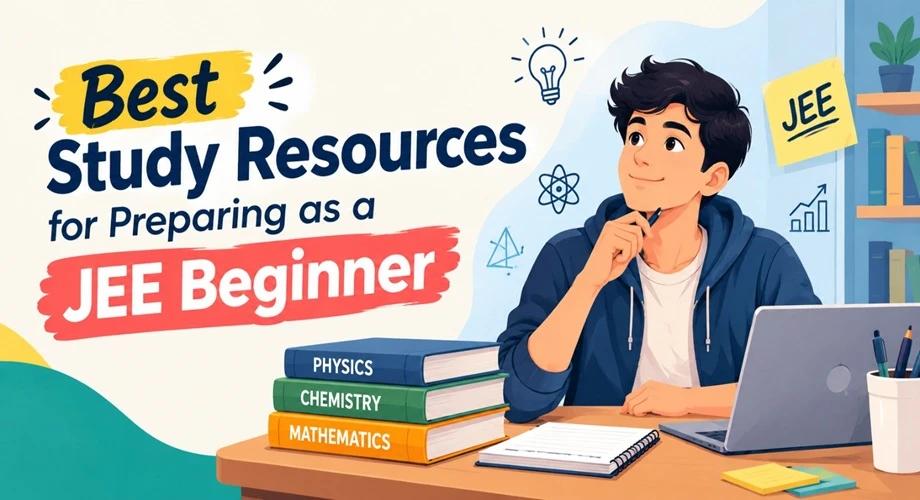
For beginners, the best JEE Main preparation material is NCERT textbooks, one reliable subject-wise practice book, chapter-wise PYQs, mock tests, and short revision notes. The key is to start with concepts first and move gradually towards JEE-level problem-solving.
For JEE Main PYQs and mock tests you can practice through the Tayari Entrance App by Target available on Appstore and Playstore.
For beginners, NCERT textbooks are the best starting point for JEE Main preparation, as they help build a strong understanding of Physics, Chemistry, and Mathematics. Once you are comfortable with the basics, move on to subject-wise practice books and chapter-wise PYQs to improve your problem-solving skills.
If you need help strengthening your concepts before attempting JEE-level questions, refer to this guide on how to build strong basics for IIT JEE.
Which Books Should a JEE Beginner Start With?
A simple beginner-friendly resource plan is:
| Subject | What to Use First |
| Physics | NCERT + concept-based numerical practice |
| Chemistry | NCERT + chapter-wise MCQs + numericals |
| Mathematics | NCERT+ solved examples + graded problem-solving |
| All subjects | Chapter-wise PYQs + mock tests |
The best book for JEE Mains Physics should explain concepts clearly before moving to numerical questions.
A good Chemistry book for JEE Mains should support NCERT with topic-wise practice, especially in Physical and Organic Chemistry.
The best book for JEE Mains Maths should contain graded questions so that you can move from basic problems to exam-level questions.
Once you are comfortable with NCERT, you can explore JEE Mains Absolute Series for detailed explanations, solved examples, and topic-wise MCQ practice. You can also consider the Trendsetter Series for structured revision, concept summaries, and exam-oriented questions.
What Should JEE Main Preparation Material Include?
Good JEE Main preparation material should provide:
- Clear chapter-wise theory
- Solved examples
- JEE-level practice questions
- Previous-year questions
- Detailed solutions
- Chapter-wise tests and mock tests
Pro Tip: Do not collect several books for the same subject.
Good resources work best when they are used within a consistent schedule. You can refer to the best daily routine for JEE aspirants to plan a balanced schedule.
Once your basics are clear, check the JEE Main chapter-wise weightage to understand which chapters have appeared more frequently and require regular practice.
When Should You Start JEE Main PYQs?
Start JEE Main PYQs chapterwise after completing each chapter to strengthen your fundamentals.
PYQs help you understand the actual difficulty level and identify commonly tested concepts. While solving them, mark questions that you answered incorrectly, skipped, or took too long to solve.
Reattempt these during revision. If you are unsure how many questions to include in your routine, a detailed guide on how many questions you should solve daily for JEE Main can help you set a practical target.
How Should Beginners Use Mock Tests?
Do not begin with full-length tests immediately.
Follow this order:
- Chapter tests
- Unit tests
- Part-syllabus tests
- Full JEE Main mock tests
A JEE Main mock test series becomes more useful once you have covered a reasonable portion of the syllabus.
After every test, analyse mistakes instead of focusing only on your score. Use your test performance to identify weak chapters and adjust your preparation accordingly rather than simply attempting more tests.
The JEE previous year chapter-wise trends guide can also help you prioritise revision alongside your test analysis.
What Notes Should You Make for JEE Main?
Your notes for JEE Mains should be short and easy to revise.
Include:
- Important formulae
- Frequently forgotten concepts
- Chemistry reactions and exceptions
- Common mistakes
- Difficult PYQs
Avoid rewriting entire chapters into notebooks.
Important Links
| JEE Main 2027: Self-Study Guide For Beginners | JEE Previous Year Trends: Which Chapters Are Asked Most |
Conclusion
Beginners should keep JEE preparation simple: strengthen concepts with NCERT, practise from one reliable book, solve chapter-wise PYQs, and gradually add mock tests. Consistent revision and practice matters more than collecting multiple resources.
FAQs
1. Which book is best for JEE Mains beginners?
Start with NCERT and one reliable subject-wise practice book that offers graded questions and detailed solutions.
2. Is NCERT enough for JEE Main?
NCERT builds the foundation, but additional numerical practice, PYQs, and mock tests are needed.
3. How many books should a JEE beginner use?
One core practice resource per subject, along with NCERT and PYQs, is usually enough.