
The recent discussions surrounding CBSE OSM have encouraged many of you students and parents to think more carefully about how learning and evaluation are evolving in modern education. While conversations about digital evaluation systems continue, the larger educational trend is equally important. Schools, educators, and academic experts are increasingly focusing on whether you truly understand concepts rather than simply memorising information for examinations.
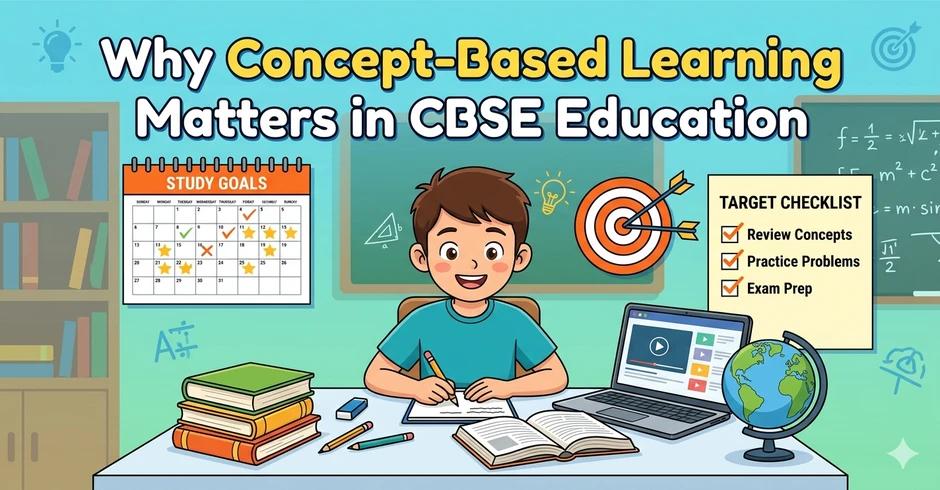
This changing approach is making Concept-Based Learning one of the most important aspects of CBSE Education today.
Why Are Learning Patterns Changing in CBSE Education?
For many years, you often depended heavily on rote learning to score marks in examinations. Memorising definitions, formulas, and textbook answers was considered enough to perform well.
However, educational expectations are gradually changing. Recent discussions around CBSE OSM have also highlighted how answer evaluation is becoming more structured, organised, and focused on clarity. At the same time, examination patterns are increasingly encouraging you to demonstrate understanding, logic, and application rather than simple recall.
As a result, students who understand concepts thoroughly often find it easier to handle unfamiliar questions, case studies, and application-based problems.
Why Is Rote Learning Becoming Less Effective?
One of the biggest challenges with rote learning is that information is often forgotten soon after examinations. You may remember answers temporarily but struggle when asked to apply the same knowledge in a different context.
Modern academic assessments increasingly require you to:
- Interpret information
- Analyse situations
- Connect multiple concepts
- Apply knowledge to real-world scenarios
- Present answers logically
This is where Concept-Based Learning becomes valuable. Instead of memorising isolated facts, you learn the reasoning behind a topic, making knowledge more meaningful and long-lasting. You should refer to the best and reliable CBSE books for learning.
When concepts are clear, you also feel more confident while solving unexpected questions, reducing exam-related stress and confusion.
How Do Application-Based Questions Support Better Learning?
Over the past few years, CBSE Education has gradually introduced more competency-based and application-oriented questions across subjects.
You are often required to explain concepts, interpret case studies, solve practical problems, and connect theoretical knowledge with real-life situations.
Such questions reward understanding rather than memorisation.
For example, in Science, you may need to explain the practical application of a principle instead of simply defining it. In Mathematics, you might be expected to apply formulas in unfamiliar situations. Similarly, in Social Science and English, analytical and reasoning skills are becoming increasingly important.
This growing focus on application naturally strengthens the importance of Concept-Based Learning.
Why Does Conceptual Understanding Improve Answer Presentation?
Another important advantage of Concept-Based Learning is better answer writing.
If you understand topics thoroughly you are often able to:
- Write more structured answers
- Explain ideas clearly
- Use relevant examples
- Avoid unnecessary memorisation errors
- Present information with greater confidence
As evaluation methods continue evolving, clarity of thought and logical presentation become increasingly valuable.
Recent conversations around CBSE OSM have also brought attention to the importance of organised answer presentation and accurate evaluation processes. While the discussions are primarily focused on assessment systems, they also reinforce a larger educational message: understanding matters.
How Can You Develop Stronger Conceptual Learning Habits?
Building conceptual understanding does not necessarily require studying for longer hours. Instead, it often requires studying smarter.
You can strengthen Concept-Based Learning by:
- Understanding the "why" behind every topic
- Solving application-oriented questions regularly
- Revising concepts through examples
- Creating summary notes in their own words
- Practising diagrams, flowcharts, and mind maps
- Discussing difficult topics with teachers and peers
Structured learning resources can also make this process easier. Many of you today prefer organised study materials, concept-focused notes, solved examples, and chapter-wise revision tools that simplify complex topics and help them build stronger foundations.
Reliable academic resources such as CBSE notes, revision material, and concept-based study support can help students learn in a more organised and stress-free manner instead of relying purely on memorisation.
The Growing Role of Technology in Academic Support
As education systems continue becoming more digital, technology is supporting you and your teachers in new ways.
Technology in education today is not limited to online learning platforms. AI-assisted academic support tools are also gradually helping teachers and evaluators manage educational workflows more efficiently. Educational institutions are increasingly exploring technology-supported systems like the recently used CBSE OSM Portal that assist evaluators in handling large-scale paper checking processes while keeping educators at the centre of decision-making.
This broader shift reflects how education is evolving towards efficiency, clarity, and better learning outcomes for everyone involved.
The future of CBSE Education is likely to place even greater emphasis on understanding, application, and critical thinking. While recent CBSE OSM discussions have generated significant attention across the education community, they also highlight a larger transformation taking place in academic systems.
Students who focus on Concept-Based Learning are often better prepared to handle changing examination patterns, application-based questions, and future academic challenges.
Rather than memorising information temporarily, building genuine understanding creates stronger confidence, deeper learning, and long-term academic success. In an education system that continues to evolve, smart learning habits and conceptual clarity may become the most valuable tools a student can develop.
Important Links:
CBSE Introduces New Three-Language Rule for Classes 9 and 10 from Academic Year 2026–27
CBSE Releases Parenting Calendar for Academic Session 2026–27