
In a major update for the upcoming academic year, the National Council of Educational Research and Training (NCERT) has officially released the draft syllabus for Grade 9.
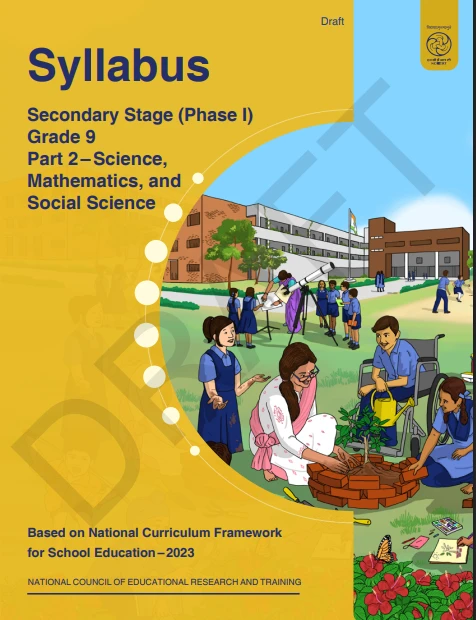
NCERT Grade 9 New Draft Syllabus 2026 Released
This new curriculum is a cornerstone of the National Curriculum Framework for School Education (NCF-SE 2023). It marks a significant shift in how students will learn and be assessed.
Designed to support teachers in their planning for the 2026–27 session, the syllabus moves away from traditional rote learning. It focuses instead on real-world skills and deeper understanding.
The new syllabus redefines how students engage with different disciplines, ensuring they aren't just reading books but are becoming ‘meaning-makers’.
- Languages (1, 2, and 3): Students will move beyond grammar. The focus is now on using language meaningfully for comprehension, expression, and critical engagement. Content will feature a balanced mix of literary and non-literary texts from diverse Indian contexts.
- Mathematics: No more mechanical procedures. The new curriculum emphasises algebraic thinking, geometry, and data handling through real-world modeling and logical reasoning.
- Science: Learning is now linked to observation and experimentation. The syllabus encourages students to connect scientific themes (physical, biological, environmental) with local contexts and technology.
- Social Science: This subject will now help students interpret society with critical awareness. Interestingly, teachers are encouraged to use Bhuvan images (India’s indigenous satellite platform) to help learners explore their regions using real-time geospatial data.
Access the complete draft NCERT Class 9 Languages syllabus PDF here to review the updated framework and learning outcomes.
New Subjects for a Changing World
Perhaps the most significant update is the introduction of subjects that focus on the ‘whole student’.
- Individuals in Society: This new interdisciplinary area allows Grade 9 students to reflect on personal identity, ethics, and social harmony. It is designed to prepare them for ‘Environmental Education,’ which will follow in Grade 10.
- Vocational Education: NCERT is giving ‘equal importance’ to vocational skills, introducing learners to work-centered knowledge and the dignity of labor linked to local livelihoods.
- Arts and Well-being: Arts Education will focus on regional artistic traditions, while Physical Education will prioritise team spirit and emotional balance over competitive ranking alone.
- Indian Knowledge Systems (IKS): The syllabus weaves in India’s rich cultural and scientific heritage, helping students connect modern concepts with indigenous traditions.
Click here to view the detailed Science, Mathematics, Social Science Class 9 syllabus PDF and explore the new curriculum structure.
The End of Rote Memorisation: New Assessment Methods
The syllabus introduces assessment tools to ensure students truly understand what they learn:
- Two-Assessment: There will be two levels of assessment in Mathematics, a mandatory ‘Proficiency Level’ for all and an optional ‘Advanced Level’ for those with deeper interest in the subject.
- Open-Book Tests: These will assess the ability to apply information rather than just recall it.
- Portfolios: Students will maintain records of their progress, providing a holistic view of their growth.
- Skill-Based Performance: In Vocational and Art subjects, evaluation will be based on tasks and creativity rather than written exams.
- Classroom Tasks: Teachers are encouraged to use ‘Mini quizzes’, ‘End of lesson tasks’, and ‘Peer and self-assessment’ to provide constructive feedback without the pressure of grades.
- 360-Degree Assessment: The syllabus adopts the NEP 2020 vision of a ‘360-degree assessment’, focusing on a student's originality and creativity in language use.
When will New NCERT Class 9 Textbooks 2026 Arrive?
While the syllabus is out now to help teachers plan ahead, the brand-new textbooks—including titles like ‘Kaveri’ (for English)—are currently under development and are expected to be available by March, 2026.
The Road Ahead
This release is just the beginning. Teachers are encouraged to use this new NCERT draft syllabus to prepare for the 2026–27 academic cycle. By March, 2026, the complete suite of textbooks will be available, fully reflecting the transformational vision of the National Education Policy (NEP) 2020.
Bottom Line: The new Class 9 syllabus isn't just a change in topics. It's a change in the entire learning experience, aiming to create ‘thoughtful, skilled, and responsible citizens’ for the future.
Source
Official Languages Syllabus PDF released by NCERT: click here to read.
Official Science, Mathematics, and Social Science Syllabus PDF released by NCERT: click here to read.
Kindly note that any and all information is subject to change as per NCERT, Education Ministry, and Government of India.