
If you are planning to pursue engineering in Maharashtra through MHT CET, knowing the right subjects is only the first step. You also need to understand what to study, which topics to prioritise and how to prepare for Physics, Chemistry and Mathematics differently.
The MHT CET PCM subjects are Physics, Chemistry and Mathematics. Whether you are in Class 11, Class 12 or preparing as a repeater, understanding the syllabus and building a subject-wise strategy can help you prepare more effectively.
What Are the MHT CET PCM Subjects for Engineering?
For students targeting engineering admissions, the PCM group consists of:
These are the core PCM subjects for engineering admission through MHT CET.
For MHT CET 2026, the State CET Cell conducted the examination for admission to first-year professional courses including B.E./B.Tech. Before applying for a future attempt, check the latest PCM eligibility for engineering Maharashtra rules applicable to your admission year.
MHT CET PCM Syllabus and Exam Pattern
The MHT CET syllabus is based on the Maharashtra State Board curriculum. This makes your textbook-based preparation particularly important. Instead of studying every topic from multiple sources, begin with the prescribed syllabus and build your concepts from the relevant State Board material.
The syllabus includes topics from Std. XI and Std. XII, with the examination framework giving greater emphasis to Std. XII. For the 2026 examination, the published framework used approximately 20% weightage for Std. XI and 80% for Std. XII.
For reference, the 2026 PCM examination had 150 MCQs to be solved in 180 minutes. Physics and Chemistry carried 1 mark per question, while Mathematics carried 2 marks per question. There was no negative marking, with Physics and Chemistry allotted the first 90 minutes and Mathematics the following 90 minutes.
This structure matters because your preparation should not focus only on knowing concepts. You also need to develop the speed, accuracy and question-selection skills required to use the available time effectively.
Most Important Chapters for MHT CET PCM
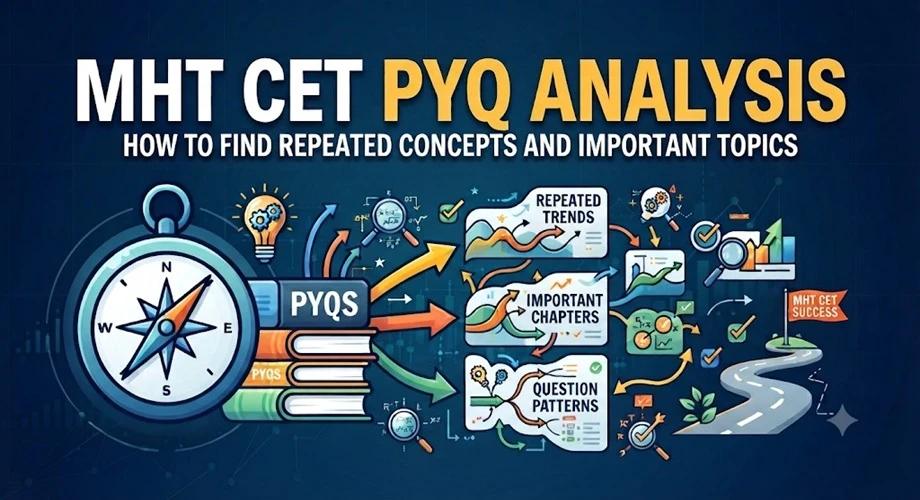
There is no single fixed list of chapters that guarantees marks in MHT CET. Your preparation should be based on the prescribed syllabus, previous-year questions and your mock-test performance.
However, some areas deserve closer attention because they involve concepts and question types that commonly require repeated practice.
Important Physics Topics for MHT CET
Prioritise topics such as:
- Rotational Motion
- Oscillations
- Wave Motion and Stationary Waves
- Electrostatics
- Current Electricity
- Magnetic Effects of Electric Current
- Electromagnetic Induction
- Wave Optics, including Interference and Diffraction
- Thermodynamics and Kinetic Theory
- Atoms, Molecules and Nuclei
- Electrons and Photons
- Semiconductors
For Physics, do not rely on formula memorisation alone. Follow this sequence:
Concept → Formula → Solved Example → MCQs → PYQs
After solving a question, ask yourself whether you understood why the formula was used. This helps you handle questions that are framed differently from the examples you have already practised.
Important Chemistry Topics for MHT CET
Chemistry requires a slightly different preparation strategy. Give attention to areas such as:
- Chemical Thermodynamics
- Solutions and Colligative Properties
- Electrochemistry
- Chemical Kinetics
- p-Block Elements
- d- and f-Block Elements
- Coordination Compounds
- Halogen Derivatives
- Alcohols, Phenols and Ethers
- Aldehydes, Ketones and Carboxylic Acids
- Organic Compounds Containing Nitrogen
- Biomolecules
- Polymers
- Chemistry in Everyday Life
Divide your Chemistry preparation into Physical, Organic and Inorganic Chemistry rather than treating the subject as one large block.
For Physical Chemistry, practise calculations regularly.
For Organic Chemistry, focus on understanding reactions, conversions and reaction conditions before memorising them.
For Inorganic Chemistry, repeated revision is important because factual information can be difficult to retain through one-time reading.
Important Mathematics Topics for MHT CET
Mathematics requires the most deliberate practice because knowing a formula does not necessarily mean you can solve a question quickly.
Give particular attention to:
- Trigonometric Functions
- Mathematical Logic
- Matrices and Determinants
- Straight Lines and Circles
- Conic Sections
- Continuity and Differentiability
- Applications of Derivatives
- Integration
- Differential Equations
- Probability and Probability Distribution
- Vectors
- Three-Dimensional Geometry
- Linear Programming
For Mathematics, maintain a formula sheet, but do not stop there. After revising a formula, solve different question types based on it.
Your objective should be to recognise the method required by a question quickly, rather than spending too much time deciding where to begin.
Important: These are preparation-priority areas, not an official guarantee of chapter-wise weightage for MHT CET 2027. Always compare them with the latest syllabus and recent PYQs before finalising your study plan.
For a detailed analysis of each chapter, you can refer to the Target Publications Triumph Series, which offers deeper insights into past MHT CET trends and how questions have been asked across different years.
How Should You Divide Your Time Between Physics, Chemistry and Mathematics?
Do not automatically divide your preparation time equally among the three subjects.
Instead, use your test performance to decide your priorities.
A student who is already strong in Chemistry may need more time for Mathematics. A student who understands Mathematics but makes repeated Physics errors may need more Physics practice.
A practical daily framework could look like this:
| Preparation Area | What to Do |
| Concept building | Learn or revise a specific topic |
| MCQ practice | Solve questions immediately after studying |
| PYQs | Practise previous-year questions |
| Revision | Revisit formulas, reactions and difficult concepts |
| Test practice | Take timed sectional or full-length tests |
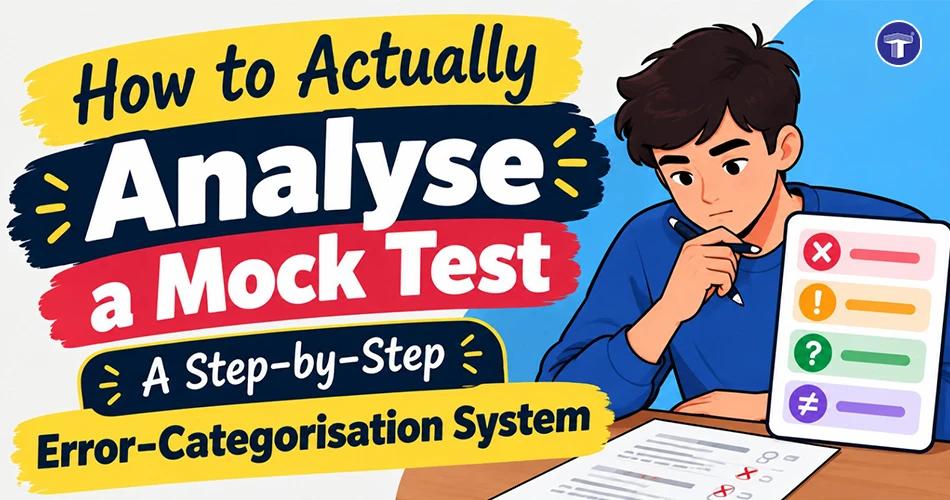
| Analysis | Identify the reason behind every repeated mistake |
As the examination approaches, gradually reduce passive reading and increase MCQ practice, PYQs, timed tests and revision.
Final Takeaway
Effective MHT CET 2027 preparation is not about treating every chapter equally.
Start with the official syllabus. Understand how Physics, Chemistry and Mathematics differ. Prioritise important areas without ignoring the rest of the syllabus, practise MCQs and PYQs regularly, and use mock-test analysis to identify exactly where you are losing marks.
Once you can answer these questions consistently, your MHT CET preparation becomes more focused, measurable and effective.
FAQs
What are the PCM subjects in MHT CET?
The PCM group in MHT CET consists of Physics, Chemistry and Mathematics. These are the main subjects for students targeting engineering courses through MHT CET.
Is MHT CET PCM compulsory for engineering?
For engineering admissions through the PCM route, Physics and Mathematics are key subjects along with the applicable qualifying-examination requirements. Check the latest official CET Cell eligibility rules for your admission year.
What is the MHT CET PCM syllabus?
The MHT CET PCM syllabus covers prescribed Maharashtra State Board Std. XI and XII topics in Physics, Chemistry and Mathematics. The exact syllabus and weightage should be checked in the official notification for your exam year.
Which subject is most important in MHT CET PCM?
No single subject is universally the most important. Your priority should depend on your accuracy, speed, strengths and weak areas across Physics, Chemistry and Mathematics.
What are the important chapters for MHT CET PCM?
Important preparation areas include topics from Mechanics, Electrostatics, Current Electricity, Optics and Modern Physics in Physics; Physical, Organic and Inorganic Chemistry topics; and Calculus, Matrices, Probability, Vectors and Three-Dimensional Geometry in Mathematics.
However, do not rely on a fixed chapter list alone. Compare the official syllabus with previous-year questions and your mock-test performance.
How should I prepare for MHT CET PCM?
Understand the concepts first, then practise MCQs and PYQs, analyse your mistakes and revise regularly. Gradually add timed sectional and full-length tests to improve speed and accuracy.
How can I improve my MHT CET PCM score?
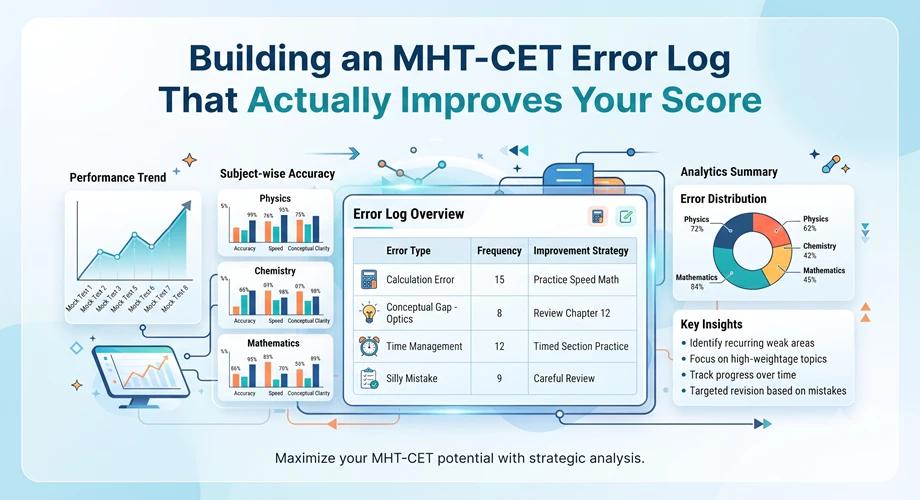
Focus on high-priority topics, practise consistently and analyse every test you take. Identify whether you are losing marks because of knowledge gaps, careless mistakes or poor time management, and change your preparation accordingly.
Is MHT CET based on the Maharashtra State Board syllabus?
Yes, MHT CET preparation is based on the Maharashtra State Board curriculum. However, always refer to the latest official CET Cell syllabus for the specific year you are appearing.