
Are you curious about how the MHT CET 2025 turned out this year? If you’re a future aspirant, a concerned parent, or just someone keeping an eye on Maharashtra’s biggest entrance exam, you’re in the right place! With every new edition, the MHT CET brings its own set of surprises, and 2025 was no exception. From tricky Physics numericals to scoring Chemistry questions and the ever-daunting Mathematics section, this year’s paper had it all.
In this blog, we’ll break down the subject-wise difficulty, highlight the most important topics, and share what students and experts had to say about the exam.
MHT CET 2025 Paper Analysis: Subject-wise Overview
The MHT CET 2025 exam maintained a moderate to moderately difficult level, with noticeable variation in difficulty across subjects and shifts. Below is a subject-wise analysis based on recent shifts and expert feedback.
MHT-CET Physics 2025 Paper analysis
- Overall Difficulty: Moderate to moderately difficult. Some shifts had slightly easier questions, but most required strong conceptual understanding and quick calculations.
- Question Types: A mix of theoretical, conceptual, and numerical questions. Application-based problems were prominent, with fewer direct formula-based questions.
- Key Topics Covered:
- Rotational Dynamics ,Kinetic Theory of Gases and Radiation, Electromagnetic Induction , Electrostatics , AC Circuits , Mechanical Properties of Fluids, Superposition of Waves, Wave Optics, Oscillations.
MHT-CET Physics 2025 Paper analysis: Chapter-wise Weightage:
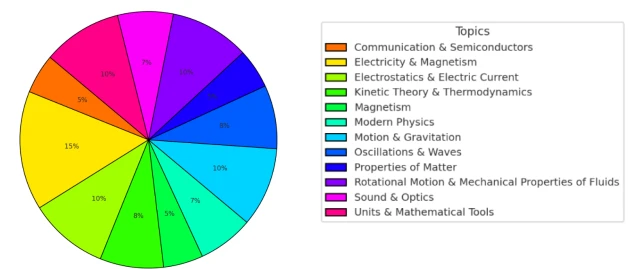 MHT-CET Physics 2025 saw the highest weightage from Electricity and Magnetism
- Communication and Semiconductors (5%): Semiconductors
- Electricity and Magnetism (15%): Electrostatics
- Electrostatics and Electric current (10%): Electrostatics & Current Electricity
- Kinetic Theory and Thermodynamics (8%): Kinetic Theory of Gases and Radiation & Thermodynamics
- Magnetism (5%): Magnetic Fields due to Electric Current , AC Circuits , Electromagnetic Induction & Magnetic Materials
- Modern Physics (7%): Dual Nature of Radiation and Matter, Structure of Atoms and Nuclei & Semiconductor Devices
- Motion and Gravitation (10%): Motion in a Plane , Gravitation & Laws of Motion
- Oscillations and waves (8%): Superposition of Waves , Oscillations & Wave Optics
- Properties of Matter (5%): Thermal Properties of Matter
- Rotational Motion and Mechanical Properties of Fluids (10%): Rotational Dynamics & Mechanical Properties of Fluids
- Sound and Optics (7%): Sound & Optics
- Units and Mathematical Tools (10%): Vectors & Error Analysis
Student Feedback: Physics required more time due to the complexity of numericals and conceptual depth, especially in shifts with a higher focus on application.
MHT-CET Chemistry 2025 Paper analysis
- Overall Difficulty: Easy to moderate. Chemistry was consistently reported as the least challenging among the three PCM subjects.
- Question Types: Predominantly direct, theory-based questions with a significant number drawn straight from XI and XII Maharashtra State Board textbooks. Emphasis on formula based questions in physical chemistry, memory based questions in inorganic chemistry and reactions in organic chemistry.
- Key Topics Covered:
- Solid state, Solutions, Ionic Equilibria, Chemical Thermodynamics, Electrochemistry, Chemical Kinetics, Halogen Derivatives, Alcohols, Phenols and Ethers, Aldehydes, Ketones and Carboxylic acids, IUPAC nomenclature.
MHT-CET Chemistry 2025 Paper analysis: Chapter-wise Weightage:
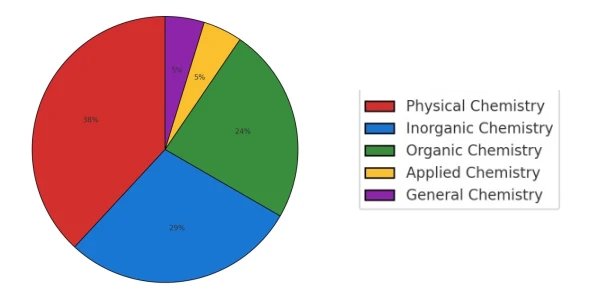 MHT-CET Chemistry 2025 with Physical Chemistry forming the core.
- Physical Chemistry (38%): Redox Reactions, States of Matter: Gaseous and Liquid States, Solid State, Solutions, Ionic Equilibria, Chemical Thermodynamics, Electrochemistry, Chemical Kinetics.
- Inorganic Chemistry (29%): Chemical Bonding, Elements of Group 1 and Group 2, Adsorption and Colloids, Elements of Groups 16, 17, and 18, Transition and Inner Transition Elements, Coordination Compounds.
- Organic Chemistry (24%): Basic Principles of Organic Chemistry, Hydrocarbons, Chemistry In Everyday Life, Halogen Derivatives, Alcohols, Phenols, and Ethers, Aldehydes, Ketones, and Carboxylic Acids, Amines, Introduction to Polymer Chemistry, Green Chemistry and Nanochemistry.
- Applied Chemistry (5%): Biomolecules, Chemistry In Everyday Life, Green Chemistry and Nanochemistry.
- General Chemistry (5%): Some Basic Concepts of Chemistry, Structure of Atom.
Student Feedback: Chemistry was scoring and less time-consuming, with many straightforward questions, especially in organic and physical chemistry.
MHT-CET Mathematics 2025 Paper analysis
- Overall Difficulty: Moderate to difficult. Mathematics was consistently the most challenging and time-consuming section, with lengthy and calculation-intensive questions.
- Question Types: Heavy focus on application, multi-step calculations, and advanced problem-solving. Some previous year questions (PYQs) were repeated.
- Key Topics Covered:
- Vectors and 3D, Derivatives, Integration, Relations and Functions, Matrices, Probability, Calculus, Algebra, Coordinate Geometry.
MHT-CET Mathematics 2025 Paper analysis: Chapter-wise Weightage:
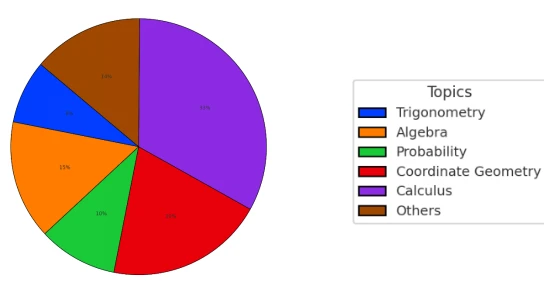 MHT-CET Mathematics 2025, Calculus dominated the paper
- Trigonometry (8%): Trigonometry – II, Trigonometric Functions
- Algebra (15%): Complex Numbers, Permutations and Combinations, Matrices
- Probability (10%): Probability, Probability Distributions, Binomial Distribution
- Co-ordinate Geometry (20%): Straight line, circle, conics, Pair of Straight Lines, vectors, line and plane
- Calculus (33%): Limits, Continuity, Differentiation, Applications of Derivatives, Indefinite Integration, Definite Integration, Application of Definite Integration, Differential Equations
- Others (14%): Functions, Mathematical Logic, Linear Programming
Student Feedback: Many students found the section lengthy and challenging, requiring efficient time management and strong conceptual clarity.
MHT-CET Biology 2025 Paper analysis
- Overall Difficulty: Moderate, with Biology being the most time-consuming section due to lengthy and dense questions.
- Question Types: Predominantly direct, questions based on the MHT CET syllabus aligned with the Maharashtra State Board Textbooks for Std. XI and XII,, with a mix of factual and application-based items. "Match the following" questions were common.
- Key Topics Covered:
- Human Physiology, Reproduction, Genetics and Evolution, Plant Physiology, Applied Biology, Ecology and Environment, Cell structure and functions
MHT-CET Biology 2025 Paper analysis: Chapter-wise Weightage:
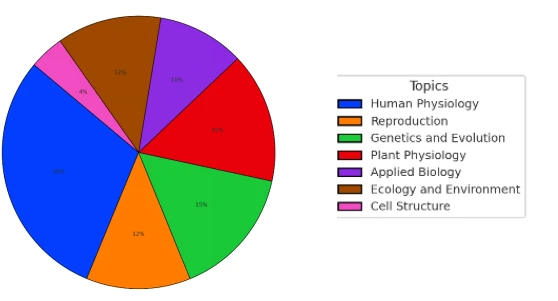 MHT-CET Biology 2025 had the highest weightage from Human Physiology.
- Human Physiology (30%): Control and Co-ordination, Respiration and Circulation, Excretion and Osmoregulation, Human Nutrition, Human Health and Diseases
- Reproduction (12%): Reproduction in Lower and Higher Animals, Reproduction in Lower and Higher Plants
- Genetics and Evolution (15%): Inheritance and Variation, Molecular Basis of Inheritance, Origin and Evolution of Life
- Plant Physiology (15%): Respiration and Energy Transfer, Plant Growth and Mineral Nutrition, Plant Water Relation
- Applied Biology (10%): Biotechnology, Enhancement of Food Production
- Ecology and Environment (12%): Biodiversity, Conservation and Environmental issues, Ecosystems and Energy Flow, Organisms and Populations
- Cell structure and functions (4%): Biomolecules
Student Feedback: While Biology was generally easier in terms of content, the section was lengthy, making time management crucial.
Summary Table: Subject-wise Difficulty & Focus Areas
| Subject | Difficulty Level | Key Focus Areas | Student Feedback |
| Physics | Moderate to Difficult | Mechanics, Modern Physics, Electromagnetism | Conceptual, time-consuming |
| Chemistry | Easy to Moderate | Physical, Organic, Inorganic Chemistry | Direct, scoring, less time needed |
| Mathematics | Moderate to Difficult | Calculus, Vectors, 3D Geometry, Algebra | Lengthy, calculation-heavy |
| Biology | Moderate (PCB only) | Control and Co-ordination, Respiration and Circulation | Lengthy, direct |
Preparation Tips for MHT-CET
- Time Management: Mathematics and Biology require more time due to length and complexity; Chemistry is generally quicker.
- Weightage: Class 12 topics carry more weight than Class 11 across all subjects.
Recommended Resources for CET Preparation
| MHT-CET Books | MHT-CET Previous Year's Question Papers |
| MHT-CET Syllabus | MHT-CET Blogs |
Final thoughts
The MHT-CET 2025 certainly kept students on their toes, with each subject bringing its own set of challenges and opportunities. While Mathematics and Physics demanded sharp problem-solving skills and quick thinking, Chemistry offered a welcome breather with its straightforward, XI and XII Maharashtra State Board textbook -based questions. For PCB aspirants, Biology proved to be a test of both knowledge and time management.
If there’s one takeaway from this year’s exam, it’s that smart preparation truly pays off focusing on high-weightage chapters, mastering the MHT-CET syllabus, and practicing effective time management can make all the difference. Whether you found the exam tough or manageable, remember: every attempt is a learning experience. Keep these insights in mind as you gear up for future exams, and you’ll be one step closer to acing the MHT-CET!
Subscribe to our blog for updates and prep tips for MHT-CET 2026
FAQs of MHT-CET 2025 Paper
1. What was the overall difficulty level of MHT-CET 2025?
Ans: MHT-CET 2025 ranged from moderate to moderately difficult. Physics and Mathematics were more challenging, while Chemistry remained easy to moderate.
2. Which topics had the highest weightage in MHT-CET 2025?
Ans: Key high-weightage topics included:
- Physics: Mechanics, Electromagnetism
- Chemistry: Physical Chemistry, Organic Reactions
- Maths: Calculus, Integration, Vectors
- Biology: Control and Co-ordination, Respiration and Circulation
3. Is Maharashtra State Board textbook enough for MHT CET preparation?
Ans: Yes, about 80–95% of questions were directly based on the Maharashtra State Board textbook syllabus, especially in Chemistry and Biology. However, solving previous year papers and mock tests is also essential.
4. What’s the best strategy for MHT CET 2026 aspirants?
Ans: Focus on:
- High-weightage chapters
- Time management skills
- Daily practice using mock tests and chapter-wise questions
- Mastering key concepts