
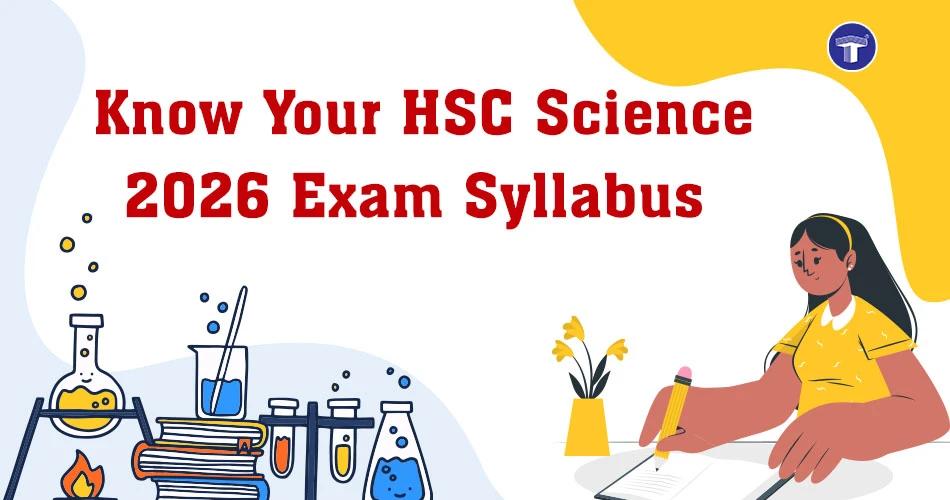
As the Maharashtra HSC Board exams 2026 draw near, the most important task for students and teachers is to grasp the HSC syllabus 2026 Maharashtra Board. Knowing the syllabus inside out helps in a structured and effective preparation.
A syllabus is not just a list of chapters, it’s a roadmap!
Whether you are a student trying to map your daily study plan or a teacher preparing a teaching schedule, this blog will bring clarity to your planning. We will walk you through Maharashtra 12th Science syllabus, including the 12th science subject list and the marking scheme.
Maharashtra HSC Science Syllabus 2026 Overview
Understanding the complete structure of the syllabus is essential for anyone preparing under the HSC Board Maharashtra, as it helps align your study strategy with exam expectations and marking patterns.
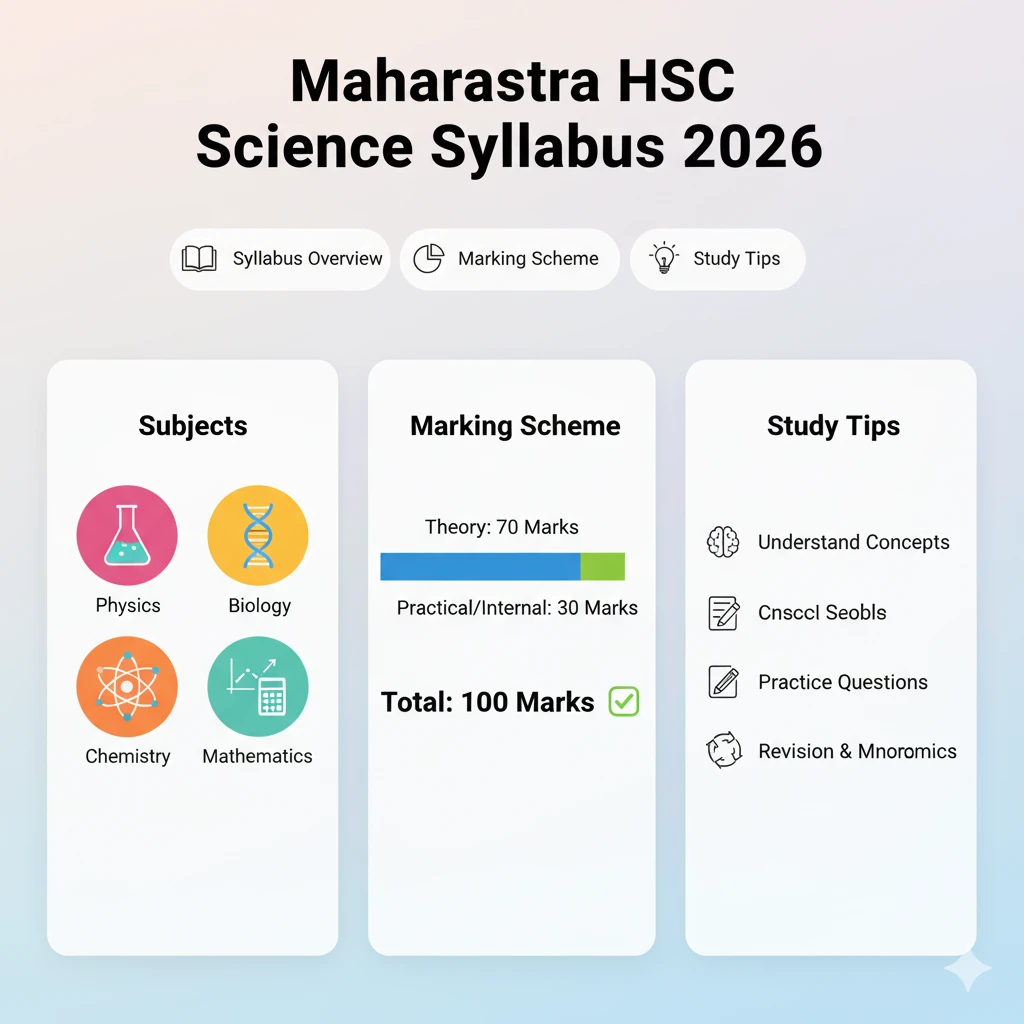
Maharashtra HSC Science Syllabus 2026 Overview
Maharashtra HSC Science Subject List 2026
Below is a simplified list of chapter and subtopics for 12th Science subjects Maharashtra Board.
Physics, Chemistry, and Biology
| Physics | Chemistry | Biology |
| Rotational Dynamics | Solid State | Reproduction in Lower and Higher Plants |
| Mechanical Properties of Fluids | Solutions | Reproduction in Lower and Higher Animals |
| Kinetic Theory of Gases and Radiation | Ionic Equilibria | Inheritance and Variation |
| Thermodynamics | Chemical Thermodynamics | Molecular Basis of Inheritance |
| Oscillations | Electrochemistry | Origin and Evolution of Life |
| Superposition of Waves | Chemical Kinetics | Plant Water Relation |
| Wave Optics | Elements of Groups 16, 17 and 18 | Plant Growth and Mineral Nutrition |
| Electrostatics | Transition and Inner transition Elements | Respiration and Circulation |
| Current Electricity | Coordination Compounds | Control and Co-ordination |
| Magnetic Fields due to Electric Current | Halogen Derivatives | Human Health and Diseases |
| Magnetic Materials | Alcohols, Phenols and Ethers | Enhancement of Food Production |
| Electromagnetic induction | Aldehydes, Ketones and Carboxylic acids | Biotechnology |
| AC Circuits | Amines | Organisms and Populations |
| Dual Nature of Radiation and Matter | Biomolecules | Ecosystems and Energy Flow |
| Structure of Atoms and Nuclei | Introduction to Polymer Chemistry | Biodiversity, Conservation and Environmental Issues |
| Semiconductor Devices | Green Chemistry and Nanochemistry |
Mathematics Part I and Part II
| Mathematics Part I | Mathematics Part II |
| Mathematical Logic | Differentiation |
| Matrices | Applications of Derivatives |
|
Trigonometric Functions
|
Indefinite Integration |
| Pair of straight lines | Definite Integration |
| Vectors | Application of Definite Integration |
| Line and Plane | Differential Equation |
| Linear programming Problem | Probability Distribution |
| - | Binomial Distribution |
Environment Education and Water Security and Information Technology
| Environment Education and Water Security | Information Technology |
|
Humans and Environment
|
Advanced Web Designing |
|
Environmental Pollution
|
Introduction to SEO (Search Engine Optimization) |
|
Sustainable Development
|
Advanced Javascript |
|
Emerging Technologies (IOT, Cloud computing, AI,5G) |
|
Water Security
|
Server-Side Scripting (PHP) |
| - | E-Commerce and E-Governance |
| - |
Skill Oriented Practicals (SOP)
|
Std 12th Science Syllabus Exam Pattern and Marking Scheme
Understanding the 12th science subjects Maharashtra Board exam pattern and marking scheme is crucial since it allows you to allocate time effectively and prepare a routine for yourself.
Below is the current exam pattern and marking scheme for Std. 12 science subjects Maharashtra Board exams:
HSC Science Exam Pattern
- The HSC Board exam paper pattern is a mix of both objective as well as subjective questions. The subjective type of questions include both short as well as long answers. Usually, you have alternatives to choose from and decide which questions to attempt.
- The duration of the examination for each paper is 3 hours (180 minutes).
- According to the Maharashtra Board HSC grading system, you must score a minimum of 35% in each subject in order to pass you Std. 12 Board exams.
Note: There is no Best of 5 Rule for Std. 12 Board exam as there is a best of 5 Rule for SSC students. All subjects are taken into account in the Maharashtra HSC Board exams.
HSC Science Syllabus Marking Scheme
Each subject paper is for a total of 100 marks.
For Physics, Chemistry, and Biology, the split is as follows:
- Theory: 70 marks
- Practicals: 30 marks
For English and Mathematics, the split is as follows:
- Theory: 80 marks
- Practicals/Project: 20 marks
Tips to Navigate the Maharashtra HSC Board Science Syllabus
For Students
- Create a chapter-wise timeline: Divide all the chapters over months and ensure you keep buffer time for revision.
- Prioritise high-weightage topics: Prioritise high-weightage topics for 12th Std. Science subject.
- Use previous years’ questions: Solving previous years’ questions will familarise you with the exam pattern and help you with the trend analysis.
- Take timely mock tests: Solving mock tests helps you understand your strengths and spot areas that need work, and manage your exam time better.
- Revise Concisely: Timely revision with the right material is the smartest way for a consistent preparation for your exams.
- Maintain a healthy routine: A sound mind, needs a sound body. Good sleep, proper nutrition, and regular exercise keeps you focused and energised for you daily preparation.
For Teachers
- Follow a backward teaching plan: Reverse plan your teaching schedule including doubt sessions, revision sessions, and tests for your students to stay on track.
- Emphasise on conceptual learning: Encourage your students to learn with conceptual clarity with the perfect notes, rather than rote learning. This will help them have an extra edge in the examination.
- Plan regular short test: Plan topic-wise and chapter-wise test for your students that also include the HSC question papers and activity sheets for practice and revision.
For Parents
- Provide a supportive environment: Encourage stable study hours and minimise distractions for a seamless study experience.
- Check progress periodically: Check if your child is following the planned study routine and help him/her to stick to their daily routine.
- Ensure healthy routines: Make sure your child has a balanced routine that includes good sleep, nutrition, and exercise.
Conclusion
The Maharashtra Board Std. 12 Science Syllabus 2026 is comprehensive, but with clarity on the subject list, exam pattern, and marking scheme, you can approach preparation in a calm and structured way.
A syllabus isn’t a set of restrictions, it’s your strategic tool. Master it, and it helps you channel your preparation in the right direction.
Have you planned your timetable? Let us know in the comments below.
Frequently Asked Questions
1. Has the Std 12 Science syllabus changed for the academic year 2025–26?
Ans: No, the Std. 12 Science syllabus for Maharashtra Board exam has not changed.
2. What is the paper pattern for Std 12 Science subjects?
Ans: The paper pattern for Maharashtra Board exams Std. 12 Science subjects is a mix of both objective and subjective questions. Each paper is of a total 100 marks.
3. When will the Maharashtra Board Std 12 exams be conducted?
Ans: The Maharashtra Board Std. 12 exams will be conducted in the month of February. To stay updated about the keep details and exam dates, check the official website.