
Every February and March, lakhs of students sit for the Maharashtra HSC Board, yet few stop to think about how this massive system came into being.
What is the HSC exam really? Why do the Maharashtra State Board exams exist, and how do they influence the education of millions?
In this blog, we’ll take you behind the scenes to understand the purpose, scale, and significance of HSC 2026—without which, the story of Maharashtra’s education would be incomplete. Moreover, we’ll also briefly get into some preparation tips to help you appear confidently for Maharashtra HSC Board exam 2026!
Firstly, let’s understand what exactly is the 12th HSC Maharashtra Board and the exam conducted by it.
What is the HSC Board Maharashtra?
The full form of HSC Board is Higher Secondary Certificate Board. It is the official certification awarded to students in Class 12 (Higher Secondary/Junior College) after successfully completing their higher secondary education. The HSC exam is one of the most important academic milestones in a student’s life.
Scope of the HSC Board Exam
MSBSHSE HSC Board exam serves as a gateway to higher education, professional courses, and career opportunities. Students from streams like Science, Commerce, and Arts appear for this exam at the end of their two-year higher secondary curriculum.
Who Conducts the HSC Board Maharashtra Exam?
The Maharashtra State Board of Secondary and Higher Secondary Education (MSBSHSE), Pune is the body responsible for conducting HSC Board exams.
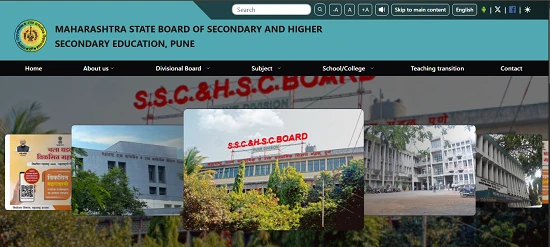
Official Website of HSC Board Maharashtra
The Board came into existence on 1 January 1966 to look after certain matters pertaining to secondary education in the state of Maharashtra. It is an autonomous body established under the provisions of the Maharashtra Act No. 41 of 1965.
The official website of Maharashtra HSC Board is mahahsscboard.in.
Divisional Structure and Reach
To manage the vast network of schools in the state, the Board operates through nine Divisional Boards located in:
- Pune
- Mumbai
- Nagpur
- Chh. Sambhajinagar
- Kolhapur
- Amravati
- Nashik
- Latur
- Konkan
Through these divisions, the Board supervises over 23,000 secondary schools (SSC) and more than 10,000 higher secondary schools/junior colleges (HSC) across Maharashtra.
Examinations Conducted
The Board conducts the SSC and HSC examinations twice a year in Maharashtra. The scale of these exams is significant:
- Main Examinations: Around 15 lakh HSC students and 17 lakh SSC students appear each year.
- Supplementary Examinations: Approximately 6 lakh students are expected to appear for both HSC and SSC combined.
Roles and Responsibilities of the HSC Board Maharashtra
The Maharashtra State Board is not just an examination authority, it also:
- Advises the State Government on policy matters related to secondary and higher secondary education.
- Maintains quality and equivalence in education across schools in the state.
- Coordinates national and state policies to ensure uniformity in education standards.
- Ensures proper alignment between primary, secondary, higher secondary, and university-level education.
- Approves and consents to textbooks, ensuring they meet curriculum standards.
- Determines financial policies required for its functioning and implements them.
- Institutes scholarships, fellowships, medals, prizes, and awards, regulating them through set terms and conditions.
- Supervises and periodically reviews the work of Divisional Boards without being directly accountable for them.
- Promotes research in educational innovations, encouraging improvements in teaching and learning methods.
HSC Board Maharashtra Important Details
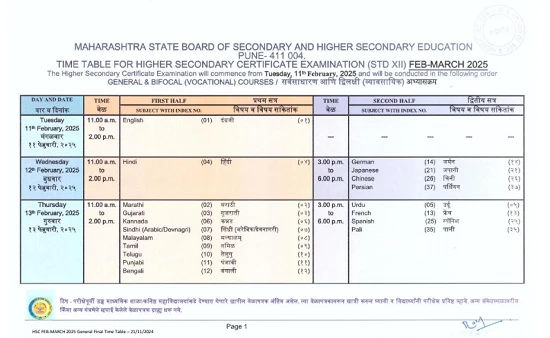
Official HSC Board Exam Maharashtra Timetable 2025
HSC Board Maharashtra: Important Registration Dates
- Regular Students: The deadline for submitting HSC examination forms 2026 has been extended to 20 October, 2025.
- Private Candidates: Must submit their HSC private candidates forms by 15 October, 2025.
After the analysis of previous years’ exam timetable, it can be estimated that HSC Board Maharashtra will conduct exams in the second or third week of February, 2026.
Maharashtra HSC Exam Date 2026: Schedule
| Practical Exams | 23 January to 9 February, 2026 |
| Examination Period | 10 February to 11 March, 2026 |
| Result Declaration | 2 May, 2026, at 12:00 p.m |
| Supplementary Exams | 16 June to 8 July, 2026 |
This exam schedule aligns with the previous year's schedule, where exams were held from February 11 to March 18, 2025. Last year, the result date for Maharashtra HSC was 05 May, 2025. Maharashtra HSC Supplementary Exams were also held in June–July 2025.
Note: The official, subject-wise time table for Maharashtra HSC Board exam 2026 is yet to be released (expected around November/December 2025).
Preparation Tips For HSC Maharashtra Board 2026

Student studying for Maharashtra HSC Board
The Maharashtra State Board of Secondary and Higher Secondary Education (MSBSHSE) had provided valuable insights from experts to help students prepare effectively for the HSC Board Exams 2025. Here are some tips you can use in your preparation for Maharashtra HSC Board 2026:
1. Practise the entire syllabus thoroughly
Practise the entire syllabus of Maharashtra HSC Board as well as additional questions to strengthen understanding and application skills. Make use of textbooks, the SCERT Prashna Pedhi, MSBSHSE mobile app, and our HSC study material.
2. Time Management during the HSC Board Maharashtra exam
Discuss answer-wise time allocation for the HSC Board Maharashtra exam with your teacher. Read the entire question paper carefully before starting and decide the order of questions.
3. Subject-Wise Guidance
English
- Read the textbook thoroughly.
- Solve previous years’ question papers.
- Focus on summaries and mind maps.
- Practise extract-based writing.
Marathi
- The 80-mark paper is divided into five sections: Gadya (Prose), Padya (Poetry), Katha Sahityaprakar Parichay (Story), Upyojit Marathi (Applied Marathi), and Vyakaran ani Lekhan (Grammar and Writing).
- It tests comprehension, application, opinions, creative writing skills, and literary terms.
Hindi
- At least 42 marks are easily achievable.
- Focus on Padya (Poetry) and Gadya (Prose).
- Pay attention to Shuddhlekhan, Kaal Parivartan (Tense), and Vikalp (8 marks).
- Prioritise sentence transformation and rules of language.
Physics
- Scoring 70 out of 98 marks is possible, with 28 marks as options.
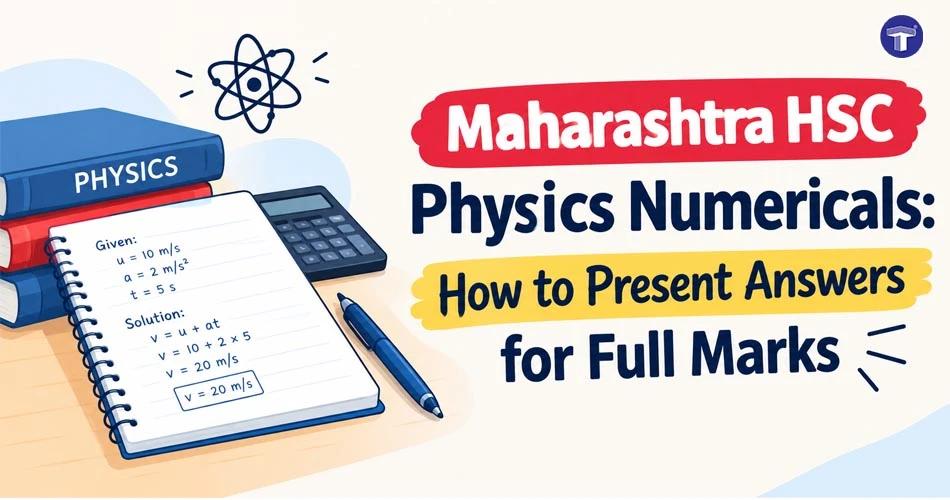
- Paper distribution: 30% knowledge-based (definitions, laws), 42% understanding-based (explanations, derivations), 28% skill-based (diagrams, numericals).
- Draw neat, labelled diagrams with a pencil.
- Revise all definitions, laws, differentiations, and properties thoroughly.
Chemistry
- Focus on IUPAC nomenclature, electronic configurations (p, d, f blocks), reaction mechanisms, and laws.
- Chemical Kinetics graphs are important.
- Key reaction mechanisms: Electrophilic/Nucleophilic attacks, positive/negative charges, compensation.
- Important reactions: Stephen, Mendius, and Clemmensen Reduction.
- Revise reaction conditions and catalysts.
- Study Markovnikov’s rule and Saytzeff’s rule.
Mathematics
- About 20% of the paper is easy.
- Memorise formulas from Trigonometry, Integration, and Derivatives (10–15 marks).
- Theorems are critical in both papers.
- Paper 1 may include 2 questions from Vectors, Trigonometric Functions, and Pair of Lines.
- Paper 2 may feature 1 question from Derivatives, Integration, or Definite Integration Properties.
Biology
- Answer objective questions briefly.
- Use clear distinctions in comparisons.
- Write long answers point-wise with diagrams where relevant.
Organisation of Commerce and Management
- Answer length should match mark allocation.
- For MCQs, rewrite only if asked.
- Case studies: answer in one word or sentence, or two if opinion-based.
- For long answers, Business Services and Marketing are important. Expect three types of long-answer questions, with varied mark distribution.
Economics
- Paper is 50% easy and 50% moderate.
- Start with Question 1, 2, and 5 (40 marks).
- Attempt Questions 3 and 6 later as they are longer.
- Topics 3A, 3B, 4, 6, 7, 8, 9 carry 12 marks each; 70–80% of the paper is based on them.
Bookkeeping and Accountancy
- Key objectives: True/False (2.5 marks each), Bill of Exchange (5 marks), other objectives (8 marks).
- Continuous practice is crucial.
History
- Treat the subject like a story for better memory.
- Questions 1, 2, and 3 account for 31 marks.
- The remaining 49 marks are from long-answer questions.
4. Exam Day Essentials
Visit your exam centre in advance to get familiar with the location. Reach the exam centre at least 30 minutes early. On arrival, check your seat number.
5. Answer Sheet Guidelines
Carry your HSC Board hall ticket and ID for verification. Ensure the answer sheet is properly numbered and bound; if it looks tampered, request a replacement. Fill in details such as seat number (both in words and numerals), subject, medium of instruction, and obtain the supervisor’s signature.
Verify that the bar code reflects the correct subject code and your details. Paste the hologram in the last 10 minutes and record the number of supplements used. Use the left side of the last page for rough work in pencil.
What After the HSC Maharashtra Result?
Once the Maharashtra HSC results are declared, carefully review your marks. If you believe there has been an error in the evaluation or are not satisfied with your score, you can apply for verification of marks or revaluation of answer sheets after the Maharashtra State Board releases the official notification, application dates, and guidelines.
If you are unable to clear one or more subjects, don't be discouraged. The Board also conducts Maharashtra HSC supplementary examinations, commonly considered the HSC Board second attempt, giving students another opportunity to improve their result without waiting for the next academic session. The application process and exam schedule are announced through a separate circular after the declaration of results.
Frequently Asked Questions (FAQs)
1. When are 12th HSC boards 2026 results?
Ans: The HSC Maharashtra result is expected to be announced in May on the official MSBSHSE website.
2. What are the Maharashtra HSC dates?
Ans: The Maharashtra HSC exam dates are tentatively scheduled for February–March.
3. Where is Maharashtra 12th exam result announced?
Ans: The Maharashtra 12th exam results are usually published on the official MSBSHSE HSC website (mahahsscboard.in).