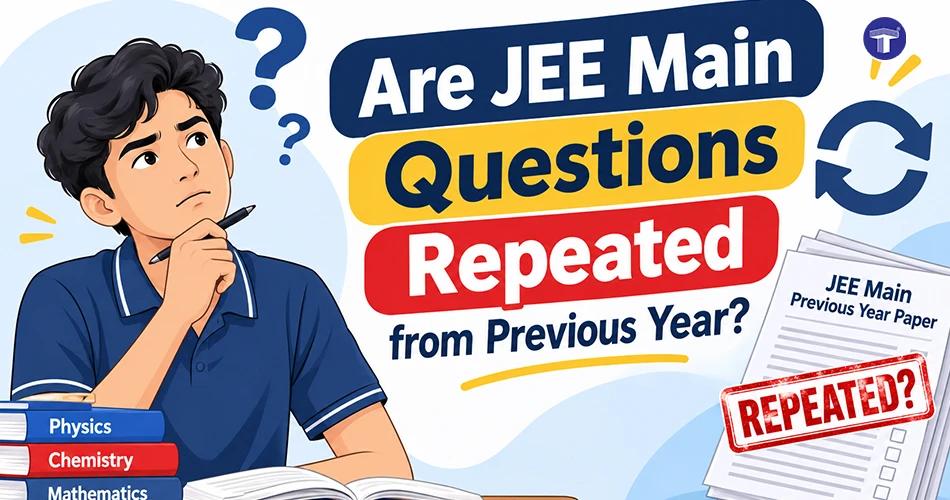
If you are preparing for JEE Main, one of the many questions that you come across is, ‘Do questions repeat in JEE Main shifts?’
The answer depends on the type of repetition. JEE Main repeated questions is a possibility, but exact question repetitions are relatively uncommon. Understanding how these repetitions work can help you use JEE Main previous year papers more effectively and prepare with greater confidence.
Does JEE Main Repeat Questions from Previous Years?
Yes, but you should understand the difference between three types of repetition:
- Exact question repetition: A question from an earlier JEE Main paper appears again with the same or almost identical wording, values, and answer options.
- Similar question repetition: The question follows a familiar structure or uses the same formula, but the numerical values or conditions are changed.
- Concept repetition: You encounter a new question that tests a concept or application previously covered in JEE Main.
While you should not depend on exact questions being repeated, you can expect familiar concepts and problem-solving patterns to feature in different papers and shifts.
This is why practising relevant, recent papers, like last 5/10 years of JEE Main question papers becomes important.
Why Should You Solve JEE Main Previous Year Papers?
Solving JEE Main PYQs offers several practical benefits. Let’s look at them one by one:
1. Identify repeated concepts from JEE Main PYQs
When you solve questions from multiple years, you can identify chapters and concepts that have appeared repeatedly. This helps you understand which areas deserve focused revision.
2. Improve Your Problem-Solving Speed
Repeated practice helps you recognise familiar question structures, recall relevant formulae, and identify JEE Main easy vs difficult questions.
3. Understand the Exam's Difficulty Level
Previous year papers give you a realistic idea of the JEE Main previous years’ questions trend helping you understand topic-wise and chapter-wise weightage and exam pattern.
For deeper understanding, refer ‘How To Use PYQs The Right Way.'
Subject-wise JEE Main Repeatedly Asked Questions
Most Repeated Questions In Jee Mains Physics
Physics has several recurring numerical and concept-based question patterns:
| Chapter | Repeated question type |
| Electromagnetic Waves | Given the electric field, calculate the corresponding magnetic field of a plane electromagnetic wave. |
| Experimental Skills | Calculate the least count of a Vernier callipers or scale. |
| Electrostatics | Calculate the energy lost when a charged capacitor is connected to an uncharged capacitor. |
| Dual Nature of Radiation | Calculate the threshold wavelength using stopping potentials at two different wavelengths. |
| Wave Optics | Calculate the maximum-to-minimum intensity ratio in Young's double-slit experiment using slit widths. |
Most Repeated Questions In Jee Mains Chemistry
Chemistry frequently tests familiar numerical methods, organic chemistry reactions and fundamental concepts:
| Chapter | Repeated question type |
| Organic Chemistry Purification | Calculate the percentage of chlorine using the Carius method and the silver chloride formed. |
| Calculate the percentage of sulphur using the mass of barium sulphate formed. | |
| Calculate the percentage of nitrogen using the Dumas method. | |
| Chemical Bonding | Identify molecular shapes and geometries using VSEPR theory. |
| Chemical Equilibrium | Solve numerical questions involving equilibrium constants and concentrations. |
Most Repeated Questions In Jee Mains Maths
Mathematics also has several recurring question formats, particularly in Algebra, Calculus, and Coordinate Geometry.
| Chapter | Repeated question type |
| Determinants | Find unknown constants in three linear equations when infinitely many solutions exist. |
| 3D Geometry | Calculate the shortest distance between two skew lines. |
| Statistics | Find unknown observations when the mean and variance are given. |
| Correct the variance after an observation has been recorded incorrectly. | |
| Sequences and Series | Find the sum of a series with a quartic denominator using telescoping. |
| Vectors | Find an unknown vector using given cross-product and dot-product conditions. |
Are PYQs Enough to Prepare for JEE Main
No. Although PYQs are an essential part of your preparation, relying on them alone can limit your practice.
For structured preparation combine previous year papers with NCERT textbooks and chapter-wise question banks to get familiar with different question types, strengthen your concepts, and improve your exam readiness.
Important Links
| JEE Main Syllabus Backlog: How To Complete Pending Chapters | JEE Main Dress Code 2027: Rules, Guidelines, & Items Allowed |
Final Takeaway
So, are JEE Main questions repeated from previous year papers? Yes, but you should focus more on repeated concepts and question patterns than on expecting identical questions.
When you practise PYQs consistently, analyse your mistakes, and strengthen your understanding, you prepare yourself to tackle both familiar and unfamiliar questions in JEE Main.
FAQs
1. Are JEE Main questions repeated with different numerical values?
Ans: Yes, JEE Main questions are repeated with different numerical values or conditions.
2. Can JEE Main previous year questions help identify high-weightage chapters?
Ans: Yes. Using JEE Main previous questions is one of the best ways to identify high-weightage chapters and topics.
3. How do I know whether a JEE Main previous year question is still relevant to the latest syllabus?
Ans: Before solving JEE Main previous year questions from past years papers, map in which year the syllabus was changed and which topics were eliminated in order to have strategic practice.