
The Central Board of Secondary Education (CBSE) has issued an important advisory regarding the misinterpretation of QR codes in question papers. This update is extremely crucial for school teachers and students, as it clarifies misconceptions and reinforces exam security practices.
Let me give you a clear breakdown about this advisory.
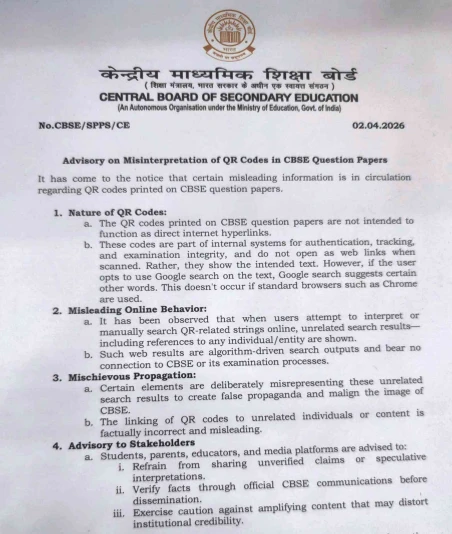
CBSE advisory on QR code misinterpretation
What Are QR Codes in CBSE Question Papers?
CBSE has introduced QR codes in question papers as a security feature. These codes are:
- Used for internal authentication purposes and do not function as direct internet hyperlinks.
- Designed to help track and verify the authenticity of question papers.
- Not meant for public interaction.
In simple words, QR codes play a backend role in ensuring that exam materials remain secure and tamper-proof.
Addressing the Confusion Around QR Codes
Recently, there has been misinformation regarding these QR codes. Some claims suggested that scanning or manually searching them could lead to external links or unrelated content. This also happens, when the user opts Google search on text. Although this doesn't happen when standard browsers such as Chrome are used.
CBSE has also noticed that certain elements are purposely misinterpreting these unrelated searches to create false propaganda and malign their image.
CBSE has firmly clarified that such results are solely algorithm-based and that the Board or the exam process doesn’t have any connection to it. And any such linked content is incorrect and misleading.
Instructions to Stakeholders Regarding the Advisory
This advisory serves as a reminder of the importance of maintaining discipline and trust during examinations. The Board has advised students and teachers to:
- Not share unverified claims or suspicious interpretations.
- Verify all the facts through the official communication made by CBSE before dissemination of any such information.
- Exercise caution and take the necessary action against such content that may harm the credibility of the institution.
CBSE has requested all the stakeholders to maintain responsibility in sharing the information and uphold the integrity of public institutions by ensuring that only verified and factual information is circulated.
Final Thoughts
In an increasingly digital examination environment, CBSE continues to adopt measures that strengthen the integrity of its processes. This clarification is crucial to prevent unnecessary panic or misuse during examinations.
Source
Official Notice by CBSE, 02 April, 2026: click here to read.
Kindly note that any and all information is subject to change as per the CBSE, Education Ministry, and Government of India.