

If you've recently received a scanned copy of your evaluated answer book and noticed a difference between the marks shown on the calculation sheet and your final total, there's no need to worry. CBSE has issued an important clarification to help students and teachers understand how marks are calculated when extra questions are attempted.
CBSE Clarifies Totaling of Marks Policy
Saw a Totaling Difference in Your Evaluated Answer Book
CBSE has received queries from students regarding what appears to be a discrepancy in the total marks awarded. In many cases, this confusion arises when students have attempted more questions than required.
To address these concerns, CBSE has explained the process used while calculating final marks.
Get instant CBSE related news on Education News by Target Publications on WhatsApp. Follow now!
How Does CBSE Calculate Marks for Extra Attempts
Many CBSE question papers include internal choices, allowing you to answer either one question or the other. But if you are one of the students who chose to answer both the questions CBSE follows a long-standing policy:
- The higher score obtained in one of the two questions is considered for the final total.
- The lower-scoring answer is treated as an ‘Over Attempt’.
- Marks from the over-attempted question are not included in the final total.
- These omitted marks are marked with an asterisk (*).
This ensures that you receive the best possible score from the questions they have attempted.
Understanding the Asterisk Mark in CBSE Evaluated Answer Books
An asterisk (*) next to a mark indicates that the marks for that question or sub-part have been excluded from the final total.
A footnote is also provided in the calculation sheet explaining that the marks for the marked questions have been omitted during totaling.
Before calculating the total marks manually, you should carefully check:
- Any asterisk (*) marks in the answer book.
- The accompanying footnote.
- Which marks have been included in the final total.
An Example Shared by CBSE
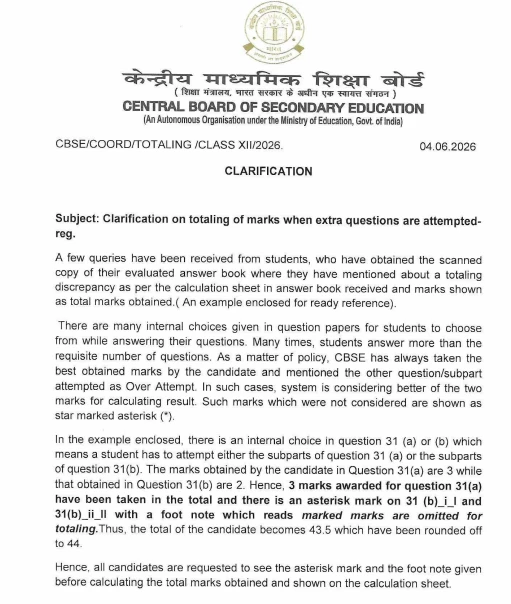
CBSE has provided an example involving Question 31, where students had the choice to attempt either question 31(a) or question 31(b).
In the example the student scored 3 marks in Question 31(a) and 2 marks in Question 31(b). Since, the student had to opt any one question, CBSE considered the higher score of 3 marks from Question 31(a) for the final total.
The marks obtained in Question 31(b) were marked with an asterisk (*) and excluded from the calculation.
As a result the total became 43.5 marks and were rounded off to 44 marks.
Important Links
| CBSE Aligns Classes 9 and 10 Scheme of Studies for Languages with NCERT Syllabus from 2026–27 | Why Concept-Based Learning Is Becoming Essential in CBSE Education |
Final Takeaway
This clarification reinforces CBSE's policy of awarding students the benefit of the higher score when extra questions are attempted. Students and teachers should pay close attention to asterisk-marked entries and footnotes in evaluated answer books to accurately understand how the final marks have been calculated.
Source
Official Notice by CBSE, 04 June, 2026: click here to read.
Kindly note that any and all information is subject to change as per the CBSE, Education Ministry, and Government of India.