
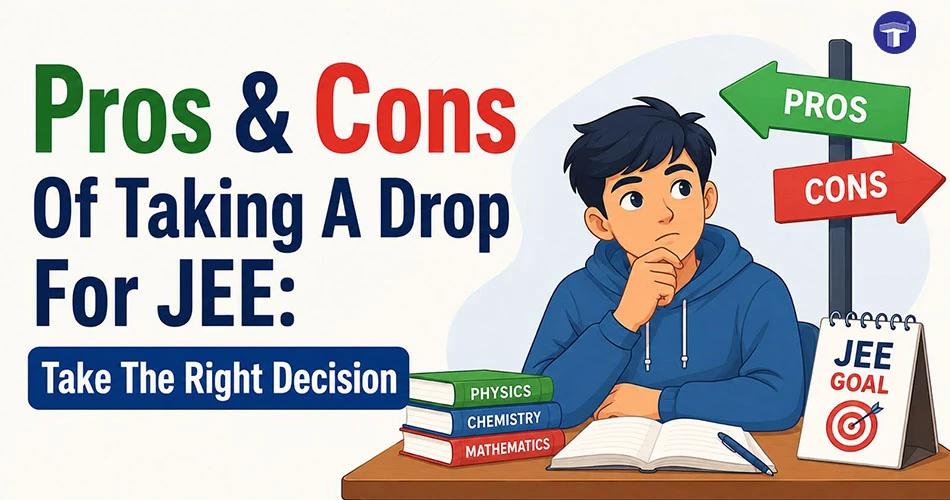
The question ‘Should I take a drop for JEE?’ becomes stressful when your score is not close to your target, but you are unsure if one more year will actually help. A JEE drop year can give you time to improve, but it also needs discipline, emotional strength, and a clear study plan.
Taking a drop for JEE is not automatically good or bad. It depends on your current score, preparation gaps, college options, family support, and your ability to study consistently for another year.
What Does a JEE Drop Year Mean?
A JEE drop year, is the year a student takes after completing the attempt after Std. 12, usually because the earlier JEE attempt did not give the desired result. Instead of joining college immediately, the student spends that year preparing for another attempt.
Students may take a 1 year drop after 12th for JEE to improve their rank, strengthen weak chapters, practise more questions, and aim for a better college or branch.
However, a drop year is useful only when you clearly identify what affected your previous attempt and change your preparation accordingly. Simply repeating the same study routine for another year may not lead to a better result.
Should I Take a Drop Year For JEE?
You should take a drop year for JEE only if you have a clear reason and a realistic plan. Do not take a drop only because friends are doing it or because you feel emotionally disappointed after the result.
Ask yourself these questions first.
| Question | If Your Answer Is Yes |
| Did I lose marks because of an incomplete syllabus? | A drop may help |
| Were my concepts weak in major chapters? | A drop can give repair time |
| Did I avoid mock tests earlier? | A drop can improve test practice |
| Am I taking a drop only due to pressure? | Think carefully |
If your problem was lack of effort, weak basics, or poor planning, a drop year can help If your previous attempt had weak basics, how to build strong basics for IIT JEE guide can help you rebuild concepts before advanced practice.
Benefits Of Taking A Drop For JEE
One of the biggest benefits of taking a drop for JEE is the opportunity for focused preparation. Since you have already completed Std. 12, you can dedicate the drop year primarily to JEE preparation, giving more time to strengthening weak topics, solving questions, taking mock tests, and improving your exam strategy.
A JEE drop year also helps you revise Std. 11 and Std. 12 topics properly. If your earlier preparation was rushed, this year can help you build stronger concepts.
| Benefit | How It Helps |
| More focused time | You can prepare only for JEE |
| Better revision | You can revisit weak chapters |
| More mock tests | You can improve speed and accuracy |
| Stronger strategy | You can devise a more realistic strategy |
| Better confidence | You get time to rebuild preparation |
For students who were close to their target rank, a drop year can be especially useful with proper revision and test analysis.
Disadvantages Of JEE Drop Year
A drop year also has challenges. You may feel pressurised because you are spending one full year only on preparation. There may be comparisons with friends who joined degree colleges.
Another disadvantage of JEE drop year is routine fatigue. If you do not manage breaks and revision properly, you may feel bored or stressed. A drop year needs mental balance. You should not study with fear. You should study with a clear plan. To plan the year in phases, use JEE Main 2027 preparation roadmap.
Partial Drop For JEE: Is It A Good Option?
A partial drop for JEE means you join a college and prepare for JEE again at the same time. This option is useful if you do not want to risk a full year.
However, partial drop is difficult because you have to manage college lectures, assignments, and JEE preparation together. It may work if your syllabus is already strong and you only need revision and mock tests.
If your basics are weak, a full drop may give better focus. If your score was decent and you want one more attempt without losing college admission, partial drop can be considered.
JEE Drop Year Strategy
A strong JEE drop year strategy should begin with analysis. First, check your previous result and identify what went wrong. Was it a syllabus gap, low accuracy, poor time management, or exam stress?
Then divide your year into three phases.
| Phase | Focus |
| First 3 months | Fix weak concepts, complete backlog, and revise |
| Middle months | Solve chapter-wise questions and PYQs |
| Final months | Mock tests, revision, and mistake analysis |
Do not start with full mock tests if your basics are weak. Build concepts first, then move to practice and timed tests.
Study Material For JEE Drop Year
During a drop year, you should avoid collecting too many books. Choose resources that help with theory revision, MCQs, numerical value type questions, previous year questions and detailed solutions.
The JEE Main Mathematics Absolute Vol. 1 and 2 books can support MCQ practice, PYQs, numerical value questions, and revision.
Important Links
| 7 common mistakes that students commit during the JEE Main Exam preparation for Engineering | Best Question Banks For JEE Main 2027 Preparation |
Conclusion
Taking a drop for JEE can be worth it, if you have a clear reason, strong discipline, and a practical study plan. It gives you time to improve concepts, revise properly, and practise mock tests.
But it also brings pressure. Choose a full drop, partial drop, or college admission after looking at your score, target, preparation gaps and mental readiness.
FAQs
1. Is Taking A Drop For JEE Worth It?
Ans: Taking a drop for JEE is worth it if you know your weak areas and are ready to follow a disciplined study plan. It should be a planned decision, not an emotional one.
2. Can I Prepare For JEE After Std. 12?
Ans: Yes, you can prepare for JEE after Std. 12. Many students take a drop year to revise concepts, solve PYQs, and improve mock test performance.
3. Is Partial Drop Good For JEE?
Ans: Partial drop can work if your syllabus is already strong and you only need revision. If your basics are weak, managing college and JEE together can become difficult.
4. What Are The Benefits Of JEE Drop Year?
Ans: A drop year gives focused preparation time, better revision, more mock test practice, and a chance to correct previous mistakes.
5. What Are The Disadvantages Of A JEE Drop Year?
Ans: Common disadvantages include pressure, comparison, routine fatigue and fear of wasting a year. A clear plan and regular progress tracking can reduce these problems.