


The NEET UG 2025 examination, held by the National Testing Agency (NTA) on May 4, 2025, saw a major structural shift — reverting to the pre-COVID format with 180 compulsory questions and no internal choice.
With 22.7 lakh+ students participating across 5,453 centers nationwide, NEET retained its reputation as India’s toughest and most competitive medical entrance test.
NEET 2025 Exam Overview
| Parameter | Details |
| Total Questions | 180 (All Compulsory) |
| Subjects | Physics (45), Chemistry (45), Biology (90) |
| Marking Scheme | +4 for correct, -1 for incorrect |
| Duration | 3 Hours |
| Mode | Offline (Pen and Paper) |
Subject-Wise NEET UG 2025 Analysis
Biology (Botany + Zoology)
- Difficulty Level: Moderate to Difficult
- Key Highlights:
- 90%+ questions based on NCERT
- High weightage to Human Physiology, Genetics, and Reproduction
- A few questions were application-based and required deeper conceptual clarity
-
Chapter-Wise Weightage – Biology
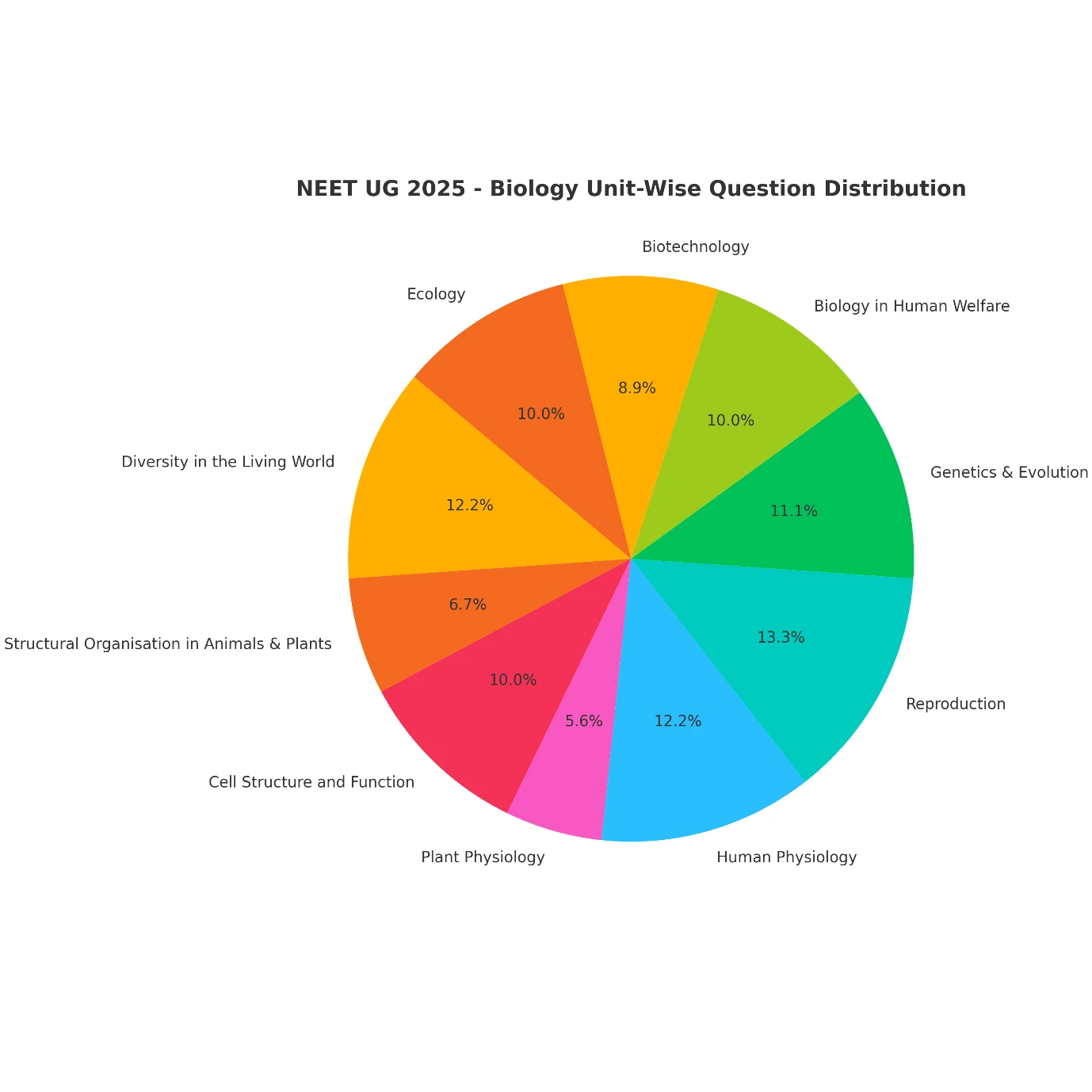
This chart provides a visual breakdown of the number of questions asked from each Biology unit in NEET UG 2025. Reproduction, Diversity in the Living World, and Human Physiology carried the highest weightage, reinforcing the importance of mastering NCERT chapters from both Class 11 and 12.
| Class | Unit Name | Questions |
| 11 | Diversity in the Living World | 11 |
| 11 | Structural Organisation in Animals & Plants | 6 |
| 11 | Cell Structure and Function | 9 |
| 11 | Plant Physiology | 5 |
| 11 | Human Physiology | 11 |
| 12 | Reproduction | 12 |
| 12 | Genetics & Evolution | 10 |
| 12 | Biology in Human Welfare | 9 |
| 12 | Biotechnology | 8 |
| 12 | Ecology | 9 |
Chemistry
- Difficulty Level: Moderate
- Key Highlights:
- Inorganic Chemistry: Mostly direct from NCERT
- Organic Chemistry: Conceptual questions on reaction mechanisms
- Physical Chemistry: Numerical-heavy and formula-based
-
Chapter-Wise Weightage – Chemistry
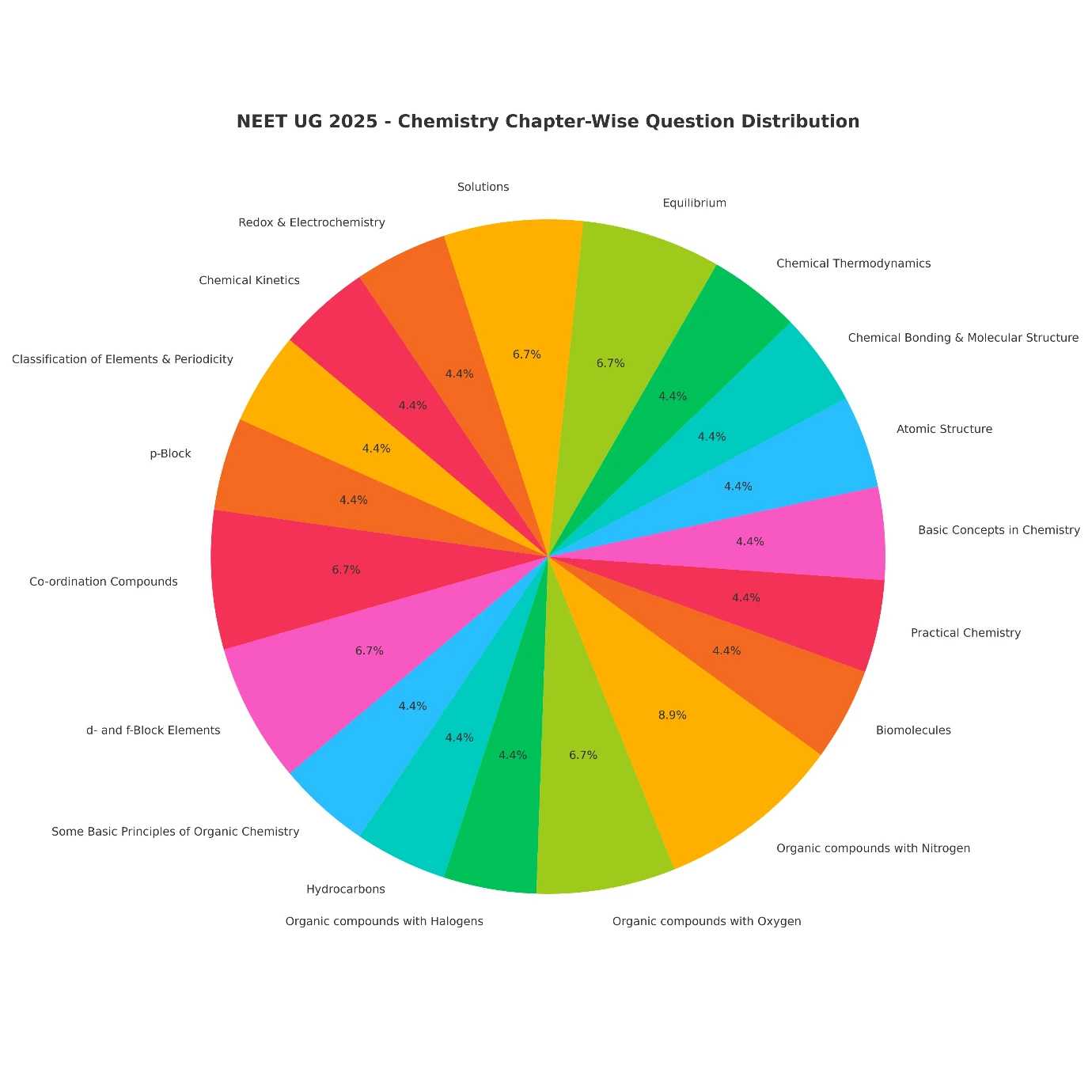
This pie chart visualizes the distribution of questions across Chemistry chapters in NEET UG 2025. Chapters like Organic Compounds containing Nitrogen, Equilibrium, Solutions, and Coordination Compounds had the highest weightage, making them crucial for aspirants aiming for top scores.
| Unit Name | Questions | |
| Inorganic Chemistry | Classification of Elements & Periodicity In Properties | 2 |
| p-Block | 2 | |
| Co-ordination Compounds | 3 | |
| d- and f-Block Elements | 3 | |
| Organic Chemistry | Some Basic Principles Of Organic Chemistry | 2 |
| Hydrocarbons | 2 | |
| Organic compounds containing Halogens | 2 | |
| Organic compounds containing Oxygen | 3 | |
| Organic compounds containing Nitrogen | 4 | |
| Biomolecules | 2 | |
| Principles related to Practical Chemistry | 2 | |
| Physical Chemistry | Some Basic Concepts in Chemistry | 2 |
| Atomic Structure | 2 | |
| Chemical Bonding and Molecular Structure | 2 | |
| Chemical Thermodynamics | 2 | |
| Equilibrium | 3 | |
| Solutions | 3 | |
| Redox Reactions & Electrochemistry | 2 | |
| Chemical Kinetics | 2 |
Physics
- Difficulty Level: Difficult
- Key Highlights:
- Heavy emphasis on numerical problems
- Required strong time management and fundamental understanding
- Lesser number of direct formula-based questions
-
Chapter-Wise Weightage – Physics
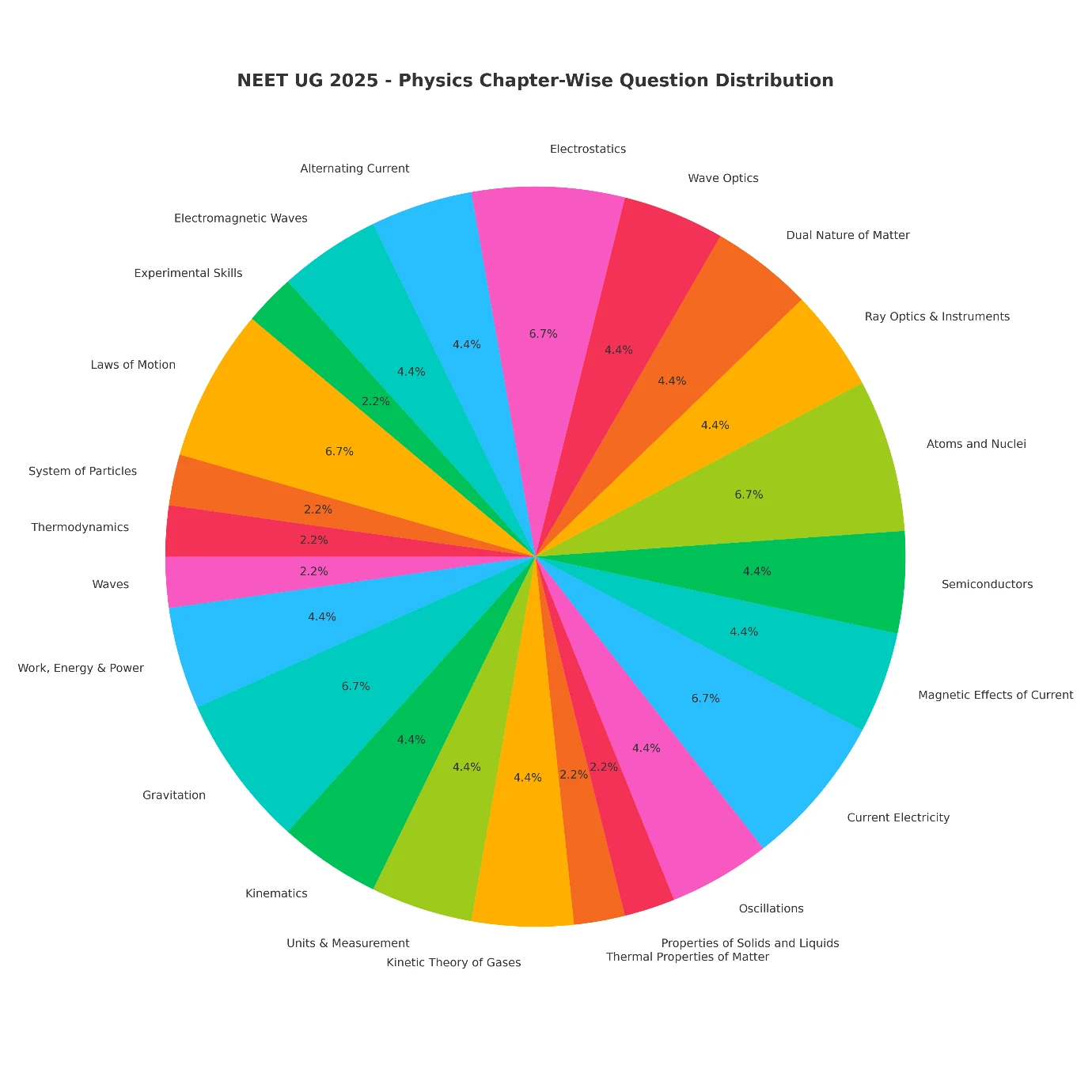
This pie chart highlights the chapter-wise distribution of Physics questions in NEET UG 2025. Topics like Electrostatics, Laws of Motion, Gravitation, Current Electricity, and Atoms & Nuclei had the most weightage, indicating the importance of concept clarity and numerical practice.
| Class | Chapter Name | Questions |
| 11 | Laws of Motion | 3 |
| 11 | System of Particles | 1 |
| 11 | Thermodynamics | 1 |
| 11 | Waves | 1 |
| 11 | Work, Energy & Power | 2 |
| 11 | Gravitation | 3 |
| 11 | Kinematics | 2 |
| 11 | Units & Measurement | 2 |
| 11 | Kinetic Theory of Gases | 2 |
| 11 | Thermal Properties of Matter | 1 |
| 11 | Properties of solids and liquids | 1 |
| 11 | Oscillations | 2 |
| 12 | Current Electricity | 3 |
| 12 | Magnetic Effects of Current | 2 |
| 12 | Semiconductors | 2 |
| 12 | Atoms and Nuclei | 3 |
| 12 | Ray Optics & Instruments | 2 |
| 12 | Dual Nature of Matter and Radiation | 2 |
| 12 | Wave Optics | 2 |
| 12 | Electrostatics | 3 |
| 12 | Alternating Current | 2 |
| 12 | Electromagnetic Waves | 2 |
| 12 | Experimental Skills | 1 |
Overall Difficulty Level Summary
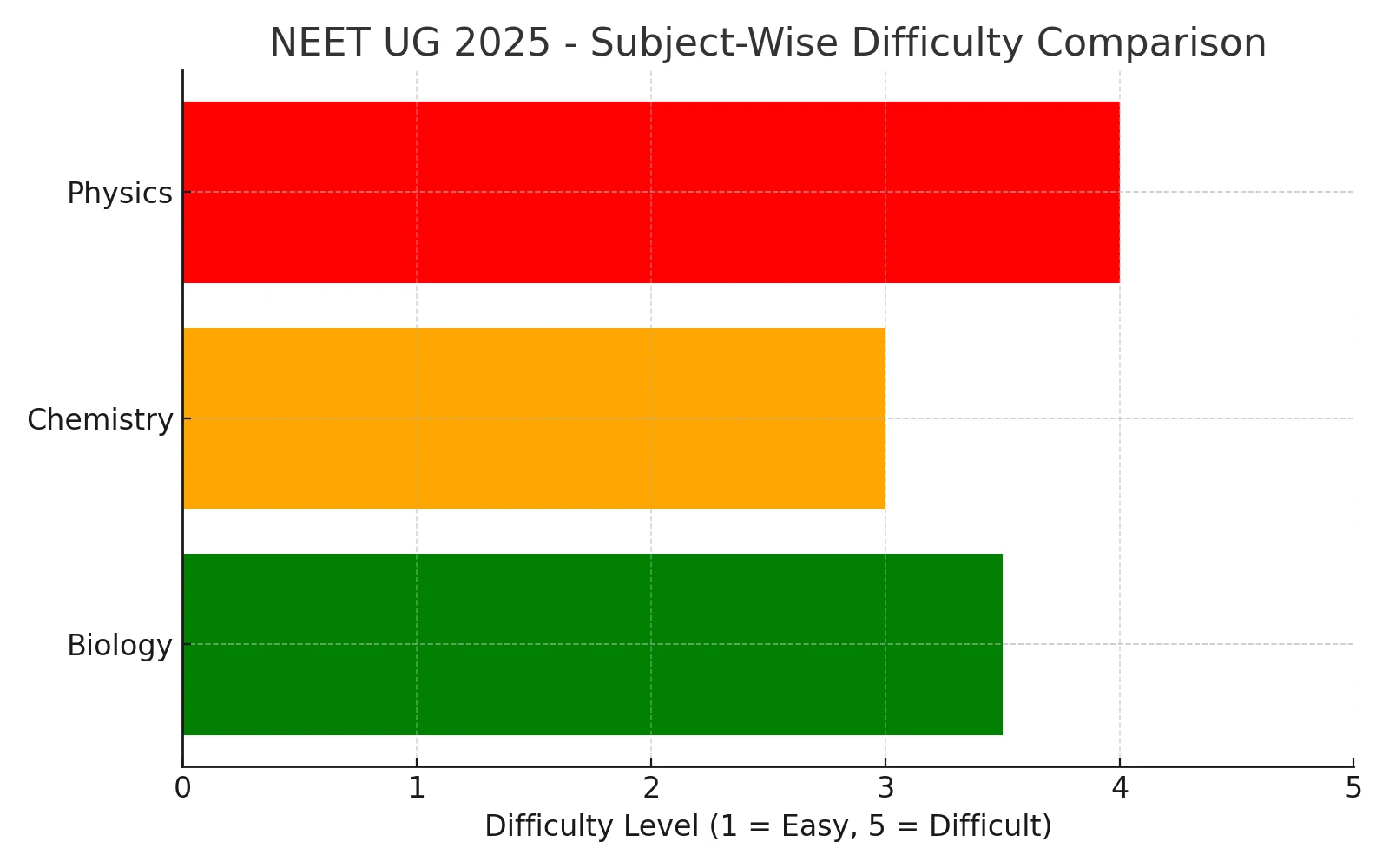
This chart shows the relative difficulty levels of each subject based on expert analysis and student feedback. Physics was the most challenging, while Chemistry remained balanced. Biology, though concept-heavy, was moderately difficult and highly scoring.
Recommended Resources for NEET Preparation
Enhance your NEET preparation with these comprehensive resources from Target Publications:
Gain insights into exam patterns and frequently asked questions with our collection of solved papers from previous NEET exams.
Simulate the actual exam environment and assess your readiness with our extensive mock test series designed to mirror the NEET exam format.
Focus on important topics by practicing questions that have appeared in past NEET exams, helping you identify trends and key areas.
Strengthen your understanding of each subject by tackling chapter-specific tests, allowing for targeted revision and mastery of concepts.
These resources are tailored to provide structured and effective preparation strategies, aligning with the insights from the NEET-UG 2025 paper analysis.
Final Thoughts
The NEET UG 2025 paper emphasized in-depth concept clarity, with NCERT textbooks serving as the core preparation source.
- Biology remained the most scoring with predictable patterns
- Physics continued to challenge students with time-bound numericals
- Chemistry balanced direct theory with numerical application
Students who focused on NCERT books, maintained consistency, and practiced with mock tests stood a better chance of scoring well.
Click here to read our blog: NEET-UG 2024 Paper Analysis: Detailed Exam Review, Difficulty Level
NEET 2025 Paper Analysis FAQs
1. What was the overall difficulty level of NEET UG 2025?
Ans: The NEET UG 2025 exam was considered moderately difficult. Biology was relatively easy but lengthy, Chemistry ranged from easy to moderate, and Physics was notably challenging due to its conceptual questions.
2. Were there any changes in the NEET UG 2025 exam pattern compared to previous years?
Ans: Yes, the NEET UG 2025 exam reverted to its pre-COVID format. The paper consisted of 180 compulsory questions—90 in Biology and 45 each in Physics and Chemistry—to be completed in 180 minutes. Optional questions and the additional 20 minutes provided in the previous three years were discontinued.
3. Which topics had higher weightage in NEET UG 2025?
Ans: In Biology, topics like Genetics, Molecular Biology, and Human Physiology were emphasized. Chemistry saw significant questions from Organic Chemistry and Physical Chemistry, while Physics focused on Mechanics, Electrodynamics, and Modern Physics.
4. How can I improve my preparation for NEET UG based on the 2025 exam analysis?
Ans: To enhance your preparation, focus on NCERT textbooks, practice previous years' question papers, and take regular mock tests. Emphasize understanding concepts, especially in Physics, and manage time effectively during practice sessions to handle lengthy sections like Biology.