
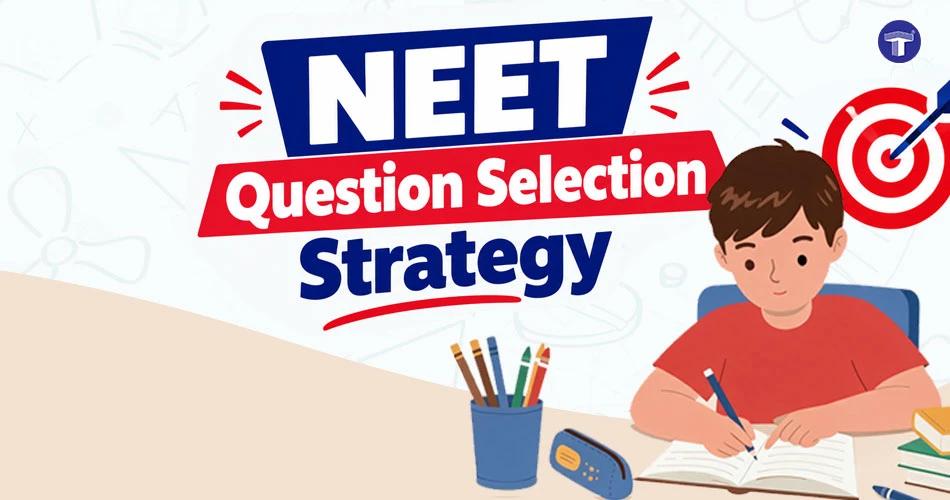
A smart NEET Question Selection Strategy can help you save time and reduce mistakes during the exam. NEET is not only about knowing the syllabus. It is also about knowing which questions to attempt first, which questions to leave for later and how to avoid wrong answers.
Before planning your attempt order, you should read the NEET exam pattern guide to understand the latest paper structure.
What Type of Questions Are Asked in NEET?
Students often ask what type of questions are asked in NEET. NEET mainly includes multiple-choice questions from Physics, Chemistry and Biology.
The questions can be:
| Question Type | What It Tests |
| Direct NCERT-based | Memory and concept recall |
| Concept-based | Understanding of topic |
| Numerical | Formula and calculation |
| Statement-based | Careful reading and accuracy |
| Diagram-based | Visual understanding |
| Application-based | Concept use in new situations |
For tricky true-false and combination questions, read NEET statement-based questions solving strategy.
How Many Questions Are There in NEET?
Students searching for how many questions are there in NEET should check the latest official pattern before the exam. As per the latest pattern, the paper has 180 compulsory questions for 720 marks.
A general subject-wise structure is:
| Subject | Questions | Marks |
| Physics | 45 | 180 |
| Chemistry | 45 | 180 |
| Biology | 90 | 360 |
| Total | 180 | 720 |
To confirm the latest syllabus before practising, you can check the NEET 2027 syllabus guide.
NEET Paper Attempt Strategy
A good NEET paper attempt strategy should be simple. Do not try to solve the paper in the exact order if it slows you down.
Use this 3-round method:
| Round | What to Attempt |
| Round 1 | Easy and direct questions |
| Round 2 | Moderate questions that need thinking |
| Round 3 | Doubtful or lengthy questions |
To practise this attempt strategy at home, read a guide on how to simulate NEET exam practice and environment.
Which Questions to Attempt First in NEET?
If you are confused about which questions to attempt first in NEET, start with questions you can solve confidently.
Avoid spending too much time on one difficult question in the first round. Mark it and return later. For chapter-wise MCQ practice before full papers, you can use NEET UG topic-wise test series with solutions.
Which Section Should I Attempt First in NEET?
Many students ask which section should I attempt first in NEET. There is no fixed rule for everyone.
You can start with Biology if it is your strongest and fastest subject. This can help you build confidence and save time for Physics and Chemistry.
Some students prefer Chemistry first because it gives a balanced start. Physics can be kept for later if it takes more time. But if Physics is your strongest subject, you can start there too.
The best section order is the one that gives you the highest accuracy in mock tests. To improve section-wise strategy, read NEET mock test analysis guide.
What Type of Questions Are Asked in NEET Biology?
Students searching for what type of questions are asked in NEET Biology should focus strongly on NCERT.
Biology questions may include:
- Direct facts
- Diagrams
- Tables
- Examples
- Statement-based questions
- Match-type questions
- Concept-based questions
Biology can be attempted faster if you have revised NCERT well. But do not rush so much that you miss words like “incorrect”, “not” or “except”.
What Type of Questions Are Asked in NEET Physics?
Students asking what type of questions are asked in NEET Physics should prepare for concept and numerical-based MCQs.
Physics questions may include:
- Formula application
- Units and dimensions
- Graphs
- Numericals
- Conceptual statements
- Calculation-based questions
In Physics, do not get stuck on one long calculation.
What Type of Questions Are Asked in NEET Chemistry?
Students searching for what type of questions are asked in NEET Chemistry should divide the subject into three parts.
| Chemistry Area | Question Type |
| Physical Chemistry | Numericals and formula-based questions |
| Organic Chemistry | Reactions, reagents and conversions |
| Inorganic Chemistry | NCERT facts, trends and exceptions |
Chemistry can be scored when you revise NCERT, formulae and reactions regularly.
Which Chapter to Attempt First in NEET?
The question “which chapter to attempt first in NEET” depends on your strength.
During preparation, start with chapters where your basics are strong. Then move to difficult and high-weightage chapters.
During the paper, attempt based on difficulty level, not chapter name. To decide which chapters need more preparation time, read the NEET important chapters 2027 guide.
How Much Time Should You Spend on Each NEET Question?
Students often ask How Much Time Should You Spend on Each NEET Question. Since the paper has many questions, you should avoid giving too much time to one question.
Do not follow this blindly. Use mock tests to find your own timing. To avoid careless errors under time pressure, read a detailed guide on common mistakes to avoid in NEET 2026 preparation.
Important Links
| 39 Years NEET PCB Previous Solved Papers | NEET Chemistry Syllabus 2026, Organic, Inorganic, Physical Chemistry Topics |
Final Advice
A smart NEET question selection strategy can improve your score without changing your knowledge level overnight. Attempt easy and familiar questions first. Keep difficult questions for later. Avoid blind guessing and use mock tests to finalise your subject order.
NEET is a test of preparation, speed, accuracy and calm decision-making. The better you select questions, the better you manage the paper.
FAQs
1. What type of questions are asked in NEET?
Ans: NEET includes MCQs from Physics, Chemistry and Biology. Questions may be direct, concept-based, numerical, statement-based, diagram-based or application-based.
2. Which questions should I attempt first in NEET?
Ans: Attempt easy, familiar and high-confidence questions first. Keep lengthy, confusing or doubtful questions for the second or third round.
3. Which section should I attempt first in NEET?
Ans: Choose the section where you have the best speed and accuracy. Many students start with Biology, but the final order should depend on your mock test performance.
4. How should I attempt the NEET question paper?
Ans: Use three rounds. First solve easy questions, then moderate ones, and finally review difficult or doubtful questions.
5. How much time should I spend on each NEET question?
Ans: Do not spend too long on one question. Easy questions should be solved quickly, while difficult questions should be marked for review and attempted later.
6. How can I improve my NEET question selection strategy?
Ans: Take mock tests, analyse mistakes, track time per subject and check which questions you should have skipped or attempted earlier.